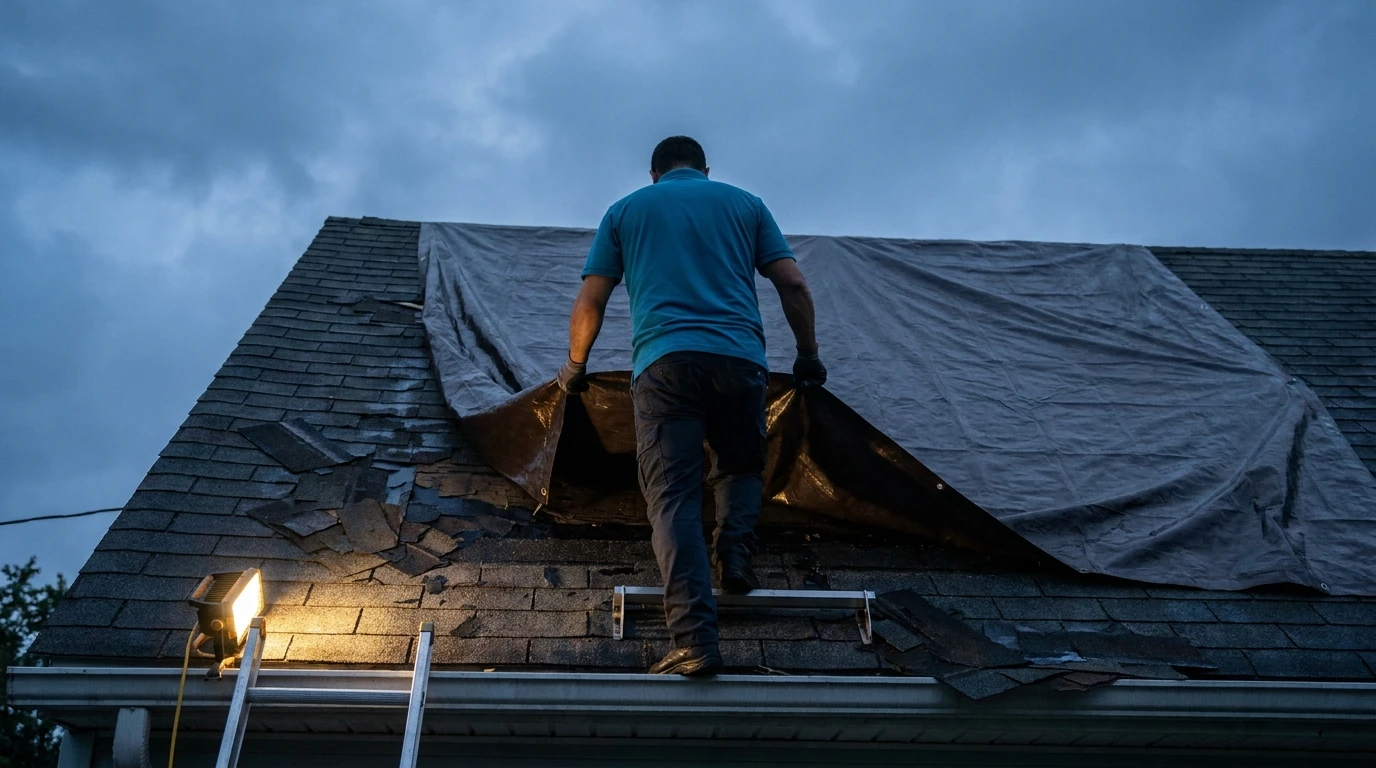
TL;DR: Emergency roof tarping in Fair Lawn, NJ typically costs $300 to $3,000, with most single-slope residential jobs landing between $500 and $1,500. Price depends on roof pitch, size of the opening, and whether the call comes overnight. Most homeowners policies reimburse tarping as an emergency mitigation expense when the underlying damage, like wind or a fallen limb, is a covered peril. A tarp is a temporary fix meant to stop water intrusion until a licensed roofer makes the permanent repair.
If a branch just came through your roof during a nor’easter, or you came home to a missing shingle patch and water stains spreading across the ceiling, the math you’re doing right now is simple: how fast can this get covered, and who’s paying for it. Fair Lawn sits between the Passaic and Saddle Rivers, and both the River Road corridor and the older Radburn and Warren Point housing stock take a beating in wind-driven storms. Here’s what emergency tarping actually costs and how the insurance piece usually works.
How much does emergency tarping cost in Fair Lawn, NJ?
Most emergency tarping jobs in Fair Lawn run $300 to $3,000, with the final number driven by roof size, pitch, and how much structural debris needs to be cleared first. A small vent leak costs far less than a full tarp-over after a tree limb opens a hole in a steep roofline.
| Scenario | Typical Cost Range |
|---|---|
| Small puncture or vent flashing leak (under 10x10 ft) | $300 - $600 |
| Average residential pitched roof, single slope | $500 - $1,500 |
| Large or multi-slope steep roof | $1,200 - $3,000 |
| Tree-through-roof with debris clearance | $800 - $2,500 |
| Flat or low-slope commercial roof | $1,500 - $4,000+ |
| After-hours or overnight response | add $150 - $400 |
These are typical industry ranges for the northern New Jersey market, not a quote. Every roof and every storm event is different, and a reputable crew should give you a written scope before any tarp goes up.
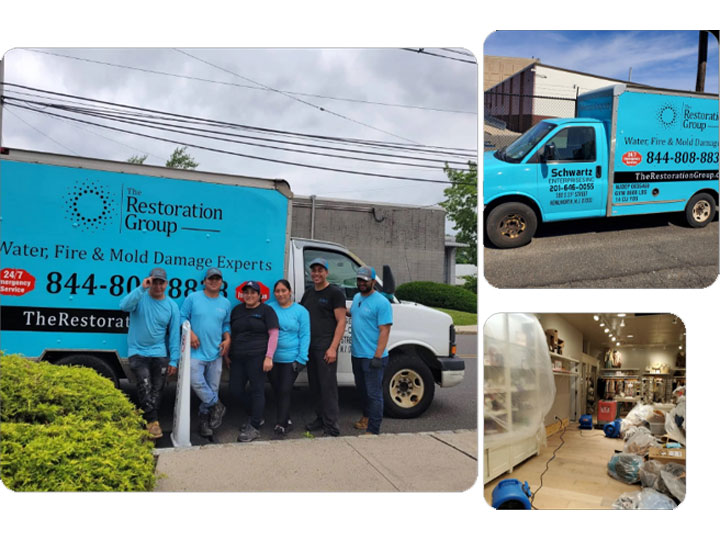
Recent job photo from The Restoration Group.
What drives the cost of emergency tarping up or down?
Roof pitch, square footage, and access are the three biggest cost drivers, with steep or multi-story roofs costing more because of the extra rigging and time required to work safely. A low, simple roof with easy ladder access is the cheapest scenario by far.
Other factors that move the number: the size of the opening (a softball-sized hole costs less to seal than a six-foot limb strike), whether debris has to be cut up and removed before the tarp can go down, and the material used. Heavy-duty reinforced poly tarps rated for wind hold up longer than consumer-grade blue tarps, and crews secure them with furring strips or battens rather than just nails through the tarp, which tears out in the next gust.
Timing matters too. A call placed at 2 a.m. during an active storm costs more than a scheduled next-morning tarp, simply because of crew mobilization. The ANSI/IICRC S500 standard also governs how fast water intrusion needs to be addressed once it starts, since Category 1 water from a roof leak can degrade quickly once it sits against insulation and drywall.
Does insurance cover emergency tarping?
Most standard homeowners policies reimburse emergency tarping as a mitigation expense, as long as the underlying cause (wind, hail, a falling tree) is a covered peril under your policy. Insurers generally expect homeowners to take reasonable steps to prevent further damage, and tarping is exactly that kind of step.
What this usually means in practice: keep your receipt or invoice, take photos of the damage before and after the tarp goes up, and call your carrier to open the claim as soon as it’s safe to do so. The Insurance Information Institute notes that wind and falling-object damage are standard covered perils on most policies, while flood and slow, gradual leaks are typically excluded and need separate coverage. If you’re unsure whether to file, our storm damage insurance claim checklist walks through what to document before you make the call.
One thing a tarp does NOT do: it doesn’t make the roof repair itself a covered expense if the storm damage falls outside your policy’s covered perils. Check your declarations page, or ask the NJ Department of Banking and Insurance if you have questions about what your specific policy covers.
What happens after the tarp goes on?
Once the tarp is secure, the next steps are inspecting for interior water intrusion, drying out any wet insulation or drywall, and getting a licensed roofer scheduled for the permanent repair. A tarp buys time; it is not the fix.
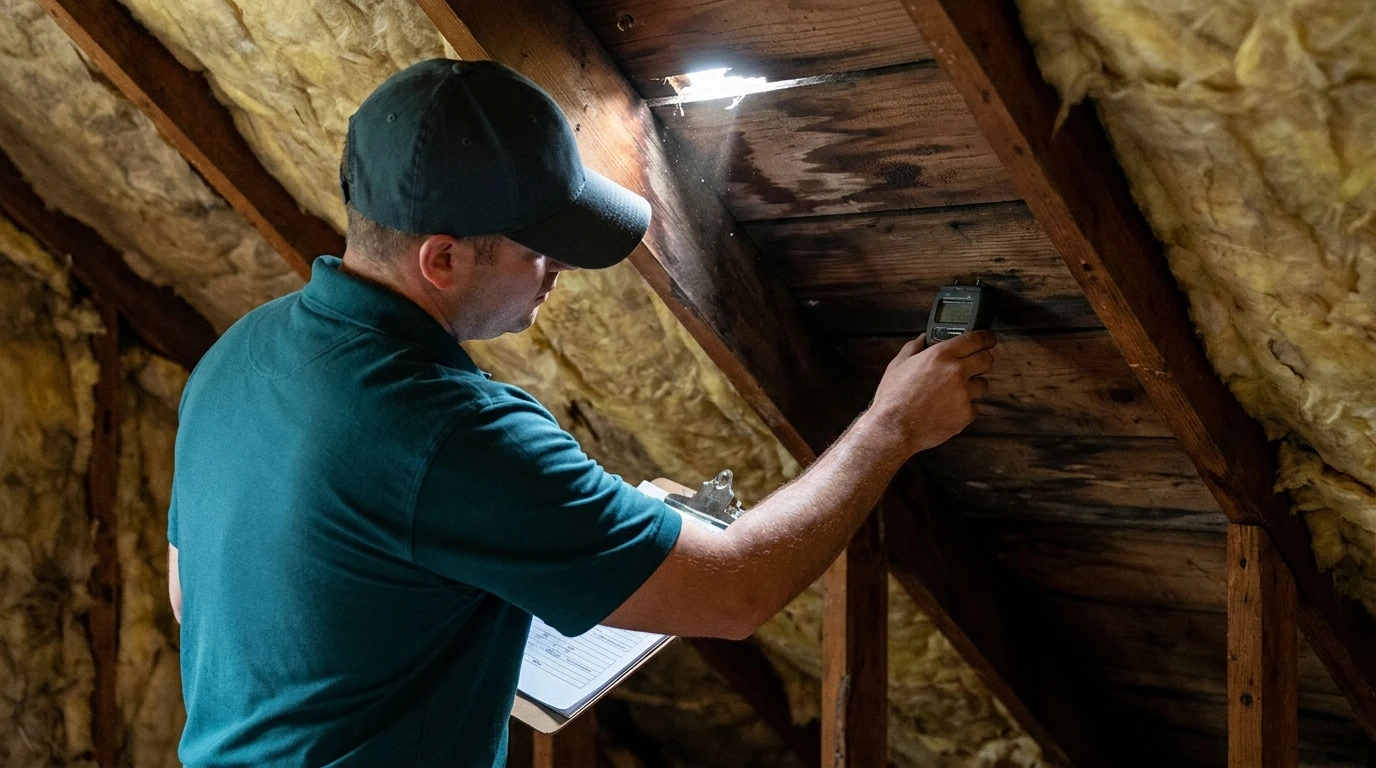
- Interior assessment. A technician checks the attic and ceiling below the breach for water intrusion, using a moisture meter to map how far moisture has traveled.
- Extraction and drying, if needed. If water already got in before the tarp went up, wet insulation gets removed and air movers or dehumidifiers go in to dry the structure per IICRC S500 guidelines, preventing the mold growth that can start within 24 to 48 hours on wet materials.
- Documentation. Photos, moisture readings, and a written scope get compiled for your insurance adjuster.
- Permanent repair scheduling. The tarp holds until a licensed roofing contractor can make the structural repair. The mitigation crew that tarped your roof typically does not do that roofing work themselves.
Fair Lawn homeowners should also know the difference between tarping and board-up: tarping seals a roof breach against water, while board-up covers broken windows, doors, or wall openings. If your storm event involved both a roof puncture and a shattered window from flying debris, you likely need both services done together.
Who do you call for emergency tarping in Fair Lawn?
Call a restoration or mitigation company that answers 24/7 and can document the damage for your insurer, not just a general handyman. The Restoration Group, based minutes away in Fair Lawn, is an IICRC Certified Firm that answers emergency calls around the clock and typically aims to have a crew on-site within about 60 minutes of the call.
If the storm also drove water into your basement or lower levels, which is common in the River Road and Saddle River Road areas after a hard rain, a single crew handling both the roof tarp and the interior water extraction keeps your claim paperwork consistent. See our emergency board-up and tarping and storm damage restoration pages for what each service covers.
A tarp over a damaged roof section is a stopgap, not a solution. The crew that tarps your roof should also document everything your insurer will ask for, and tell you plainly when it’s time to bring in a licensed roofer for the permanent fix.
About The Restoration Group
The Restoration Group is an IICRC Certified Firm (#210213) serving Fair Lawn and the surrounding New Jersey, New York City metro, and eastern Pennsylvania region since 2021. The company is a NJ Licensed Home Improvement Contractor and answers emergency calls 24/7. Their crews handle water, fire, storm, and mold damage mitigation, including emergency board-up and tarping, water extraction, structural drying, and contents protection, across northern and central New Jersey.
Need help now? Call The Restoration Group at (844) 808-8838.