TL;DR: Whether to file a water damage claim comes down to three numbers: your deductible, the estimated repair cost, and how many claims you have filed in the past three to five years. If the damage is less than 1.5 to 2 times your deductible, most homeowners pay out of pocket to protect their CLUE report history and avoid a premium increase. If the loss is clearly larger, document everything, start drying immediately, and then call your insurer. Drying is not optional while you decide.
Your washing machine supply line failed overnight. Or a pipe let go inside a wall and you found the damage this morning. You are standing in front of real water damage, and someone told you to think carefully before you call your insurance company. That advice is not wrong, but it needs context. Here is how to think through the decision in the next 24 to 48 hours.
What actually happens when you file a water damage claim?
Filing a claim creates a record in the CLUE database (Comprehensive Loss Underwriting Exchange), a national database insurers use to check a property’s claim history before writing or renewing a policy. That record stays for five to seven years. Your insurer may raise your premium at renewal, and if you file multiple claims within a few years, some carriers will non-renew the policy entirely.
According to the New Jersey Department of Banking and Insurance, insurers in NJ are permitted to surcharge or non-renew policies based on claim frequency, even for claims you did not cause. That is the real risk of filing a small claim: the long-term cost of the premium increase can easily exceed what the insurer would have paid.
None of that means you should never file. It means you should run the numbers first.
How do I decide whether the damage is worth claiming?
Compare your deductible to a realistic repair estimate. A common rule of thumb: if the damage estimate is less than 1.5 to 2 times your deductible, pay out of pocket. If it is clearly larger, filing is likely worth it.
Here is how to apply that in practice:
- Know your deductible. Pull your declarations page. Most homeowners policies carry a $1,000 to $2,500 deductible. Some have a separate water-damage or sewer-backup deductible.
- Get a rough estimate before you call your insurer. A restoration company can walk through the damage and give you a written scope. That scope tells you the real number. See the water damage restoration cost guide for NJ for typical ranges by loss type.
- Count your recent claims. If you filed one or more claims in the past three to five years, a second claim materially increases your non-renewal risk. That changes the math.
- Check your coverage type. Actual cash value (ACV) policies pay depreciated value. Replacement cost value (RCV) policies pay what it actually costs to restore. ACV payouts are often lower than homeowners expect, especially on older flooring and cabinetry.
Example: Your deductible is $2,000. The restoration scope comes back at $3,200. The net payout would be roughly $1,200 before any depreciation. If you filed a claim two years ago, that $1,200 may not be worth the premium impact. If you have a clean history and the scope is $14,000, filing is almost certainly the right call.
What is the duty to mitigate, and why does it matter?
Your policy almost certainly contains a duty-to-mitigate clause. It requires you to take reasonable steps to prevent further damage after a loss, regardless of whether you have decided to file. Insurers can reduce or deny a claim if you waited for the adjuster before starting drying and the delay allowed mold to grow or structural damage to worsen.
Mold can begin to develop within 24 to 48 hours on wet materials, per EPA guidance on mold and moisture. The adjuster may not arrive for two to five days. That gap is your exposure.
Practically, this means:
- Extract standing water immediately. Do not wait.
- Remove saturated materials (carpet padding, wet insulation) that cannot be dried in place.
- Run air movers and dehumidifiers to begin structural drying.
- Document everything with photos and video BEFORE you move or remove anything.
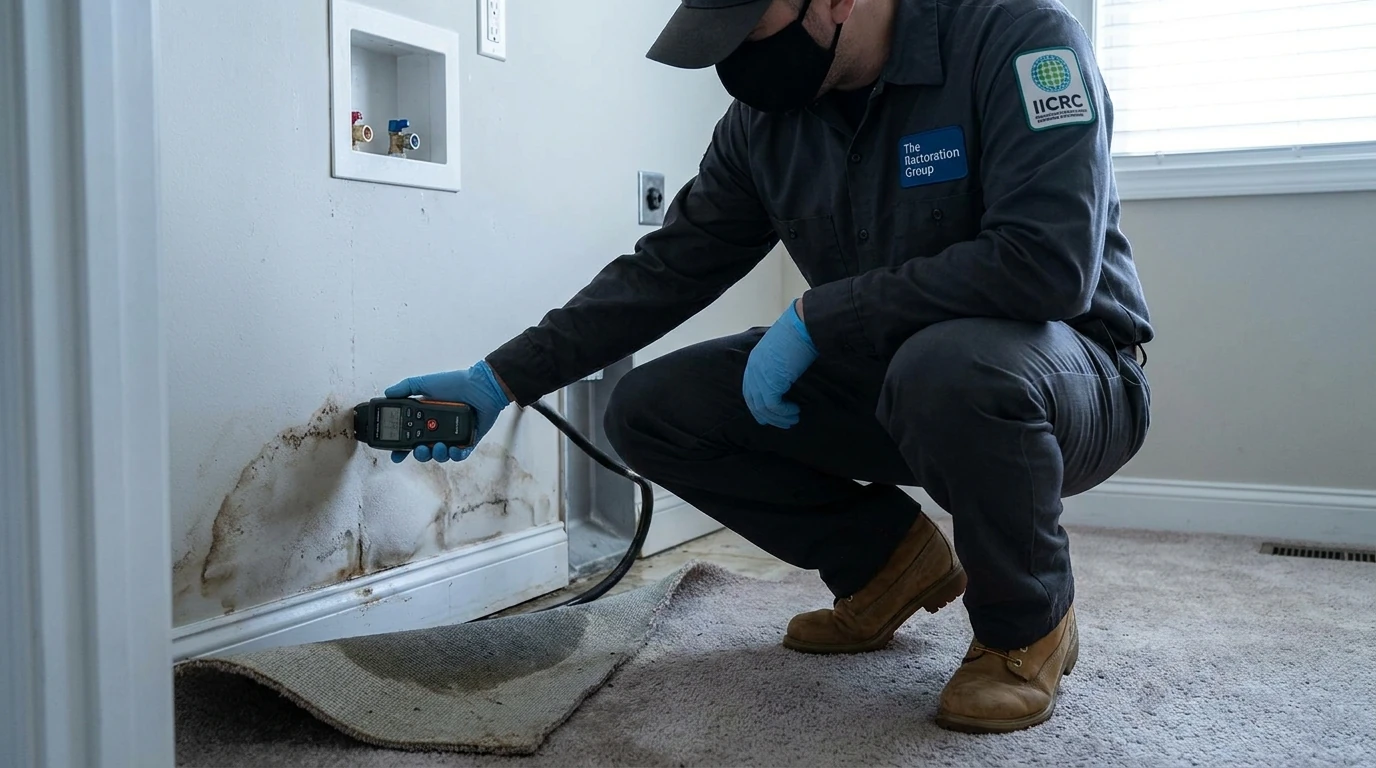
Starting mitigation is not an admission that you are filing a claim. It is a contractual obligation under most policies. A professional mitigation company will document the scope of work with moisture readings, equipment logs, and photos, which protects your claim if you do file. See what to do in the first 24 hours after water damage for a step-by-step breakdown.
What documentation do I need before I call my insurer?
Good documentation is the difference between a smooth claim and a disputed one. Collect the following before or during mitigation:
Photographic evidence
- Wide shots of every affected room showing the full extent of visible damage
- Close-ups of the source (failed pipe, appliance connection, roof penetration)
- Waterline marks on walls and framing
- Damaged contents in place, before removal
Moisture data
- A certified restorer uses a penetrating moisture meter and a thermal imaging camera to map wet areas that are not visible to the eye. Those readings, taken at the time of loss, establish the scope the insurer cannot later dispute.
Written scope of work
- A line-item mitigation and repair estimate from a licensed contractor or restoration company gives you a number to compare against your deductible and tells the adjuster exactly what was affected.
Source documentation
- If a pipe burst, photograph the failed section before it is cut out. If an appliance caused the loss, note the make, model, and the condition of the supply line or drain connection.
For a complete checklist, the storm damage insurance claim checklist covers documentation steps that apply to water losses as well.
What water damage does homeowners insurance typically cover?
Most standard homeowners policies (HO-3 form) cover sudden and accidental water damage from internal sources. They do not cover flooding from outside the home. That is a separate NFIP or private flood policy.
Covered under most HO-3 policies:
- Burst pipes (sudden failure, not a slow leak you ignored)
- Appliance supply line failures (washing machine, dishwasher, refrigerator ice maker)
- Accidental overflow from a tub, sink, or toilet
- Sudden water heater failure
Typically NOT covered:
- Gradual leaks or seepage you knew about or should have known about
- Flooding from surface water, storm surge, or overland flow (requires flood insurance)
- Sewer or drain backup (requires a separate endorsement on most policies)
- Maintenance failures (a rusted-through pipe that had been leaking for months)
If your loss involves a burst pipe, the burst pipe repair service page explains what the mitigation process looks like and what documentation the crew produces.
For a deeper look at what policies cover and exclude, see does homeowners insurance cover water damage.
What should I do right now?
If you are in the first 24 to 48 hours after a water loss, here is the sequence:
- Stop the source if it is still active. Shut off the supply valve or the main.
- Start extraction and drying immediately. Do not wait for an adjuster.
- Document everything before moving or removing materials.
- Get a written scope from a restoration company. That number drives your filing decision.
- Check your deductible and your recent claim history.
- Call your insurer if the scope clearly exceeds the deductible threshold and your claim history supports it.
The restoration company’s job is to document the loss accurately and dry the structure to the IICRC S500 standard for water damage restoration. That documentation is useful whether you file or not. It is your record of what happened.
The Restoration Group provides written scopes, moisture mapping, and full mitigation documentation for water losses across New Jersey and the New York metro area. If you need a damage assessment to make this decision, contact us or call (855) 650-7422. We handle the documentation either way.
About The Restoration Group
The Restoration Group is an IICRC Certified Firm (#210213) serving New Jersey and the New York metro area since 2021. Licensed as an NJ Home Improvement Contractor and available 24/7, their crews handle water damage restoration, flood damage restoration, burst pipe response, basement flooding cleanup, mold remediation, fire and smoke damage restoration, sewage cleanup, storm damage restoration, and related services. Every job includes moisture mapping, equipment logs, and a written scope designed to hold up to adjuster review.