Mold Inspection and Testing in Bayonne
24/7 mold inspection and testing in Bayonne, NJ. IICRC-certified, insurance billing accepted. Call (855) 650-7422.
Our IICRC-certified technicians are dispatched from our Fair Lawn, NJ headquarters and are typically on-site in Bayonne within 60 minutes of your call.
Bayonne’s position as a narrow peninsula between Newark Bay and the Kill Van Kull means moisture is never far away, and in the dense rows of early 20th-century two- and three-family homes that line streets from Bergen Point up through Uptown, that moisture has had decades to find its way into wall cavities, basement slabs, and crawl spaces. If you’re smelling something musty, seeing discoloration on a finished basement wall, or dealing with a tenant complaint about air quality, a professional mold inspection and testing visit is the right first step before any remediation work begins.
Why Bayonne Properties See Elevated Mold Risk
The geography does a lot of the work here. Low-lying blocks near the Newark Bay waterfront and around Constable Hook took on significant storm surge during Sandy in 2012, and water that saturates a brick rowhouse foundation or a finished basement doesn’t always dry completely, especially when the original cast-iron floor drains are partially blocked or the sump pit is undersized. Mold can begin colonizing porous materials in as little as 24 to 48 hours after a moisture event, and in a home where the basement ceiling is finished with drywall over original framing, that growth can be invisible for months.
Beyond storm exposure, the housing stock itself is a factor. Most of Bayonne’s residential blocks in the 07002 ZIP code were built before 1950, with original supply plumbing that’s now failing on schedule, pinhole leaks inside plaster walls, slow drips under cast-iron radiators, and condensation on uninsulated cold-water lines in unconditioned basements. Tight rental turnover compounds the problem: a slow leak in a tenant unit may go unreported for weeks before a landlord is notified, by which point mold colonies are well established.
Our Mold Inspection and Testing Process in Bayonne
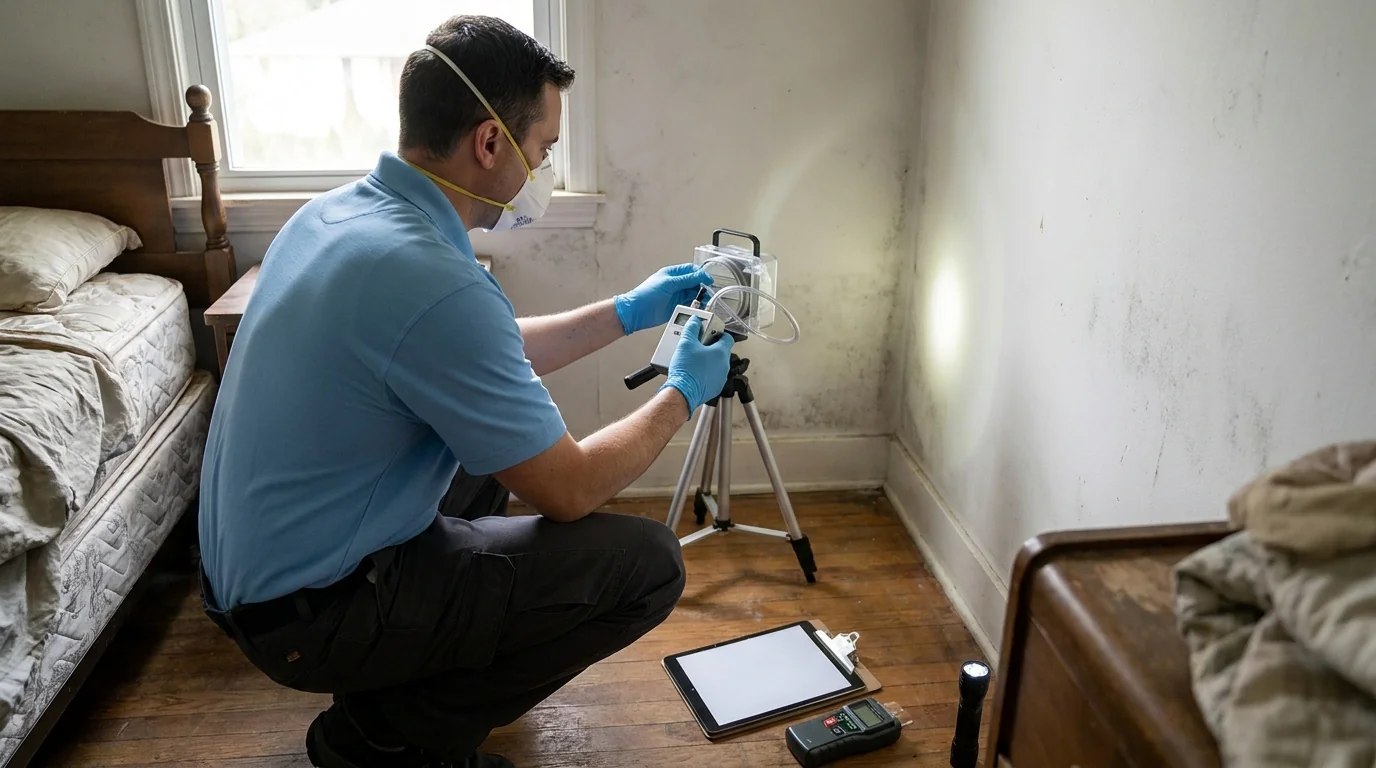
A mold inspection is not a visual sweep with a flashlight. The process starts with a structured walkthrough of the property, attic to basement, looking for moisture intrusion points, visible growth, staining, and building envelope failures. We use thermal imaging cameras and calibrated moisture meters to identify wet material behind finished surfaces without opening walls unnecessarily.
When sampling is warranted, we collect air samples using calibrated spore-trap cassettes at multiple locations inside the property and a control sample outside, following IICRC assessment protocols. Surface swabs or tape-lift samples are added when visible growth needs to be identified by species. All samples go to an accredited third-party laboratory, and results typically return within 24 to 48 hours. The written report we provide documents findings, moisture readings, sample locations, lab results, and a recommended scope, which is what you’ll need if you’re coordinating with an insurance adjuster, a landlord, or a remediation contractor.
For commercial properties along the Route 440 corridor or at Bayonne Crossing, we also offer indoor air quality testing protocols calibrated to occupied retail and office environments, where HVAC cross-contamination and fresh-air intake placement are common contributing factors.
Reaching Bayonne from Kenilworth
The Restoration Group is based in Kenilworth, NJ, and dispatches crews around the clock. Bayonne is accessible via the New Jersey Turnpike to Route 440 or via Routes 1 and 9 south through Linden and Elizabeth. We serve all Bayonne neighborhoods, from the older rowhouse blocks in Downtown Bayonne and Midtown to the more industrial fringe near Constable Hook, and we’re available 24/7 for initial consultations and scheduling.
Local Note: What Bayonne’s Plaster Walls Mean for Sampling
In Bayonne’s pre-war two- and three-family homes, the interior walls are frequently original three-coat plaster over wood lath rather than modern drywall. Plaster is less porous than drywall and doesn’t wick moisture the same way, but it also masks moisture readings on standard pin-type meters, the wet zone is often in the lath and framing behind the plaster face, not in the plaster itself. When we inspect these properties, we supplement pin-meter readings with non-invasive radio-frequency moisture meters and thermal imaging to locate hidden wet framing before deciding whether a wall opening is necessary. Getting this right at the inspection stage prevents both under-scoping (missing active mold) and over-scoping (unnecessary demolition of plaster that’s structurally sound).
If you’re dealing with a potential mold problem in a Bayonne home or commercial property, whether it’s a post-flood basement, a chronic leak in an older rowhouse, or an indoor air quality concern flagged by a tenant, call The Restoration Group at (855) 650-7422. We’ll schedule an inspection, give you lab-backed results, and provide a clear written assessment you can act on.
Serving Bayonne from our Fair Lawn headquarters — ★ 4.8 · 166 Google reviews
“Prompt, knowledgeable, skillful and honest. Highly recommend. They remediated within 24 hours. Total peace of mind restored. Worth every penny.” - Anne, October 2026Read our reviews on Google →
Mold Inspection and Testing in Bayonne: Service Coverage
Frequently Asked Questions
How fast can you arrive for mold inspection and testing in Bayonne?
Are homes near the Newark Bay waterfront in Bayonne more likely to test positive for elevated mold spore counts?
My Bergen Point rental has a tenant complaint about air quality — what does a mold inspection actually involve?
How does Bayonne's older housing stock — plaster walls, cast-iron plumbing — affect the mold testing process?
Can a mold inspection report from The Restoration Group be used when filing a homeowner's insurance claim in Bayonne?
What's the difference between a mold inspection and mold testing — do I need both for a Bayonne property?
Mold Inspection and Testing response in Bayonne
Most Bayonne calls see a technician on-site within 60 minutes from our Fair Lawn headquarters.