Commercial Restoration in Bridgewater
24/7 commercial restoration in Bridgewater, NJ. IICRC-certified, insurance billing accepted. Call (855) 650-7422.
Our IICRC-certified technicians are dispatched from our Fair Lawn, NJ headquarters and are typically on-site in Bridgewater within 60 minutes of your call.
When a sprinkler head discharges overnight at an office park off Route 22, or a roof drain backs up during a nor’easter and floods a retail bay near Bridgewater Commons, the clock starts immediately, not just on the water damage itself, but on lost revenue, tenant displacement, and the insurance documentation your carrier will demand. The Restoration Group handles commercial losses across Bridgewater’s 08807 and 08805 ZIP codes, from the low-lying industrial corridors near Finderne to the mixed-use developments clustered around the Route 22/287 interchange.
Why Bridgewater Commercial Properties Face Distinct Restoration Risks
Bridgewater’s commercial landscape is unusually varied for a suburban township. The Route 22 and Route 202/206 retail corridors include everything from big-box anchors to strip centers built in the 1970s and 1980s, structures with aging flat roofs, cast-iron interior drains, and HVAC systems that were never designed for the humidity loads New Jersey summers now deliver. Office parks tucked behind the TD Bank Ballpark and along the Raritan Valley rail corridor often have finished lower levels that sit at or near the water table.
The Raritan River and Middle Brook have repeatedly demonstrated what that means in practice. During Hurricane Ida in 2021, the Finderne flats and the Bound Brook-adjacent sections of Bridgewater took on several feet of floodwater in hours. Businesses that had never flooded before found themselves with saturated slab-on-grade floors, ruined inventory, and drywall that had been wicking water for days before anyone could safely re-enter. Older supply plumbing in pre-1990 commercial buildings, galvanized steel and early CPVC, is also reaching end of life, and pinhole leaks inside finished walls can go undetected until a ceiling tile collapses or a mold odor surfaces.
Fire risk follows a different pattern. Retail and restaurant tenants in high-turnover strip centers along Route 22 generate a disproportionate share of kitchen suppression activations and small electrical fires. Even a contained fire leaves smoke residue that penetrates HVAC ductwork and affects adjacent suites, a loss that looks minor on arrival but expands significantly once air sampling is done.
Our Commercial Restoration Process in Bridgewater
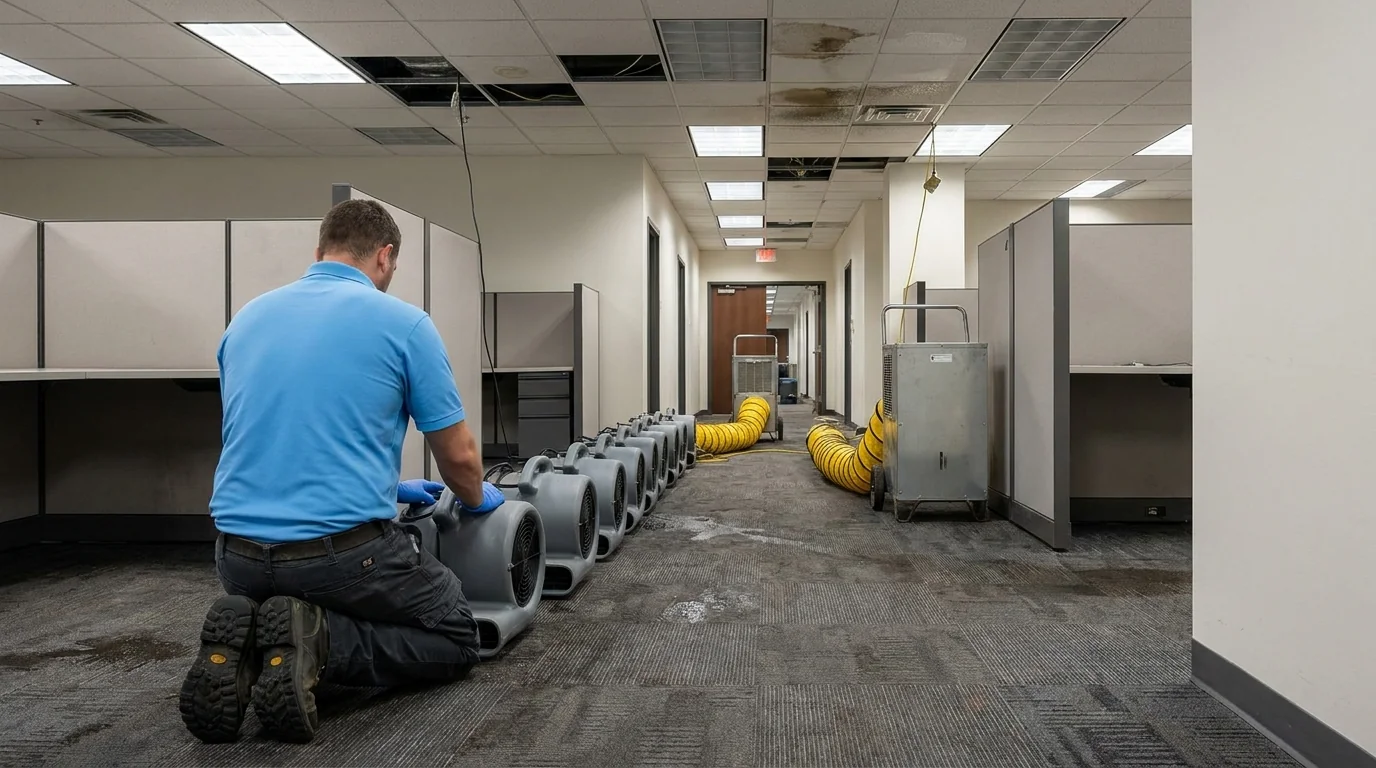
Every commercial job begins with a documented scope, not a verbal estimate. When we arrive at a Bridgewater property, our first step is a moisture mapping survey using thermal imaging and calibrated meters to establish exactly where water has migrated. In slab-on-grade buildings common along the Route 22 corridor, that means checking under vinyl composition tile and floating floors before any drying equipment is placed, because trapped moisture under impermeable surfaces will not evaporate upward, it has to be mechanically extracted or the slab dried from below with desiccant systems.
For fire and smoke losses, we conduct a room-by-room odor and residue assessment before any cleaning begins. Dry smoke from fast-burning electrical fires behaves differently from wet smoke produced by smoldering materials, the cleaning chemistry and dwell times are not interchangeable, and using the wrong approach on the wrong residue type drives the odor deeper into porous surfaces. We document every affected material with photographs and moisture readings that are formatted for direct submission to commercial property carriers.
Drying timelines in commercial spaces are governed by the IICRC S500 standard. We set daily drying goals, log psychrometric readings each visit, and adjust equipment placement when a space is not tracking toward dry. Business owners get written progress reports, not just a technician’s verbal update, because your property manager, your insurer, and your tenant all need the same information.
Reaching Bridgewater from Kenilworth
Our Kenilworth headquarters puts us on Route 22 within minutes, and Bridgewater is a straightforward run west, typically along Route 22 directly into the heart of the township’s commercial corridors. For properties in the Martinsville section or near Chimney Rock Park, we route through Route 202/206 depending on traffic. Because our team operates 24/7, a sprinkler discharge at 2 a.m. or a burst pipe discovered on a Sunday morning gets the same response as a weekday call. We carry extraction, drying, and board-up equipment on every vehicle so the first crew on site can begin mitigation immediately rather than waiting for a second truck.
Local Note: What Bridgewater’s Flood History Means for Commercial Drying
Contractors who haven’t worked in the Finderne and Bradley Gardens areas of Bridgewater sometimes underestimate how long concrete block foundation walls retain moisture after a flood event. The soil in the low sections near the Raritan River is heavy clay, it drains slowly and stays saturated for weeks after a major storm. A commercial building that looks dry inside two weeks after a flood may still have block walls reading elevated moisture content, and if those walls are furred out with fiberglass batt insulation, the cavity behind the drywall can be actively growing mold while the surface feels dry to the touch. We probe and meter those assemblies before signing off on any drying job in Bridgewater’s flood-prone sections, a step that adds time upfront but prevents a mold remediation call three months later.
Bridgewater Insurance Coordination for Commercial Losses
Commercial property claims in Bridgewater follow the same carrier landscape as the rest of Somerset County, but the documentation requirements for business interruption coverage add a layer that residential claims don’t have. We provide itemized moisture logs, equipment placement records, and photo documentation formatted to support both the property damage claim and any business interruption rider. If your policy requires a third-party industrial hygienist for post-remediation clearance, common on larger commercial mold losses, we coordinate that scheduling so it doesn’t become a bottleneck at job closeout. Call (855) 650-7422 to reach our team directly; we can walk you through the documentation process before we even arrive on site.
When a commercial property in Bridgewater needs to get back to operating condition, the difference between a two-week closure and a six-week closure often comes down to how quickly the scope was defined and how consistently the drying was managed. Reach out to The Restoration Group at (855) 650-7422, our team is available around the clock and knows the building stock, flood history, and carrier expectations specific to Bridgewater.
Serving Bridgewater from our Fair Lawn headquarters — ★ 4.8 · 166 Google reviews
“Hired the Restoration Group after mold and flood in our house. Their 24 hour line was always available. They came right away and were prompt completing the work. Everyone was friendly.” - Amanda, October 2026Read our reviews on Google →
Commercial Restoration in Bridgewater: Service Coverage
Frequently Asked Questions
How fast can you arrive for commercial restoration in Bridgewater?
How quickly can The Restoration Group reach a commercial property near the Route 22/287 interchange in Bridgewater?
Our Bridgewater office building flooded during a storm event — does the Raritan River floodplain affect how you approach the drying process?
A fire suppression system discharged in our retail space on Route 22 — what does commercial water damage restoration involve for a tenant-occupied strip center?
Does Bridgewater's older commercial building stock — particularly pre-1990 properties along Route 202/206 — create any specific complications for fire and smoke restoration?
What documentation does The Restoration Group provide for a commercial insurance claim on a Bridgewater property?
Commercial Restoration response in Bridgewater
Most Bridgewater calls see a technician on-site within 60 minutes from our Fair Lawn headquarters.