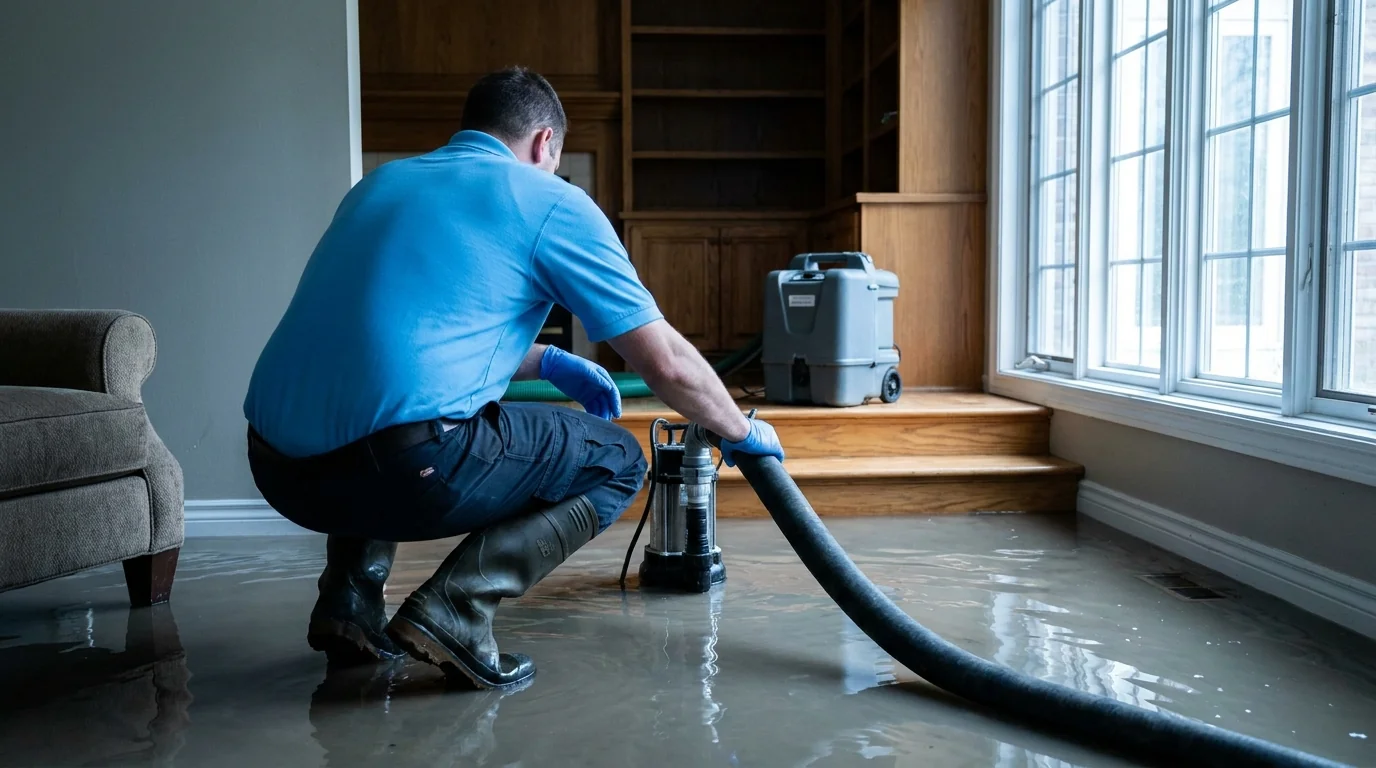
24/7 Emergency Flood Damage Restoration in Bridgewater
24/7 emergency flood damage restoration in Bridgewater, NJ. IICRC-certified, insurance billing accepted. Call (855) 650-7422.
Our IICRC-certified technicians are dispatched from our Fair Lawn, NJ headquarters and are typically on-site in Bridgewater within 60 minutes of your call.
When the Raritan River crests or a nor’easter stalls over Somerset County, Bridgewater’s low-lying flats, particularly in Finderne and the Bound Brook-adjacent sections near Route 22, can take on water faster than a sump pump can cycle. The township saw that firsthand during Hurricane Floyd and again during Ida in September 2021, when finished basements in postwar ranches and split-levels filled to the joists within hours. If you’re standing in inches of water right now, The Restoration Group responds 24/7 and can be reached at (855) 650-7422.
Why Bridgewater Properties See Flood Damage So Often
Bridgewater’s geography works against it in a few specific ways. The Raritan River and Middle Brook drain a wide watershed, and the flat sections around Finderne and Bradley Gardens sit at elevations that leave them vulnerable whenever upstream volumes spike. Soil in these older subdivisions is heavily compacted from decades of development, which slows absorption and pushes surface water toward foundations rather than away from them.
The housing stock adds another layer of risk. Many of the postwar ranches and split-levels built between the 1950s and 1970s were finished with cast-iron drain lines and galvanized supply plumbing that has long since corroded. A single failed joint can dump hundreds of gallons into a finished basement before anyone notices. Newer townhome developments and the commercial corridor stretching along Route 22 and Route 202/206, including office parks near the Route 22/287 interchange, face their own exposure: aging fire-suppression sprinkler heads, flat commercial rooflines that pond water, and overnight losses that go undetected until morning.
Our Flood Damage Restoration Process in Bridgewater
Every flood loss starts with a scope assessment before any equipment is staged. We document standing water depth, identify the moisture boundary in walls and subfloor assemblies, and photograph everything for your insurance carrier before extraction begins. That documentation step matters especially in Bridgewater’s older split-levels, where water migrates from a flooded lower level into wall cavities that connect to upper living spaces, a pattern that’s easy to miss if you start pulling equipment in without mapping the loss first.
Extraction comes next: truck-mounted units for standing water, then desiccant and refrigerant dehumidifiers calibrated to the cubic footage of the affected space. Drying is monitored with daily moisture readings logged against the IICRC S500 standard until structural materials reach acceptable levels. We don’t close a job based on how the space looks, we close it based on what the meters say.
For finished basements with drywall, we perform flood cuts at the appropriate height to expose wet insulation and framing rather than trapping moisture behind intact walls. For homes with original plaster, still common in some of the older Martinsville and Chimney Rock-area tracts, drying timelines run longer because plaster releases absorbed moisture more slowly than drywall. We adjust equipment placement and dwell time accordingly.
Reaching Bridgewater from Kenilworth
The Restoration Group is based in Kenilworth, NJ, and Bridgewater sits roughly 20 miles to the west via I-78 or Route 22. Because we operate around the clock, a call at 2 a.m. during an active flood event gets the same dispatch response as a call at noon. For properties in the 08807 ZIP code, which covers much of central and western Bridgewater including areas near Bridgewater Commons and the TD Bank Ballpark, we route via I-78 west to Route 287. For the Finderne and Bradley Gardens sections in the 08805 ZIP, the Route 22 corridor is typically the faster approach.
Bridgewater Insurance Coordination
Flood losses in Bridgewater frequently involve two separate policies: a standard homeowner’s policy (which may cover sudden and accidental discharge from a burst pipe) and a separate NFIP or private flood insurance policy (which covers rising water from the Raritan or Middle Brook). We document the loss in a format that satisfies both claim types, moisture mapping, photo logs, drying records, and a scope of work that separates the categories of damage. That distinction matters because adjusters handle the two policy types differently, and a combined documentation package speeds up both claims simultaneously.
Local Note
One thing we’ve learned working in Bridgewater’s older subdivisions: the finished basements in many of the 1960s and 1970s split-levels were built with a partial crawl space or utility chase running beneath the slab that isn’t visible from inside the finished space. During a flood event, that void fills with water and stays saturated long after the visible basement floor appears dry. If your home was built in that era and sits in a low section of the township, ask us to probe that cavity before we finalize the drying scope, skipping it is one of the most common reasons a flood remediation job develops a mold problem two weeks later.
If your Bridgewater home or commercial property has taken on water, whether from the Raritan, a failed sump, a burst supply line, or a sprinkler discharge, call (855) 650-7422 now. The Restoration Group is IICRC Certified (Firm #210213), licensed by the NJ Division of Consumer Affairs as a Home Improvement Contractor, and available every hour of the day to begin flood damage restoration before the damage compounds.
Serving Bridgewater from our Fair Lawn headquarters — ★ 4.8 · 166 Google reviews
“Hired the Restoration Group after mold and flood in our house. Their 24 hour line was always available. They came right away and were prompt completing the work. Everyone was friendly.” - Amanda, October 2026Read our reviews on Google →
Flood Damage Restoration in Bridgewater: Service Coverage
Frequently Asked Questions
How fast can you arrive for flood damage restoration in Bridgewater?
Are homes in Finderne and Bradley Gardens at higher risk for repeat flood damage?
How does Bridgewater's split-level housing stock affect the flood restoration process?
Does Bridgewater's location in a FEMA Special Flood Hazard Area affect how the insurance claim is handled?
What does the drying timeline typically look like for a flooded finished basement in the 08807 ZIP code?
Can you handle flood losses at commercial properties along the Route 22 corridor or near Bridgewater Commons?
Flood Damage Restoration response in Bridgewater
Most Bridgewater calls see a technician on-site within 60 minutes from our Fair Lawn headquarters.
Nearby & Related
- 24/7 Emergency Flood Damage Restoration in Kenilworth
- Restoration Services in Bridgewater
- 24/7 Emergency Fire Damage Restoration in Bridgewater
- Mold Remediation in Bridgewater
- 24/7 Emergency Flood Damage Restoration in Bayonne
- 24/7 Emergency Flood Damage Restoration in Bloomfield
- Contact The Restoration Group