Mold Remediation in Clark
24/7 mold remediation in Clark, NJ. IICRC-certified, insurance billing accepted. Call (855) 650-7422.
Our IICRC-certified technicians are dispatched from our Fair Lawn, NJ headquarters and are typically on-site in Clark within 60 minutes of your call.
Clark’s postwar ranches, split-levels, and capes were built fast and built tight, finished basements, minimal crawl-space ventilation, and cast-iron drain lines that are now sixty-plus years old. When Robinson’s Branch backs up during a summer downpour or a copper supply line finally gives way behind a Valley Road utility room, moisture moves into wall cavities and under slab-on-grade floors before most homeowners realize anything happened. Mold can begin colonizing damp cellulose, drywall paper, wood framing, carpet pad, within 24 to 48 hours of a water event, and in a sealed basement that timeline is unforgiving.
Why Clark Properties See Mold Issues
The geography does a lot of the work here. The Rahway River and its Robinson’s Branch tributary define Clark’s northern and western edges, and the low ground near Lake Avenue sits in a natural drainage basin. During Hurricane Ida in 2021, both waterways jumped their banks and pushed sewage backward through floor drains into basements off Valley Road, a combination of clean water, gray water, and raw sewage that creates ideal mold conditions even after the visible water is gone. Category 3 (sewage-contaminated) losses require full containment and antimicrobial treatment of every affected surface, not just drying.
Beyond flooding, the housing stock itself is a factor. Clark’s 1950s and 1960s construction relied heavily on paper-faced drywall in finished basements, wood-panel wainscoting, and fiberglass batt insulation that holds moisture against framing for weeks. Sump-pump failures during the heavy convective storms that roll through Union County every summer are the single most common call in the 07066 ZIP code, and a failed sump in a finished basement can saturate 800 to 1,200 square feet of floor assembly before the homeowner gets home from work.
Our Mold Remediation Process in Clark
Every job starts with a thorough visual inspection and moisture mapping using thermal imaging and pin-type meters. In Clark’s split-levels and raised ranches, that means checking the half-story transitions where plumbing chases run, those cavities trap humidity and are frequently missed in a surface-only walkthrough.
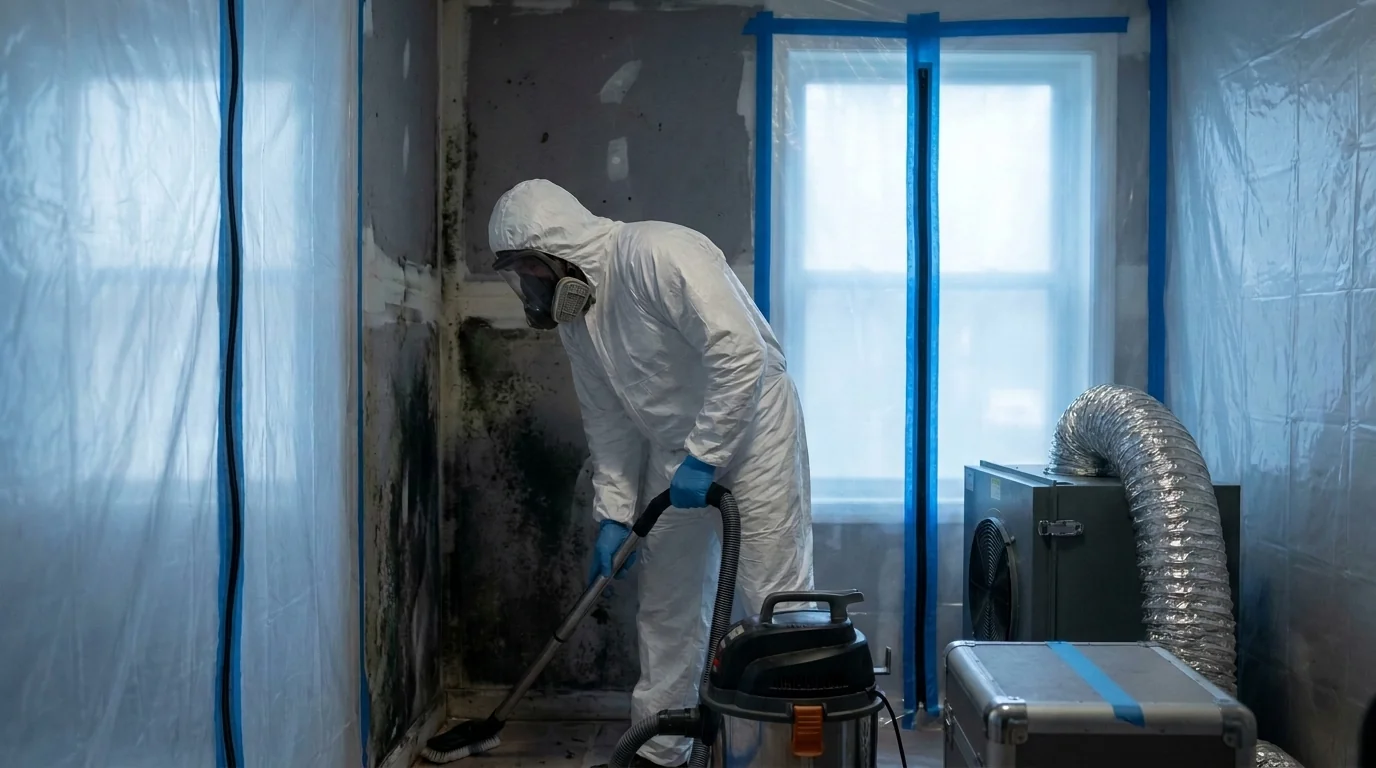
Once affected areas are identified, the crew establishes negative-air containment with 6-mil poly barriers and HEPA-filtered air scrubbers running at negative pressure. This keeps spores from migrating into living areas during demolition of compromised materials. Affected drywall, insulation, and wood framing that cannot be cleaned to bare substrate are removed and bagged in sealed poly for disposal, there is no encapsulation shortcut on active mold growth.
After demolition, all remaining structural surfaces are HEPA-vacuumed, wire-brushed where needed, and treated with an EPA-registered antimicrobial agent. Drying equipment, LGR dehumidifiers and air movers, runs until moisture readings in framing and concrete return to regional equilibrium levels (typically 12–15% MC in wood, below 4% in concrete for this part of New Jersey). The job is not closed until those numbers are confirmed in writing.
The team holds IICRC Certified Firm status (#210213), and all work follows the IICRC S520 Standard for Professional Mold Remediation.
Reaching Clark from Kenilworth
The Kenilworth shop sits roughly three miles from the center of Clark, a straight shot down Kenilworth Boulevard to Raritan Road. That proximity matters when a sump alarm goes off at 2 a.m. or a tenant calls about a musty smell that turns out to be an active colony behind a bathroom wall. Calls are answered around the clock, and crews can be dispatched any hour. Homes near the Westfield Avenue corridor and the Raritan Road business district are typically the easiest to reach; addresses closer to the Brant Lake area or near Arthur L. Johnson High School add only a few minutes. For commercial losses on the Raritan Road strip, restaurants, retail, the same process applies, with containment scaled to the square footage.
Local Note
One thing that comes up specifically in Clark’s finished-basement ranches: the drop ceilings installed in the 1970s and 1980s often conceal original 1950s fiberboard tile above the suspended grid. That tile is highly absorbent and is almost never visible during a standard walkthrough. When moisture readings in the lower level are elevated but no obvious source is apparent, lifting a few grid panels to inspect the original ceiling above is a step that saves homeowners from a mold recurrence six months after remediation. It is a small thing, but it is the kind of detail that only shows up after you have worked in this specific housing stock long enough to know what is hiding above the drop ceiling.
If you are seeing discoloration on basement walls, a persistent musty odor in a lower level, or you had standing water after a recent storm, do not wait for visible growth to confirm the problem. Call The Restoration Group at (855) 650-7422, the crew serving Clark is familiar with what these homes hide, and an assessment is the right first step before mold turns a contained moisture problem into a full remediation project.
Serving Clark from our Fair Lawn headquarters — ★ 4.8 · 166 Google reviews
“The company was very prepared and professional. They were prompt with coming out to inspect the water damage that occurred and had the team come out the next day. They even wore booties in the house. They cut out all areas of damage, sprayed and use numerous fans and humidifiers in the wet area. I…” - Melanie, October 2026Read our reviews on Google →
Mold Remediation in Clark: Service Coverage
Frequently Asked Questions
How fast can you arrive for mold remediation in Clark?
Are homes near Lake Avenue and the Robinson's Branch area at higher risk for mold after a storm?
How quickly can The Restoration Group reach a Clark address for a mold emergency?
Clark has a lot of 1950s and 1960s finished basements — does the older construction affect how mold remediation is done?
What does the mold remediation process look like from start to finish, and how long does it take in a typical Clark home?
Will my homeowner's insurance cover mold remediation in Clark, and does the cause of the mold matter?
Mold Remediation response in Clark
Most Clark calls see a technician on-site within 60 minutes from our Fair Lawn headquarters.