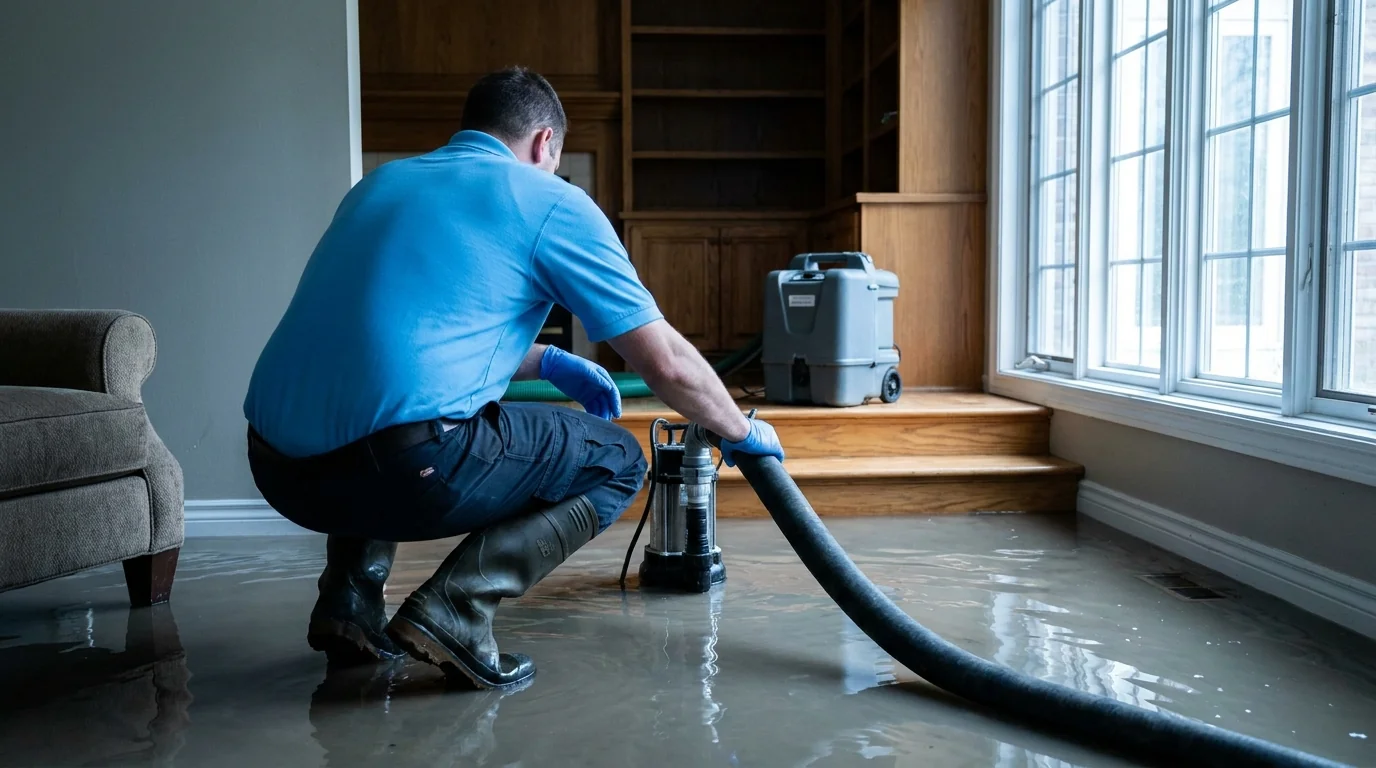
24/7 Emergency Flood Damage Restoration in East Orange
24/7 emergency flood damage restoration in East Orange, NJ. IICRC-certified, insurance billing accepted. Call (855) 650-7422.
Our IICRC-certified technicians are dispatched from our Fair Lawn, NJ headquarters and are typically on-site in East Orange within 60 minutes of your call.
When a heavy rain event rolls through Essex County, East Orange’s dense grid of century-old brick apartment buildings and two-family Victorians doesn’t drain the way a newer suburb does. Flat roofs pool, aging cast-iron stacks back up, and finished basement apartments along the low corridors near Ampere and Brick Church can take on inches of water before a tenant even notices. The Restoration Group responds to flood damage calls in East Orange around the clock, because in a building where one flooded unit can wick moisture into the unit above and the unit next door, time is the variable that separates a drying job from a gut renovation.
Why East Orange Properties See Repeated Flood Losses
East Orange’s housing stock is one of the densest and oldest in New Jersey. The three-story walk-ups and converted Victorians that line streets in Elmwood and Doddtown were built between roughly 1905 and 1940, when galvanized steel supply lines and flat or low-pitched roofs were standard. Galvanized pipe corrodes from the inside out, it doesn’t burst dramatically, it weeps, and that slow leak behind a plaster wall can saturate floor joists for weeks before anyone sees a stain on the ceiling below.
Below grade, the picture is different. Basement mechanical rooms and finished cellars throughout the 07017 and 07018 ZIP codes flood during sustained rain events because the combined sewer infrastructure serving much of the city can’t always handle peak flow. During Tropical Storm Ida in 2021, tributaries feeding the Second River pushed water into low-lying streets in the eastern sections of the city, affecting ground-floor units and parking garages that had never flooded before. That event was a reminder that flood risk here isn’t limited to buildings near obvious waterways.
The Central Avenue commercial corridor adds another category: sprinkler activations, roof-drain overflows, and overnight pipe failures in mixed-use buildings where a retail space on the ground floor sits directly below residential units. A single event on that corridor can affect multiple tenants, multiple insurance policies, and a landlord who needs coordinated documentation for all of them.
Our Flood Damage Restoration Process in East Orange
The first priority on any flood call is stopping ongoing intrusion, whether that means identifying the source, coordinating with the building super to shut a main, or sandbagging a window well. Once the water source is controlled, the extraction phase begins. In East Orange’s multi-unit buildings, that often means working across more than one unit simultaneously, because water follows gravity through shared floor assemblies.
After extraction, the process follows the IICRC S500 standard for water damage restoration: moisture mapping with thermal imaging and pin meters to trace exactly how far water has migrated into walls, subfloors, and ceiling cavities. In buildings with original plaster-over-lath construction, common throughout Elmwood and Presidential Estates, that mapping step is especially important, because plaster holds moisture differently than drywall and can read as dry on the surface while the lath behind it is still saturated.
Drying equipment, commercial-grade desiccant dehumidifiers and high-velocity air movers, is placed based on the moisture map, not by room count. Daily monitoring adjusts the equipment layout as materials dry. Affected materials that can’t be dried in place (saturated insulation, buckled hardwood, compromised subfloor sections) are documented, removed, and logged for the insurance claim before any reconstruction begins. The Restoration Group is an IICRC Certified Firm (#210213) and a licensed NJ Home Improvement Contractor, so the documentation we produce meets carrier requirements.
Reaching East Orange from Kenilworth
The Restoration Group operates out of Kenilworth, which puts East Orange roughly 20 to 25 minutes away via the Garden State Parkway to Route 21 or via Springfield Avenue depending on traffic. Because the team is available 24/7, a call that comes in at 2 a.m. from a landlord near Brick Church station gets the same dispatch as a midday call. For multi-unit buildings near East Orange General Hospital or along the Main Street corridor, we coordinate with building management on access before arrival, parking and equipment staging in dense urban blocks requires a plan, not an assumption.
East Orange Insurance Coordination
Flood and water damage claims in multi-family East Orange buildings frequently involve more than one policy: the building owner’s commercial policy, individual renters’ policies, and sometimes a separate flood policy if the property sits in a mapped flood zone. The Restoration Group documents each affected unit separately, scope of loss, moisture readings, affected materials, photo log, so that claims can be filed cleanly across multiple carriers without disputes over what damage belongs to which unit or which event.
We bill carriers directly where possible and provide a written scope that adjusters can work from without a second site visit. If a public adjuster is already involved, we coordinate with them.
Local Note
In East Orange’s older brick walk-ups, the floor assemblies between units are often a mix of original wood joists, decades of added concrete topping, and vinyl or tile finishes, not the uniform construction a moisture map assumes. We’ve found that these layered floors trap water at the concrete-wood interface long after the surface reads dry, which means drying timelines in these buildings routinely run longer than the industry average. If you’re a landlord managing a building near Watsessing Park or along the Ampere corridor and a contractor tells you the job will be done in three days, ask to see the daily moisture logs before you sign off.
If your property has taken on water, call The Restoration Group at (855) 650-7422. We’ll assess the loss, map the moisture, and give you a documented scope, so you know exactly what you’re dealing with before any work begins.
Serving East Orange from our Fair Lawn headquarters — ★ 4.8 · 166 Google reviews
“The company was very prepared and professional. They were prompt with coming out to inspect the water damage that occurred and had the team come out the next day. They even wore booties in the house. They cut out all areas of damage, sprayed and use numerous fans and humidifiers in the wet area. I…” - Melanie, October 2026Read our reviews on Google →
Flood Damage Restoration in East Orange: Service Coverage
Frequently Asked Questions
How fast can you arrive for flood damage restoration in East Orange?
How quickly can The Restoration Group reach a flooded basement in the Brick Church or Ampere area of East Orange?
East Orange has a lot of older brick apartment buildings — does that change how flood drying works?
Are ground-floor units near the Second River tributaries in ZIP code 07017 at higher flood risk than the rest of East Orange?
A sewer backup flooded our finished basement in the Elmwood neighborhood — is that covered differently than a pipe burst?
Our building on Central Avenue has multiple tenants with separate insurance policies — how do you handle documentation for a flood loss that affects more than one unit?
Flood Damage Restoration response in East Orange
Most East Orange calls see a technician on-site within 60 minutes from our Fair Lawn headquarters.
Nearby & Related
- 24/7 Emergency Flood Damage Restoration in Kenilworth
- Restoration Services in East Orange
- 24/7 Emergency Fire Damage Restoration in East Orange
- Mold Remediation in East Orange
- 24/7 Emergency Flood Damage Restoration in Bayonne
- 24/7 Emergency Flood Damage Restoration in Bloomfield
- Contact The Restoration Group