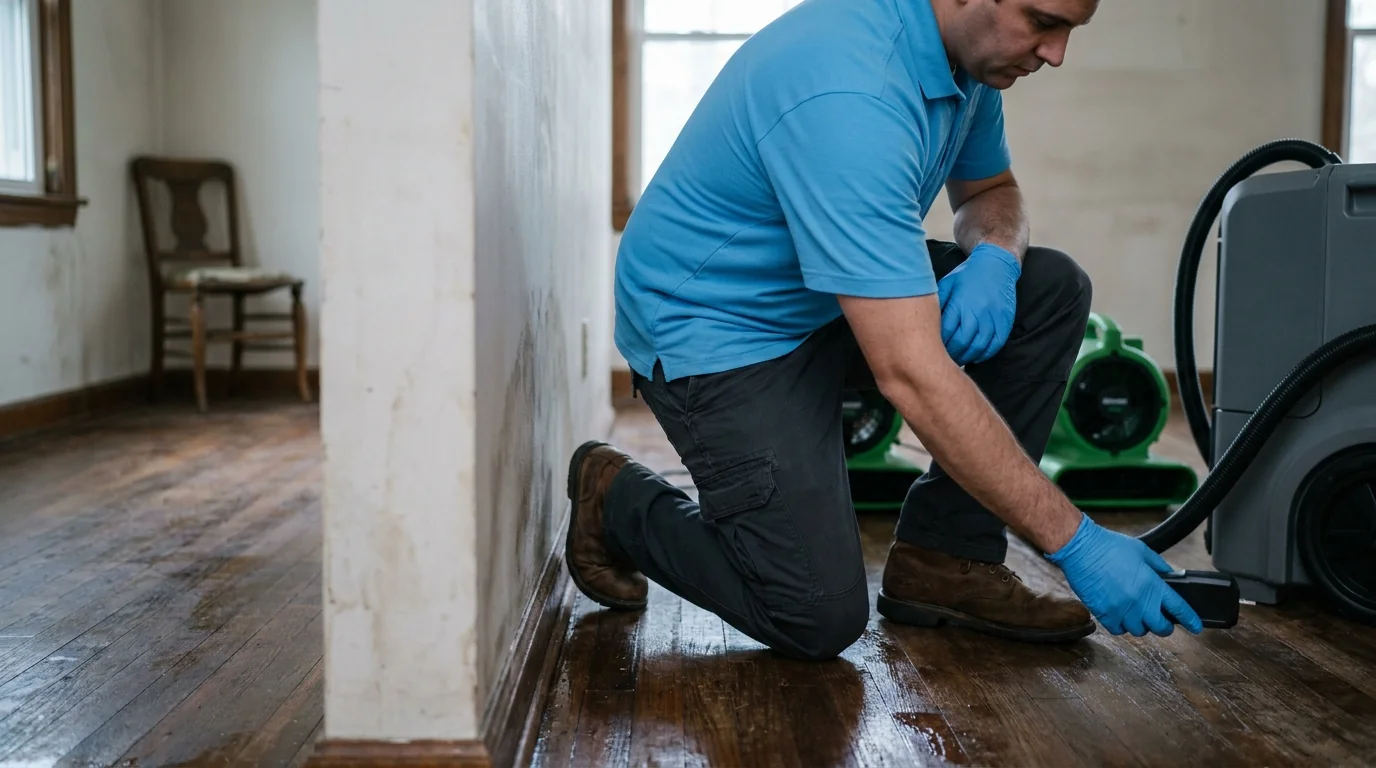
24/7 Emergency Water Damage Restoration in East Orange
24/7 emergency water damage restoration in East Orange, NJ. IICRC-certified, insurance billing accepted. Call (855) 650-7422.
Our IICRC-certified technicians are dispatched from our Fair Lawn, NJ headquarters and are typically on-site in East Orange within 60 minutes of your call.
When a galvanized riser finally gives out in a three-story walk-up off Central Avenue, or a flat roof lets go during a nor’easter over one of Brick Church’s prewar apartment buildings, water doesn’t stop at one unit, it migrates through plaster ceilings, travels down brick party walls, and pools in finished basements before most tenants realize anything is wrong. The Restoration Group responds 24/7 to water damage emergencies across East Orange, bringing IICRC-certified water mitigation directly from our Kenilworth base to ZIP codes 07017, 07018, and 07019.
Why East Orange Properties See Repeated Water Losses
East Orange’s housing stock is one of the densest concentrations of early-20th-century multifamily construction in Essex County. The brick apartment buildings and two-families that line the streets around Ampere and Elmwood were built when galvanized steel pipe was standard, and that pipe is now 80 to 100 years old. Galvanized pipe corrodes from the inside out, narrowing over decades until it finally splits under winter pressure spikes or a sudden temperature drop. When it goes, the failure rarely stays contained to one unit.
Flat and low-slope roofs compound the problem. Ponding water after a heavy rain finds every seam and penetration, and by the time a ceiling stain appears on the third floor, water has often been sitting inside the roof assembly for days. Basement mechanical rooms, common in the postwar infill buildings near Presidential Estates, flood during heavy rain events because the combined sewer system in low-lying areas backs up before street drainage can keep pace. East Orange saw that pattern play out dramatically during Hurricane Ida in 2021, when Second River tributaries pushed water into ground-floor and below-grade spaces across the city’s lower elevations.
Sprinkler activations are another recurring source of loss along the Central Avenue and Main Street commercial corridors and near the East Orange General Hospital campus. A single head discharge in a commercial corridor building can release 15 to 25 gallons per minute, enough to saturate multiple floors before the system is shut off.
Our Water Damage Restoration Process in East Orange
Every job starts with a moisture map, not a guess. When we arrive, we use thermal imaging cameras and calibrated moisture meters to trace exactly where water has traveled, through plaster, into subfloor assemblies, behind tile, and along the inside faces of brick walls. In East Orange’s older buildings, water routinely moves further than it looks because original plaster is highly absorbent and brick cavity walls act as hidden channels.
Once the scope is confirmed, water removal begins with truck-mounted extraction equipment capable of pulling standing water from hardwood floors, carpet, and concrete slab areas simultaneously. Structural drying follows using commercial-grade desiccant and refrigerant dehumidifiers positioned to create a controlled drying chamber, airflow is calculated per the IICRC S500 standard, not estimated. We set and monitor daily drying logs, adjusting equipment placement as materials release moisture over the drying cycle.
For multi-unit buildings, which make up a large share of East Orange’s residential stock, we coordinate access with building superintendents and property managers to inspect adjacent units above, below, and beside the primary loss area. Water that has migrated into a neighboring unit and gone unaddressed is one of the most common reasons a restoration job has to be reopened weeks later.
Reaching East Orange from Kenilworth
Our Kenilworth location puts us on the Garden State Parkway or Route 22 east within minutes, with access to East Orange via the Garden State Parkway to Route 280 east, a route that keeps us off local surface streets during peak hours. We can reach Brick Church station and the surrounding neighborhood, the Elmwood corridor, and addresses near Watsessing Park on the western border without navigating through the congestion that typically builds on Springfield Avenue and Central Avenue during morning and evening hours. Because we operate 24/7, late-night and early-morning calls, when burst pipes are most common during cold snaps, reach a live dispatcher immediately, not an answering service.
Local Note: Plaster Walls and Hidden Moisture in East Orange’s Older Buildings
One thing that surprises property owners in East Orange’s prewar buildings is how long structural drying actually takes compared to a newer home. Modern drywall releases moisture relatively quickly once dehumidification is running. Original three-coat plaster over wood lath, the wall system in most of the Victorians and brick walk-ups in Doddtown and the blocks around Cicely Tyson School, holds water like a sponge and releases it slowly, sometimes over 7 to 10 days rather than the 3 to 4 days typical for drywall construction. We account for this in our drying projections upfront so that property owners and insurance adjusters aren’t caught off guard when the job takes longer than a comparable loss in a newer building would.
Insurance Coordination for East Orange Water Losses
Most homeowner and landlord policies cover sudden and accidental discharge, a burst pipe, a failed appliance supply line, a roof leak from storm damage. What they typically exclude is long-term seepage or gradual deterioration, which is why documentation of the loss event matters from the first hour. We photograph and log conditions on arrival, produce moisture readings with timestamps, and provide the detailed scope of work that carriers and public adjusters need to process a claim efficiently. We bill most major carriers directly and work with property managers handling multi-unit losses where multiple policy holders may be involved in a single event.
If you’re dealing with water in your East Orange home or building right now, call (855) 650-7422. We’re available around the clock, and the sooner extraction starts, the less material has to come out.
Serving East Orange from our Fair Lawn headquarters — ★ 4.8 · 166 Google reviews
“The company was very prepared and professional. They were prompt with coming out to inspect the water damage that occurred and had the team come out the next day. They even wore booties in the house. They cut out all areas of damage, sprayed and use numerous fans and humidifiers in the wet area. I…” - Melanie, October 2026Read our reviews on Google →
Water Damage Restoration in East Orange: Service Coverage
Frequently Asked Questions
How fast can you arrive for water damage restoration in East Orange?
How quickly can The Restoration Group reach the Brick Church area of East Orange for a water emergency?
East Orange has a lot of older apartment buildings — does water damage restoration work differently in those properties?
My basement flooded after heavy rain in East Orange — is that covered by standard homeowner's insurance?
What equipment do you use for structural drying, and how do you know when a building is actually dry?
Can you handle a water loss that has spread across multiple units in an East Orange apartment building?
Water Damage Restoration response in East Orange
Most East Orange calls see a technician on-site within 60 minutes from our Fair Lawn headquarters.
Nearby & Related
- 24/7 Emergency Water Damage Restoration in Kenilworth
- Restoration Services in East Orange
- 24/7 Emergency Fire Damage Restoration in East Orange
- Mold Remediation in East Orange
- 24/7 Emergency Water Damage Restoration in Bayonne
- 24/7 Emergency Water Damage Restoration in Bloomfield
- Contact The Restoration Group