Mold Remediation in Englewood
24/7 mold remediation in Englewood, NJ. IICRC-certified, insurance billing accepted. Call (855) 650-7422.
Our IICRC-certified technicians are dispatched from our Fair Lawn, NJ headquarters and are typically on-site in Englewood within 60 minutes of your call.
Mold doesn’t wait for a convenient time to appear, and in Englewood it rarely does. The low-lying streets near Overpeck Creek tributaries flooded hard during Hurricane Ida in 2021, leaving finished basements saturated for days, long enough for mold colonies to establish behind drywall before homeowners even filed an insurance claim. Whether you’re dealing with a musty crawl space in a century-old East Hill estate or visible black mold spreading across the ceiling of a Fourth Ward apartment, the conditions here create specific, recurring mold problems that demand more than a coat of paint and a dehumidifier.
Why Englewood Properties See Mold Issues
Englewood’s housing stock spans nearly every era of residential construction. The grand homes on East Hill were built with stone foundations and plaster walls that absorb moisture slowly and release it even more slowly, ideal conditions for hidden mold growth behind baseboards and inside wall cavities. On the west side, postwar multifamily buildings and early-1900s row houses often have aging cast-iron supply lines and galvanized drain stacks that develop slow, concealed leaks for months before anyone notices the staining.
The city’s geography compounds the problem. Tributaries feeding Overpeck Creek run beneath and alongside residential streets in the 07631 ZIP code, and high water tables in low-lying areas mean slab moisture intrusion is common even without a visible flood event. Flat Rock Brook, which winds through the nature preserve before passing near residential neighborhoods, contributes to elevated ambient humidity during wet seasons, humidity that doesn’t need a broken pipe to push interior moisture levels into mold-growth territory.
On the commercial side, the Palisade Avenue corridor sees sprinkler discharges and overnight pipe failures in retail and restaurant spaces that go undetected until Monday morning. Mold can begin colonizing porous materials within 24 to 48 hours of a water event, so a weekend leak in a restaurant prep kitchen can mean active mold growth by the time staff return.
Our Mold Remediation Process in Englewood
Every job starts with a thorough inspection, moisture meters, thermal imaging, and air sampling where warranted, to map the full extent of contamination before any demolition begins. In older Englewood homes, that inspection often reveals mold behind original plaster or inside balloon-framed wall cavities that aren’t accessible without targeted opening of surfaces.
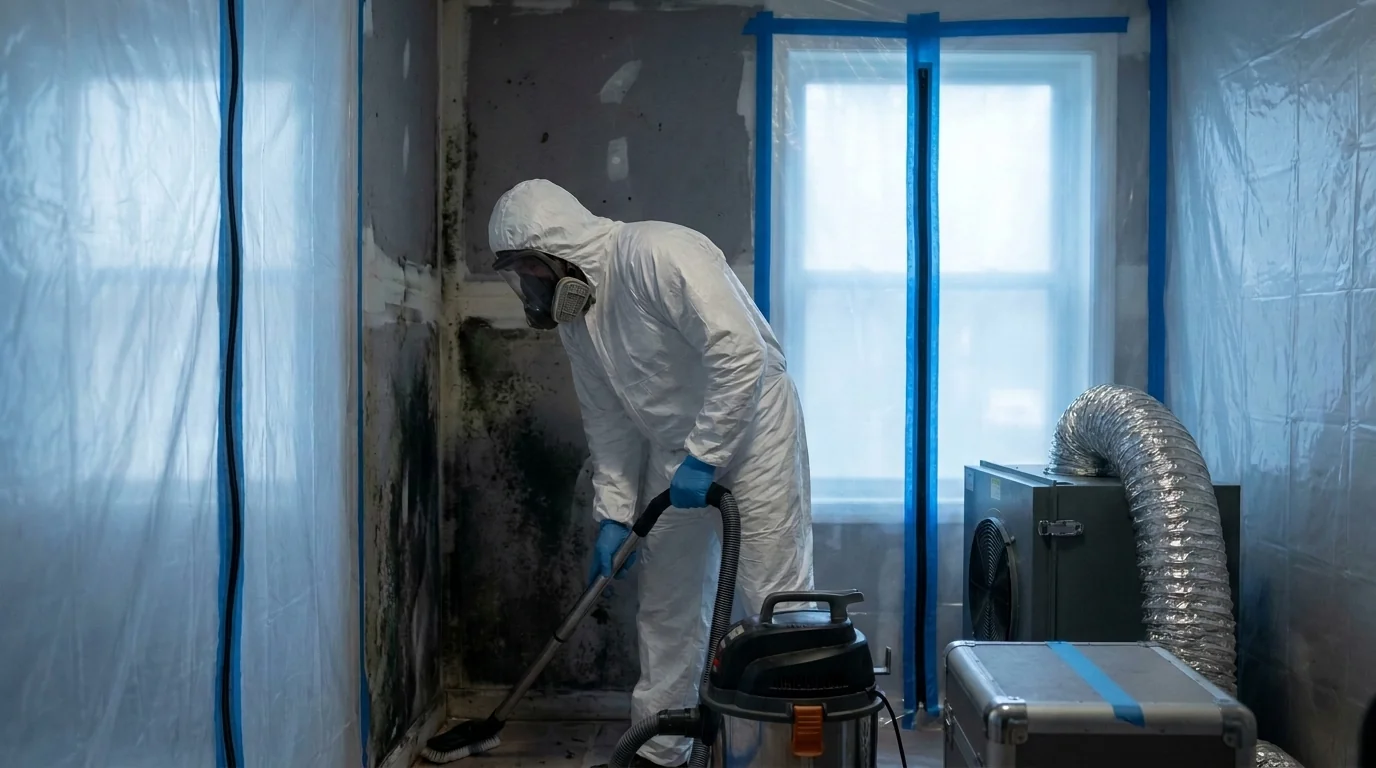
Once the scope is defined, we establish negative-air containment barriers to prevent spores from migrating to unaffected areas of the home or building. HEPA-filtered air scrubbers run continuously throughout remediation. Affected materials, drywall, insulation, wood framing where necessary, are removed, bagged, and disposed of per New Jersey Department of Environmental Protection guidelines. Remaining structural surfaces are treated with EPA-registered antimicrobial agents and allowed to dry to verified moisture content before any reconstruction begins.
For multi-unit buildings, which are common across Englewood’s apartment stock, we coordinate unit access and containment sequencing to minimize disruption to neighboring tenants while ensuring cross-contamination between units is controlled.
Reaching Englewood from Kenilworth
The Restoration Group operates 24/7 out of Kenilworth, NJ, and Englewood is well within our active service area. Our crews travel Route 3 East to the Garden State Parkway North, reaching Englewood typically within the hour depending on traffic. We serve all Englewood neighborhoods, from the dense residential streets of the Fourth Ward to the larger properties along the Englewood Cliffs border, and we’re reachable any time of day or night at (855) 650-7422.
Englewood Insurance Coordination
Mold claims in New Jersey can be complicated. Insurers frequently dispute coverage based on whether the underlying water intrusion was sudden and accidental versus long-term and maintenance-related. Our documentation process is designed with that dispute in mind: we photograph moisture readings, map the affected area with measurements, and produce a written scope of work that aligns with carrier expectations. We work directly with adjusters and can communicate findings in the format most carriers require, reducing back-and-forth delays that cost homeowners time while mold continues to spread.
For commercial properties along Palisade Avenue or institutional accounts near Englewood Hospital, we can also coordinate with property management companies and facilities teams to ensure the documentation chain is complete for both insurance and regulatory purposes.
Local Note
One pattern we see repeatedly in Englewood’s East Hill homes: the original plaster walls, common in houses built between 1900 and 1940, act as a moisture reservoir rather than a moisture barrier. When a slow roof leak or a sweating pipe wets plaster, the material holds that moisture for weeks, creating a prolonged growth window for mold even after the source is repaired. Homeowners who fix the leak and assume the problem is solved often call us months later when the smell returns. In these homes, we use extended drying protocols and take additional moisture readings at depth before we ever close up a wall.
If you’re seeing discoloration, smelling mustiness, or you’ve had any water event in the last 60 days, call The Restoration Group at (855) 650-7422. We’ll assess the situation in Englewood specifically, not with a generic checklist, but with the building knowledge and local context this city’s housing stock actually requires.
Serving Englewood from our Fair Lawn headquarters — ★ 4.8 · 166 Google reviews
“Well, the restoration group I would say they are always prompt in terms of arriving on time. they came and They did what they had to do. very friendly and they were able to explain to me the process what they were doing and what it was for. I did appreciate that. most importantly I needed to get a…” - Viergina, September 2026Read our reviews on Google →
Mold Remediation in Englewood: Service Coverage
Frequently Asked Questions
How fast can you arrive for mold remediation in Englewood?
Are homes in Englewood's East Hill neighborhood more prone to hidden mold than newer construction?
How does Englewood's flooding history near Overpeck Creek affect mold risk in nearby homes?
Can mold spread between units in Englewood's older apartment buildings?
What does the mold remediation process look like from start to finish, and how long does it typically take?
Will my insurance cover mold remediation in Englewood, and how does the claims process work?
Mold Remediation response in Englewood
Most Englewood calls see a technician on-site within 60 minutes from our Fair Lawn headquarters.