24/7 Emergency Fire Damage Restoration in Fort Lee
24/7 emergency fire damage restoration in Fort Lee, NJ. IICRC-certified, insurance billing accepted. Call (855) 650-7422.
Our IICRC-certified technicians are dispatched from our Fair Lawn, NJ headquarters and are typically on-site in Fort Lee within 60 minutes of your call.
Fire damage emergency in Fort Lee? We answer 24/7. Call now and our crew can be on-site within 60 minutes to secure the property and start the recovery.
Fort Lee’s skyline is defined by high-rise towers stacked along the Palisades edge, and when fire breaks out in one of those buildings, or in one of the older wood-frame homes tucked into Coytesville or The Hill, the damage rarely stays contained to a single unit. Smoke travels through shared HVAC shafts, soot settles on surfaces two floors away from the origin, and the water used to knock down the flames soaks into concrete cores and plaster walls that were built to last a century. If you’re dealing with that right now in Fort Lee (07024), the steps you take in the first 24 to 48 hours determine how much of your property can be saved.
Why Fort Lee Properties See Distinct Fire Damage Challenges
The building stock here doesn’t behave like a typical suburban neighborhood. The dense condominium towers clustered near the George Washington Bridge and the Hudson Lights mixed-use complex were built with interconnected mechanical systems, a fire in one unit means smoke infiltration and suppression-water migration into adjacent units, sometimes affecting three or four floors before the fire department clears the scene. That creates a multi-party loss that requires careful documentation before any demolition begins.
On the other side of town, Coytesville and The Hill contain a significant number of prewar multifamily homes and older single-family wood-frames. These structures often have balloon-frame construction, where wall cavities run uninterrupted from the basement to the roof line. Fire and smoke travel those cavities fast, and soot deposits in areas that look undamaged from the outside. Thermal imaging and systematic cavity inspection are not optional on these jobs, they’re the difference between a complete restoration and a callback six months later when hidden char is discovered.
Our Fire and Smoke Restoration Process in Fort Lee
Every post-fire restoration starts with a structured assessment, not a quick walk-through. The Restoration Group documents the loss with photographs, moisture readings, and air quality samples before a single piece of debris is moved. That documentation package is what your insurance adjuster needs, and it’s what protects you if scope disputes arise later.
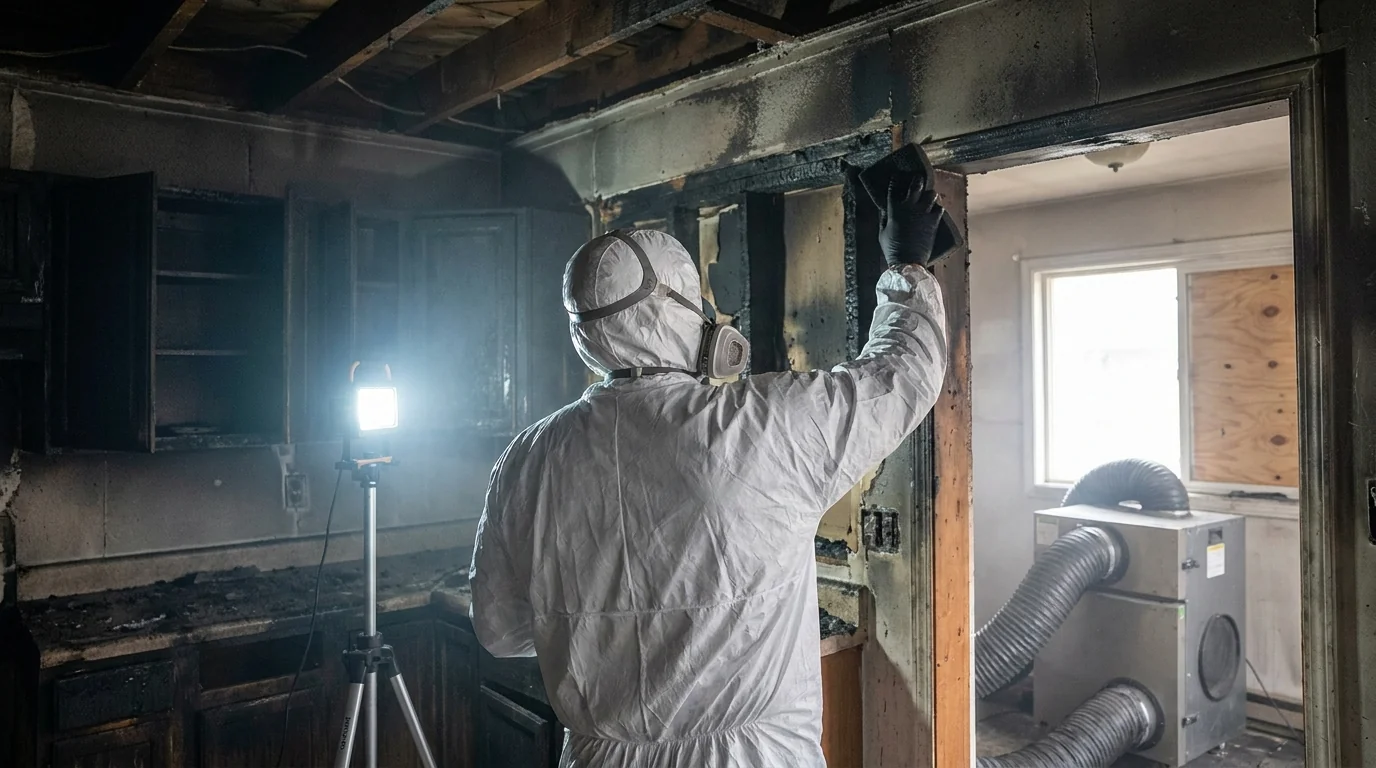
Once the assessment is complete, the process moves through demolition of unsalvageable materials, HEPA-filtered negative air pressure containment to prevent soot cross-contamination, structural drying if suppression water is present, and then odor neutralization using thermal fogging and hydroxyl generation. Smoke odor in a Fort Lee high-rise is particularly stubborn because HVAC recirculation embeds particles into ductwork, we treat the mechanical system, not just the visible surfaces.
Content pack-out, cleaning, and storage are coordinated for residents who need their belongings protected while structural work continues. Final reconstruction is handled under the same NJ Licensed Home Improvement Contractor license, so you’re not managing two separate contractors.
Reaching Fort Lee from Kenilworth
The Restoration Group dispatches from Kenilworth, NJ, and maintains 24/7 availability for fire damage emergencies. The most direct route to Fort Lee runs up Route 9W or the Garden State Parkway to I-95 East, with access points serving both the Palisade cliff-side towers and the inland residential streets of Central Fort Lee. For addresses near the George Washington Bridge approach, the upper level of the GWB provides a direct corridor when local traffic allows.
Because Fort Lee’s street grid compresses significantly near the bridge plaza, we confirm staging access before arrival on high-rise jobs, loading docks, freight elevators, and parking garage clearances all affect how quickly equipment reaches the affected floor.
Fort Lee Insurance and HOA Coordination
Fire losses in Fort Lee’s condominium buildings almost always involve two insurance policies: the unit owner’s HO-6 policy and the building’s master policy. The line between what each covers, and who is responsible for what portion of structural repair, varies by building declaration and sometimes by which unit the fire originated in. The Restoration Group prepares a scope-of-loss document that maps damage to the correct coverage tier, which reduces the back-and-forth with adjusters and gets remediation authorized faster.
For commercial losses along the Main Street business district or within the Hudson Lights complex, we work directly with commercial property managers and their carriers, providing the itemized documentation that commercial policies require before releasing funds.
Local Note
One thing that catches property owners off guard in Fort Lee’s older Coytesville and Palisade-area homes: the original horsehair plaster walls common in pre-1950 construction absorb smoke particulates differently than modern drywall. The plaster itself can hold odor compounds deep in its matrix, and standard surface cleaning doesn’t reach them. On these jobs, we test for odor penetration depth before deciding whether encapsulation or full plaster removal is the right call, removing structurally sound historic plaster unnecessarily adds cost and timeline, but leaving contaminated material behind means the smell returns within weeks.
If you’re in Fort Lee and a fire has affected your home or building, call (855) 650-7422. The Restoration Group’s IICRC Certified team is available around the clock, and the sooner structural drying and soot containment begin, the more of your property, and your claim value, can be preserved.
Serving Fort Lee from our Fair Lawn headquarters — ★ 4.8 · 166 Google reviews
“Great workers, so nice and efficient! And Ottavio is the best” - Emma, October 2026Read our reviews on Google →
Fire Damage Restoration in Fort Lee: Service Coverage
Frequently Asked Questions
How fast can you arrive for fire damage restoration in Fort Lee?
How quickly can The Restoration Group reach a fire damage emergency in Fort Lee's high-rise corridor near the George Washington Bridge?
A fire started in a neighboring unit in my Fort Lee condo building — am I responsible for smoke damage inside my own unit?
Are older homes in Coytesville and The Hill at higher risk of hidden fire and smoke damage?
What does the smoke odor removal process involve for a Fort Lee property with shared HVAC systems?
How long does fire damage restoration typically take for a Fort Lee apartment or condo unit?
Will my homeowners insurance cover fire damage restoration in Fort Lee?
Fire Damage Restoration response in Fort Lee
Most Fort Lee calls see a technician on-site within 60 minutes from our Fair Lawn headquarters.