24/7 Emergency Flood Damage Restoration in Garfield
24/7 emergency flood damage restoration in Garfield, NJ. IICRC-certified, insurance billing accepted. Call (855) 650-7422.
Our IICRC-certified technicians are dispatched from our Fair Lawn, NJ headquarters and are typically on-site in Garfield within 60 minutes of your call.
When the Passaic River crests along River Drive, it doesn’t just flood the blocks nearest the water, it backs up through aging cast-iron laterals into the finished basements of frame two- and three-families that stretch east toward Belmont and Plauderville. Garfield’s dense housing stock, most of it built before World War II on small lots with minimal grade separation, means a single hard storm can push water into a dozen homes on the same block within hours. The Restoration Group responds 24/7 to flood damage calls across Garfield (07026), bringing IICRC Certified Firm (#210213) drying protocols and direct insurance billing to a city that has learned, especially since Ida in 2021, that flood recovery is not a weekend project.
Why Garfield Properties Flood the Way They Do
Garfield’s flood vulnerability isn’t random. The Passaic River’s western edge along River Drive has a well-documented history of severe inundation, Tropical Storm Ida in September 2021 put riverfront blocks underwater and drove water into basements that hadn’t flooded in decades. But the river isn’t the only source. Tributaries of the Saddle River create secondary low spots throughout the city, and after a hard two-inch rain those low spots can accumulate standing water faster than storm drains, many of them original cast-iron infrastructure, can move it.
The housing stock compounds the problem. Garfield is dense with early-1900s frame construction: balloon-framed walls, original plaster-over-lath interiors, and finished basements that homeowners use as living space. When flood water enters these basements, it doesn’t just wet the floor, it wicks into wood framing, saturates insulation packed into rim joists, and begins climbing wall cavities in ways that aren’t visible from the surface. The Passaic Street corridor and Belmont Avenue corridor also concentrate small commercial and retail spaces where overnight pipe failures or roof leaks can go undetected for hours, compounding the loss by morning.
Our Flood Damage Restoration Process in Garfield
Flood restoration in Garfield’s older homes requires a different sequence than a straightforward pipe-break in newer construction. Here’s how a typical job moves:
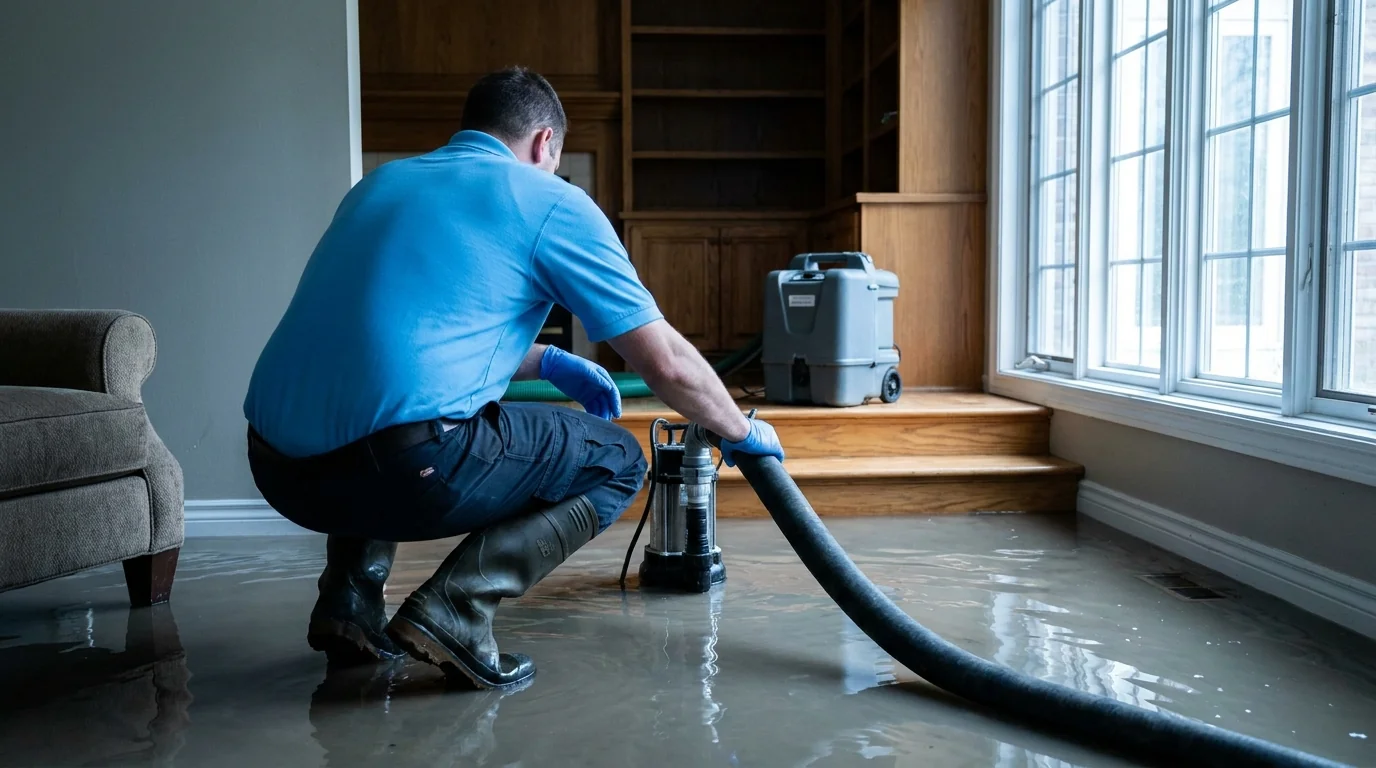
Rapid assessment and water extraction. On arrival, the crew identifies all water intrusion points, floor drains, sump pits, wall penetrations, and deploys truck-mounted and portable extractors to pull standing water before it migrates further into wall cavities or under flooring.
Moisture mapping. Thermal imaging and calibrated moisture meters map exactly how far water has traveled inside walls and under subfloors. In Garfield’s plaster-and-lath homes, this step is critical: plaster holds surface moisture longer than drywall, but the wood lath and framing behind it can be saturated even when the plaster face feels dry.
Controlled demolition and drying. Flood-category water (IICRC Category 2 or 3, which is typical for Passaic River backflow events) requires removing affected materials that cannot be dried in place, baseboards, lower wall sections, saturated insulation. Industrial air movers and desiccant or refrigerant dehumidifiers are positioned per the IICRC S500 standard drying protocol and monitored daily until all readings reach dry standard.
Antimicrobial treatment and documentation. Flood water from river backflow carries contaminants. Affected structural surfaces receive EPA-registered antimicrobial treatment before any reconstruction begins. Every step is photo-documented for your insurance claim.
Reaching Garfield from Kenilworth
The Restoration Group is based in Kenilworth, NJ, and dispatches crews to Garfield around the clock. The route via Route 21 North connects directly to the River Drive corridor and the Passaic Street business district, putting crews into the most flood-prone western sections of the city efficiently. Neighborhoods further east, Plauderville, the Dahnert’s Lake area near Dahnert’s Lake County Park, and the Harrison Avenue district, are reachable via Route 46 or the Garfield train station interchange without navigating the tightest residential blocks during a storm response.
Because Garfield’s streets are narrow and parking is dense, our dispatch team notes access constraints at the address before arrival so crews come prepared with the right equipment configuration, compact extractors for tight basement stairwells, extension hoses for units above the first floor in multifamily buildings.
Insurance Coordination for Garfield Flood Claims
Flood losses in Garfield often involve both standard homeowner’s policies (for sudden and accidental discharge) and separate National Flood Insurance Program (NFIP) policies, which are common in the Passaic River flood zone. The Restoration Group documents losses in the format adjusters expect: itemized moisture logs, daily drying reports, photo sets by room, and material removal inventories. We bill most major carriers directly and can work alongside your public adjuster if you’ve retained one. Multifamily owners on the Passaic Street corridor dealing with shared-wall losses across units should ask about our multi-unit documentation process, which keeps each unit’s claim record separate even when the source is common.
Local Note
One thing that catches homeowners off guard in Garfield’s older two- and three-families: the finished basement that flooded is often not on the original Certificate of Occupancy. Unpermitted finishing work is common in this housing stock, and some insurance adjusters will flag it during the claim review. It doesn’t disqualify the claim, but it can slow it down. When we document a Garfield basement loss, we note existing conditions carefully and flag anything that may prompt adjuster questions so you’re not surprised mid-claim.
If your home or property in Garfield has taken on flood water, whether from the Passaic, a backed-up drain, or a storm that overwhelmed your sump, call The Restoration Group at (855) 650-7422. We’re available 24/7, and the faster extraction begins, the less structural drying and demolition the job requires.
Serving Garfield from our Fair Lawn headquarters — ★ 4.8 · 166 Google reviews
“Hired the Restoration Group after mold and flood in our house. Their 24 hour line was always available. They came right away and were prompt completing the work. Everyone was friendly.” - Amanda, October 2026Read our reviews on Google →
Flood Damage Restoration in Garfield: Service Coverage
Frequently Asked Questions
How fast can you arrive for flood damage restoration in Garfield?
How quickly can The Restoration Group reach the Passaic Street corridor or River Drive area after a flood call?
Are homes near Dahnert's Lake and the Plauderville neighborhood at higher flood risk than other parts of Garfield?
Garfield has a lot of older two- and three-family homes — does that change how flood drying works?
My Garfield basement flooded during a Passaic River event — does my homeowner's policy cover that, or do I need my NFIP policy?
How long does flood damage restoration typically take for a finished basement in Garfield's 07026 ZIP code?
Will my homeowners insurance cover flood damage restoration in Garfield?
Flood Damage Restoration response in Garfield
Most Garfield calls see a technician on-site within 60 minutes from our Fair Lawn headquarters.