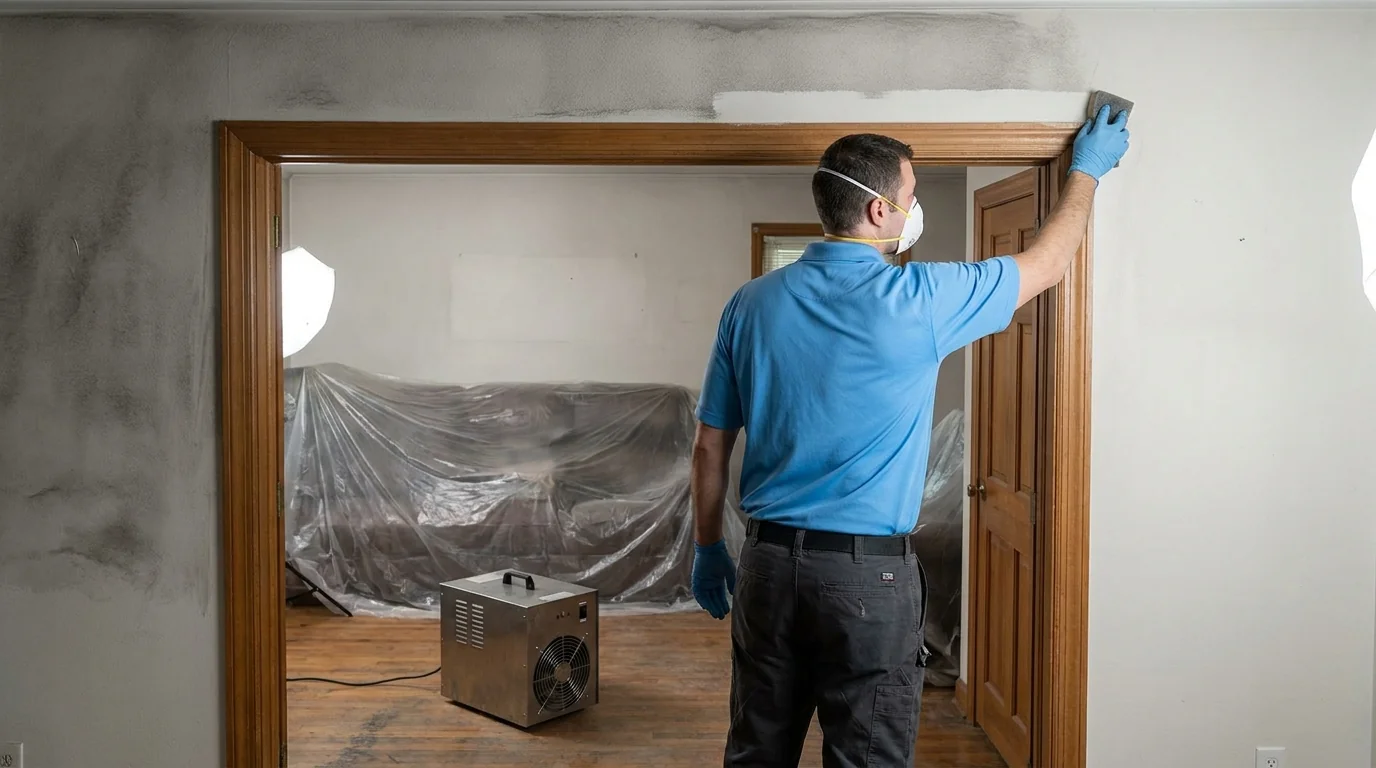
24/7 Emergency Smoke Damage Restoration in Garfield
24/7 emergency smoke damage restoration in Garfield, NJ. IICRC-certified, insurance billing accepted. Call (855) 650-7422.
Our IICRC-certified technicians are dispatched from our Fair Lawn, NJ headquarters and are typically on-site in Garfield within 60 minutes of your call.
Smoke damage emergency in Garfield? We answer 24/7. Call now and our crew can be on-site within 60 minutes to stop smoke and soot damage from spreading.
A house fire leaves more than charred wood behind. In Garfield’s dense blocks of early-1900s two- and three-family frame homes, the kind stacked tightly along the Belmont Avenue corridor and throughout the Plauderville neighborhood, smoke travels fast through shared wall cavities, climbs into finished attics, and settles into every porous surface before the fire department clears the scene. The odor you smell three days later is not just unpleasant; it is soot particulate and volatile organic compounds embedded in plaster, subfloor, and HVAC ductwork. Getting it out requires more than airing out a room.
Why Garfield’s Housing Stock Complicates Smoke Damage
Garfield (ZIP 07026) is a city built before modern building codes standardized fire stops and compartmentalization. The two- and three-family frames that line streets from the Harrison Avenue district to the Passaic Street corridor were constructed with balloon framing, a method where wall cavities run continuously from the basement sill plate to the roof ridge with no horizontal blocking. In a balloon-framed home, smoke and hot gases travel vertically through those open cavities the moment a fire starts on any floor. By the time the fire is out, the odor-causing compounds have already migrated two or three stories away from the room where the fire originated.
That matters for restoration because standard smoke cleanup protocols designed for platform-framed postwar capes will underperform in these older structures. Cavity access, targeted negative-air pressure, and thermal fogging into wall interiors are often necessary steps that a surface-only cleaning will miss entirely. Garfield’s older plaster walls also absorb smoke differently than drywall, the lime-based substrate is porous and can hold odor compounds deep in the substrate, requiring longer dwell times for encapsulants and sealers.
Our Smoke Damage Restoration Process in Garfield
Every job starts with a structured scope assessment, not a visual walk-through. We use particle counters and thermal imaging to map where smoke traveled beyond the visible burn zone, including inside wall cavities, above drop ceilings, and into HVAC return plenums. In Garfield’s multifamily buildings, we also assess adjoining units when shared walls are present, because smoke migration into a neighbor’s unit is a liability issue that needs to be documented early.
From there, the process follows a defined sequence:
- Content pack-out and inventory, salvageable belongings are removed, catalogued, and transported for off-site ozone or ultrasonic cleaning before the structure work begins.
- Dry soot removal, HEPA-filtered vacuuming of all surfaces before any wet cleaning, because wiping dry soot without vacuuming first drives it deeper into porous materials.
- Wet cleaning and chemical sponging, surfaces are cleaned with pH-appropriate agents matched to the soot type (protein smoke from kitchen fires behaves very differently from synthetic-material smoke).
- Cavity treatment, where balloon-frame cavities are confirmed or suspected, we introduce thermal fog or hydroxyl treatment into the wall interiors through controlled access points.
- Odor neutralization and sealing, affected structural surfaces receive an odor-blocking encapsulant rated for smoke, followed by a final air quality check before any reconstruction begins.
- Reconstruction coordination, as an NJ Licensed Home Improvement Contractor, we can carry the job through drywall, paint, and finish work without the homeowner managing a second contractor.
The team is IICRC Certified (Firm #210213), and work is available around the clock, a meaningful detail when a fire happens at 2 a.m. and the adjuster wants a scope started before the weekend.
Reaching Garfield from Kenilworth
The Restoration Group is based in Kenilworth, NJ, roughly 12 miles from central Garfield via Route 21 North. Under normal traffic conditions, that puts a crew at addresses near the Garfield train station or along River Drive well within a reasonable drive. For properties in Plauderville or near Dahnert’s Lake County Park on the city’s eastern side, access is straightforward via Passaic Street. We operate 24/7, so late-night and early-morning dispatches are routine, not an exception.
Insurance Coordination for Garfield Homeowners and Landlords
Smoke damage claims in multifamily buildings often involve more than one policy, the building owner’s policy, a tenant’s renter’s insurance, and sometimes a neighboring unit’s carrier if smoke migrated through shared walls. We document the loss systematically: moisture and particle readings with timestamps, photo documentation of every affected surface, and a written scope that matches the line-item format most major carriers use. That documentation package reduces back-and-forth with adjusters and supports a more complete claim. We work directly with insurance carriers and can communicate with your adjuster on your behalf throughout the process.
Local Note
One thing that catches homeowners off guard in Garfield’s older multifamily stock: the finished basements common throughout the city often have drop-ceiling tiles directly below first-floor framing. When a fire occurs on the first floor, smoke drops into the basement through gap-prone tile systems and saturates the tile, insulation, and any stored contents below, even when the fire never reached the basement. We routinely find the most concentrated soot loading in basement ceilings on these jobs, not in the room where the fire started. If you have a finished basement in a pre-1960 Garfield home, expect it to be part of the scope.
If smoke has moved through your home, call (855) 650-7422. We will assess the full extent of the damage, including the spaces you cannot see, and walk you through every step before any work begins.
Serving Garfield from our Fair Lawn headquarters — ★ 4.8 · 166 Google reviews
“Hired the Restoration Group after mold and flood in our house. Their 24 hour line was always available. They came right away and were prompt completing the work. Everyone was friendly.” - Amanda, October 2026Read our reviews on Google →
Smoke Damage Restoration in Garfield: Service Coverage
Frequently Asked Questions
How fast can you arrive for smoke damage restoration in Garfield?
How quickly can The Restoration Group reach a home near the Belmont Avenue corridor after a fire?
Garfield has a lot of balloon-framed two- and three-family homes — does that change how smoke damage is treated?
A fire in my Plauderville two-family may have pushed smoke into the upstairs tenant's unit — are both units covered under one restoration scope?
What type of smoke is hardest to clean, and does it come up more often in Garfield's older homes?
How does smoke damage documentation work for an insurance claim on a Garfield rental property?
Smoke Damage Restoration response in Garfield
Most Garfield calls see a technician on-site within 60 minutes from our Fair Lawn headquarters.