24/7 Emergency Water Damage Restoration in Garfield
24/7 emergency water damage restoration in Garfield, NJ. IICRC-certified, insurance billing accepted. Call (855) 650-7422.
Our IICRC-certified technicians are dispatched from our Fair Lawn, NJ headquarters and are typically on-site in Garfield within 60 minutes of your call.
When the Passaic River backs up along River Drive or a corroded cast-iron drain finally gives out under a century-old two-family in Plauderville, the water doesn’t wait for business hours. Garfield’s dense blocks of early-1900s frame homes and postwar capes sit on small lots with finished basements that fill fast, and the tighter the lot, the faster water migrates through shared walls into a neighbor’s unit. The Restoration Group dispatches 24/7 from Kenilworth to address water emergencies across Garfield’s 07026 ZIP code before saturation turns a manageable loss into a structural one.
Why Garfield Properties See Water Damage So Often
Garfield’s housing stock is one of the oldest in Bergen County. Most of the two- and three-family frame homes lining the Belmont Avenue corridor and the streets off Passaic Street were built between 1910 and 1950, when cast-iron supply and drain lines were standard. Those pipes are now well past their design life. Pinhole leaks are common; full-bore failures happen without warning. Finished basements, nearly universal in this housing stock, convert what would be a crawlspace drip into a flooded living space within minutes.
The geography compounds the problem. The Passaic River runs the entire western edge of the city, and its flood history is not abstract. When Hurricane Ida hit in September 2021, riverfront blocks along River Drive and low-lying basements throughout the city took on water that in some cases exceeded three feet. Saddle River tributaries add secondary flood risk: after a hard two-inch storm, low spots in Plauderville and the Dahnert’s Lake area can sheet-flood before municipal storm drains catch up. Multifamily buildings along the Passaic Street business district face an additional exposure, a single overhead pipe failure on an upper floor can track water through multiple units before anyone notices.
Our Water Damage Restoration Process in Garfield
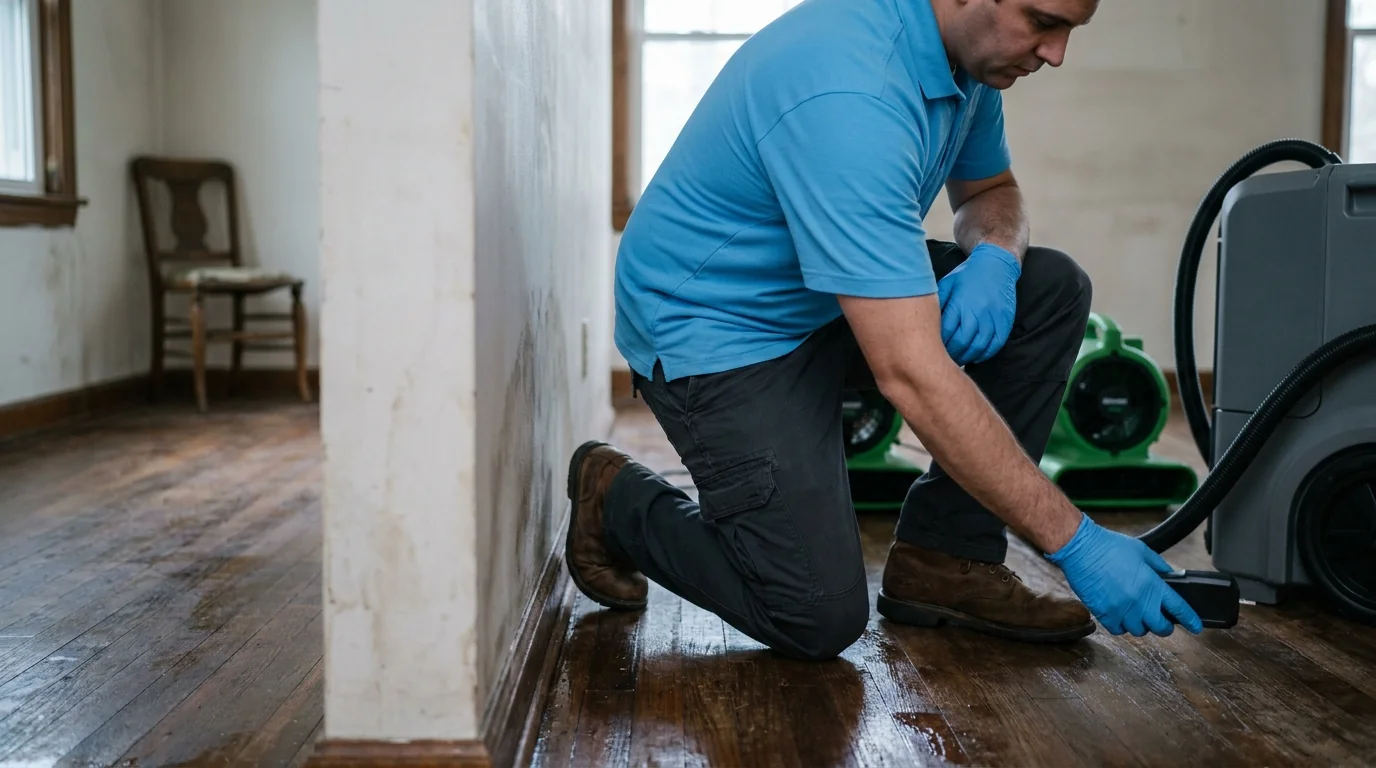
Every job starts with a moisture map, not a mop. When a crew arrives at a Garfield property, the first step is thermal imaging and moisture metering across walls, subfloor, and ceiling cavities, because in a wood-framed row home, water travels further than the visible stain suggests. That baseline reading drives every decision that follows.
Water extraction comes next. Truck-mounted extraction units pull standing water from finished basements and living areas; portable units handle tight spaces common in Garfield’s older floor plans. Once bulk water is removed, structural drying begins: industrial desiccant or refrigerant dehumidifiers and high-velocity air movers are positioned according to the IICRC S500 standard for psychrometric drying, not by guesswork. Moisture readings are logged daily so drying progress is documented, a record your insurance adjuster will want.
For homes with plaster-and-lath walls, still common in pre-1940 Garfield construction, drying timelines run longer than they would in a modern drywall home. Plaster is dense and releases absorbed moisture slowly. We account for that in the drying plan rather than pulling equipment prematurely and leaving hidden moisture behind.
Reaching Garfield from Kenilworth
The Restoration Group’s Kenilworth base puts Garfield well within our primary service corridor. Crews travel Route 21 northbound or cut through Passaic depending on traffic, reaching most Garfield addresses without the delays that affect contractors coming from further out. For overnight emergencies, a burst pipe discovered at 2 a.m. near the Garfield train station, a sump failure during a nor’easter, the same 24/7 dispatch line connects you to a live coordinator who can route the nearest available crew.
Garfield Insurance Coordination
Most Garfield homeowners carry standard HO-3 policies, but coverage for water damage depends heavily on the cause: a sudden pipe burst is typically covered; long-term seepage is typically excluded. We photograph and document the loss origin at the start of every job, which matters when an adjuster questions whether damage was sudden or gradual. For riverfront properties that carry separate NFIP flood policies, more common along River Drive after the Ida claims, we can work within the NFIP documentation requirements and coordinate directly with your assigned adjuster. We bill carriers directly and can provide a detailed scope of loss to support your claim.
Local Note
In Garfield’s multifamily housing, especially the three-family frames common between the Belmont Avenue corridor and Harrison Avenue, water from an upper-floor event almost always tracks into the unit below through the subfloor before it becomes visible. Landlords and property managers sometimes discover the second-unit damage days later when a tenant complains about a ceiling stain. If you own or manage a multifamily property and have a water event on any floor, it’s worth having the units above and below inspected at the same time. Catching hidden moisture in an adjacent unit early costs far less than remediating mold in a shared wall two weeks later.
If you’re dealing with standing water, a soaked basement, or the aftermath of a pipe failure anywhere in Garfield, call (855) 650-7422. The Restoration Group is available around the clock, documents everything for your insurer, and dries to a verified standard, not just until the floor looks dry.
Serving Garfield from our Fair Lawn headquarters — ★ 4.8 · 166 Google reviews
“Hired the Restoration Group after mold and flood in our house. Their 24 hour line was always available. They came right away and were prompt completing the work. Everyone was friendly.” - Amanda, October 2026Read our reviews on Google →
Water Damage Restoration in Garfield: Service Coverage
Frequently Asked Questions
How fast can you arrive for water damage restoration in Garfield?
How quickly can The Restoration Group reach a water emergency in Plauderville or the Dahnert's Lake area?
Garfield has a lot of pre-1940 homes with plaster walls — does that change how long water damage drying takes?
My Garfield property is near River Drive and I have an NFIP flood policy, not just homeowners insurance — can you work with that?
I own a three-family rental on the Belmont Avenue corridor — if water damages one unit, do I need to inspect the others?
What does the water extraction and drying process actually involve, and how long will equipment be in my home?
Water Damage Restoration response in Garfield
Most Garfield calls see a technician on-site within 60 minutes from our Fair Lawn headquarters.