24/7 Emergency Flood Damage Restoration in Highland Park
24/7 emergency flood damage restoration in Highland Park, NJ. IICRC-certified, insurance billing accepted. Call (855) 650-7422.
Our IICRC-certified technicians are dispatched from our Fair Lawn, NJ headquarters and are typically on-site in Highland Park within 60 minutes of your call.
Flooding emergency in Highland Park? We answer 24/7. Call now and our crew can be on-site within 60 minutes to pump out the water and stop the damage from spreading.
When the Raritan River crests its banks, as it did violently during Hurricane Ida in 2021, Highland Park’s lowest-lying streets flood with little warning. River Road properties, the fields around Donaldson Park, and the dense blocks of pre-war colonials and two-families just inland all sit in the path of that surge. If your home or business in the 08904 ZIP code is dealing with standing water right now, the clock matters: mold colonization can begin on wet framing and drywall within 24 to 48 hours of initial saturation.
Why Highland Park Properties Are Especially Vulnerable to Flood Damage
Highland Park’s housing stock is one of the oldest in Middlesex County. The colonials, bungalows, and two-family homes built between roughly 1910 and 1945 were constructed long before modern waterproofing standards existed. Many of these homes have finished basements, common throughout Livingston Manor and the Triangle neighborhood, that sit below the water table during a significant rain event. Original cast-iron drain lines and galvanized supply plumbing, still in service in a surprising number of these properties, are prone to joint failure and backflow when the municipal system is overwhelmed.
The borough’s topography compounds the problem. Highland Park slopes gently toward the Raritan River along its entire southern edge, meaning that stormwater from higher elevations in North Highland Park and the Meadow area drains toward the same low corridors that already absorb river overflow. During a 100-year storm event, those two water sources, surface runoff and river backflow, can meet inside a basement simultaneously.
The Raritan Avenue business district adds a commercial dimension. Restaurants and retail spaces along that corridor run commercial dishwashers, grease traps, and fire-suppression sprinkler systems, any of which can contribute to significant interior flooding independent of weather.
Our Flood Damage Restoration Process in Highland Park
Every flood loss is different, but the sequence we follow is consistent and calibrated to what we actually find in Highland Park homes.
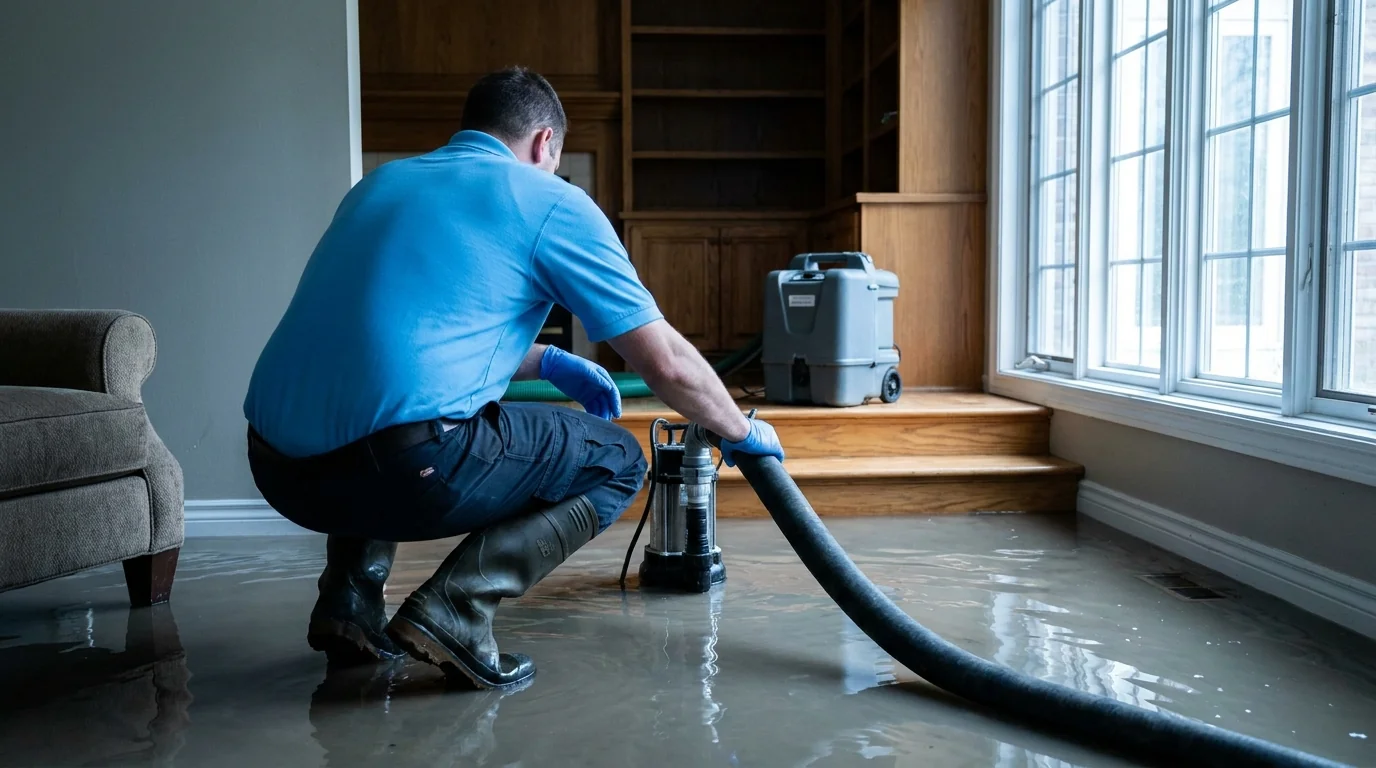
Rapid assessment and water extraction come first. We use truck-mounted and portable extraction units to remove standing water from basements, finished living areas, and crawl spaces. In older homes with original hardwood subfloors, common in the pre-war stock throughout Downtown Highland Park, we probe moisture levels at multiple depths before assuming extraction is complete, because water wicks laterally through tongue-and-groove boards in ways that aren’t visible on the surface.
Structural drying follows extraction. We place industrial dehumidifiers and high-velocity air movers in a calculated pattern based on the square footage and construction type of the affected space. Drying timelines are validated against the IICRC S500 standard, and we log moisture readings daily so you have a documented record for your insurance adjuster.
Affected material removal is handled selectively. Not every wet wall cavity requires demolition. We use thermal imaging and pin-type moisture meters to identify exactly where water has migrated before cutting, which limits unnecessary damage to original plaster, trim, and flooring that would be costly or impossible to replicate in a 1920s bungalow.
Post-drying documentation and scope closes out the mitigation phase and hands off a clear picture to your insurance carrier or, if you’re self-paying, to our reconstruction team.
Reaching Highland Park from Our Kenilworth Office
Our office is in Kenilworth, roughly 12 miles from Highland Park via Route 27 or the Garden State Parkway to Route 1. Because we operate around the clock, we can dispatch at any hour, including during the overnight and early-morning window when pipe failures and storm surges are most likely to go undetected. Highland Park is a compact borough, so once we cross the Landing Lane Bridge or come in from the north, we can reach most addresses quickly regardless of which neighborhood is affected.
Highland Park Insurance Coordination
Flood losses in Highland Park frequently involve both homeowners insurance and separate NFIP (National Flood Insurance Program) flood policies, particularly for properties within the Raritan River’s mapped floodplain. These two policies cover different categories of damage and have different documentation requirements, which can create confusion during an already stressful event. We photograph and document affected materials systematically, separate out categories of loss, and communicate directly with adjusters so the claim process moves forward without requiring you to manage two simultaneous conversations with insurers.
If your property is a multi-unit rental, a common ownership structure in Highland Park given the large number of two-families and the proximity to Rutgers University, we’re accustomed to coordinating access across multiple tenants and keeping the documentation organized by unit.
Local Note
One pattern we’ve seen repeatedly in Highland Park’s finished basements: original 1930s and 1940s concrete block foundation walls absorb floodwater through their cores rather than just at the surface. When water recedes, that moisture stays trapped inside the block cavities and continues releasing humidity into the space for days after the visible flooding is gone. Standard moisture readings taken only at the wall surface will miss this entirely. We take readings at multiple points across the block face and use extended drying protocols on these foundations, skipping that step is one reason some Highland Park basements develop mold weeks after a flood even when the initial cleanup looked complete.
If your home or business in Highland Park has taken on water, whether from the Raritan, a failed drain line, or a backed-up sump, call (855) 650-7422. We’re available 24/7, we’re an IICRC Certified Firm (#210213), and we’re licensed through the NJ Division of Consumer Affairs as a Home Improvement Contractor. The sooner extraction begins, the more of your home’s original materials we can save.
Serving Highland Park from our Fair Lawn headquarters — ★ 4.8 · 166 Google reviews
“Great workers, so nice and efficient! And Ottavio is the best” - Emma, October 2026Read our reviews on Google →
Flood Damage Restoration in Highland Park: Service Coverage
Frequently Asked Questions
How fast can you arrive for flood damage restoration in Highland Park?
Are homes near Donaldson Park and River Road at higher flood risk than the rest of Highland Park?
How quickly can you reach a flood emergency in the Livingston Manor or Triangle neighborhoods?
Highland Park has a lot of pre-war homes with original plaster walls. Does that change how flood drying works?
My Highland Park property is a two-family rental. How do you handle flood restoration across multiple occupied units?
How long does flood drying typically take in a Highland Park basement, and what does the process look like day to day?
Will my homeowners insurance cover flood damage restoration in Highland Park?
Flood Damage Restoration response in Highland Park
Most Highland Park calls see a technician on-site within 60 minutes from our Fair Lawn headquarters.
Nearby & Related
- 24/7 Emergency Flood Damage Restoration in Kenilworth
- Restoration Services in Highland Park
- 24/7 Emergency Fire Damage Restoration in Highland Park
- Mold Remediation in Highland Park
- 24/7 Emergency Flood Damage Restoration in Bayonne
- 24/7 Emergency Flood Damage Restoration in Bloomfield
- Contact The Restoration Group