24/7 Emergency Smoke Damage Restoration in Hillside
24/7 emergency smoke damage restoration in Hillside, NJ. IICRC-certified, insurance billing accepted. Call (855) 650-7422.
Our IICRC-certified technicians are dispatched from our Fair Lawn, NJ headquarters and are typically on-site in Hillside within 60 minutes of your call.
Smoke damage emergency in Hillside? We answer 24/7. Call now and our crew can be on-site within 60 minutes to stop smoke and soot damage from spreading.
When a kitchen fire tears through one of Hillside’s compact 1940s colonials or a two-family on the Saybrook side of town, the smoke doesn’t stop at the room where the flames were. It follows the path of least resistance, up through balloon-framed wall cavities, into finished basements, and deep into the plaster and lathe that line most pre-war homes in the 07205 ZIP code. By the time the fire department clears the scene, soot has already begun bonding to surfaces, and the acrid, oily odor of smoke residue has settled into every porous material in the structure. Fast, methodical smoke damage restoration is the only way to stop that contamination from becoming permanent.
Why Hillside Homes Are Especially Vulnerable to Smoke Damage
Hillside’s housing stock is one of the oldest in Union County. The tight grid of colonials, capes, and postwar two-families that runs from Hillside Center out toward Coe’s Corner was built largely between the 1920s and 1950s, and most of those structures share a few characteristics that make smoke damage harder to contain and clean.
First, balloon framing, common in homes built before the 1950s, lacks the fire-blocking between floors that platform-frame construction provides. When smoke enters a wall cavity, it can travel vertically from the basement to the attic without interruption, depositing fine particulate soot along every stud bay. Second, original plaster walls are far more porous than modern drywall. Smoke penetrates the surface layer and embeds in the brown coat beneath, which means surface wiping alone won’t eliminate the odor. Third, many Hillside basements are finished or semi-finished, adding carpeting, drop ceilings, and drywall that trap smoke particles and hold odor long after the source fire is extinguished.
The Route 22 corridor and the Conant Street industrial area also generate a different category of loss, commercial warehouse fires, sprinkler-discharge events, and overnight structure fires in mixed-use buildings where smoke spreads across large open floor plates before anyone notices.
Our Smoke Damage Restoration Process in Hillside
Smoke damage restoration isn’t a single step, it’s a sequenced process, and cutting corners on any phase means the odor comes back. As an IICRC Certified Firm (#210213), the work follows established industry protocols from the first walk-through to final clearance.
Step 1, Scope and documentation. We photograph and document every affected surface, cavity, and material before anything is touched. This protects the insurance claim and establishes a baseline for clearance.
Step 2, Controlled demolition of unsalvageable materials. Plaster that has absorbed heavy soot beyond the surface layer, saturated insulation, and charred structural members are removed before any cleaning begins. Attempting to clean over deeply contaminated substrate is one of the most common reasons smoke odor returns months later.
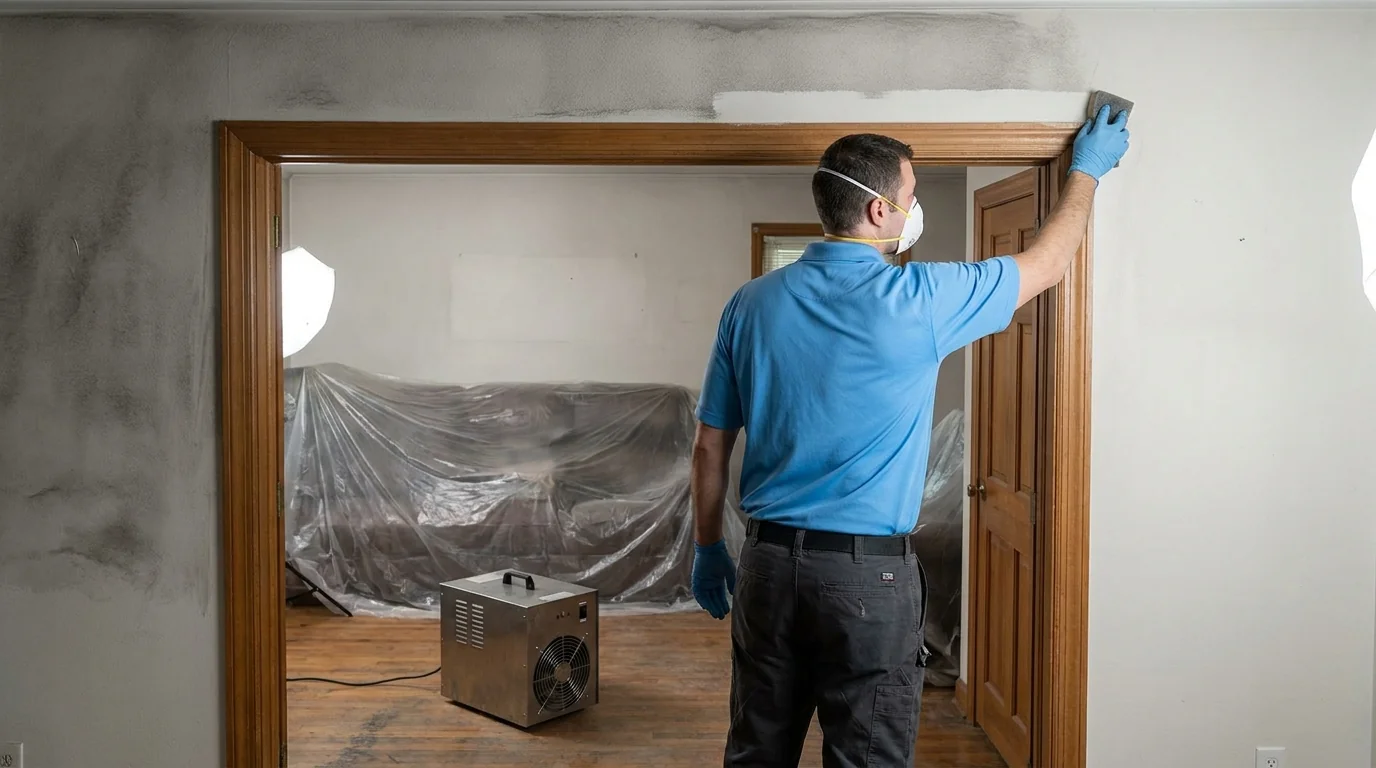
Step 3, Dry and wet chemical sponge cleaning. Soot chemistry varies by fire type, protein fires from kitchen grease behave differently than synthetic fires from furniture or electrical components. We match the cleaning agent to the residue type rather than applying a single product to every surface.
Step 4, Thermal fogging and hydroxyl treatment. For odor that has penetrated porous materials, plaster, wood framing, subflooring, thermal fogging or hydroxyl generation neutralizes odor molecules rather than masking them. In Hillside’s older homes, this step is rarely optional.
Step 5, HEPA air scrubbing and final inspection. HEPA-filtered air scrubbers run continuously through the restoration to capture fine particulate before the space is re-occupied.
Reaching Hillside from Kenilworth
The Restoration Group is based in Kenilworth, which puts Hillside roughly 10 to 15 minutes away depending on traffic on Route 22 or Garden State Parkway access. Because the team operates 24/7, a call at 2 a.m. after a kitchen fire gets the same response as a call at noon, crews mobilize from Kenilworth and can be on-site in Hillside quickly, whether the loss is in a residential neighborhood near Evergreen Cemetery or a commercial property along the Route 22 retail corridor.
Insurance Coordination for Hillside Property Owners
Most homeowners’ policies cover smoke damage as part of a fire loss, but the documentation requirements vary by carrier. Hillside’s older homes sometimes complicate claims because adjusters unfamiliar with plaster construction may underestimate the scope of odor penetration or the cost of matching original trim and molding profiles during reconstruction.
The Restoration Group documents losses in the format most carriers accept, itemized line-item estimates, moisture and soot readings, photo logs, and material samples when needed. We work directly with your adjuster and can explain why, in a 1940s Hillside colonial, the restoration scope is legitimately broader than it would be in a newer home.
Local Note
In Hillside’s older colonials and two-families, particularly those in the Winans and Conant neighborhoods, interior walls are often true plaster over wood lathe rather than gypsum drywall. Plaster absorbs smoke odor at multiple layers: the finish coat, the brown coat, and sometimes the scratch coat beneath. A surface wipe that would clear odor in a newer home won’t reach the contamination in plaster construction. When we scope a smoke loss in one of these homes, we probe wall cavities and test multiple depths before finalizing a cleaning plan, because the difference between a thorough job and a callback six months later is often what’s happening two inches behind the wall surface.
If you’ve had a fire in a Hillside property and the smell hasn’t cleared after initial cleanup, that’s almost always why, and it’s a solvable problem. Call (855) 650-7422 any time, day or night, and we’ll assess the full scope of smoke penetration before recommending a course of action.
Serving Hillside from our Fair Lawn headquarters — ★ 4.8 · 167 Google reviews
“Well, the restoration group I would say they are always prompt in terms of arriving on time. they came and They did what they had to do. very friendly and they were able to explain to me the process what they were doing and what it was for. I did appreciate that. most importantly I needed to get a…” - Viergina, September 2026Read our reviews on Google →
Smoke Damage Restoration in Hillside: Service Coverage
Frequently Asked Questions
How fast can you arrive for smoke damage restoration in Hillside?
How quickly can The Restoration Group reach a home in Hillside after a fire?
Hillside has a lot of older plaster-wall homes — does that change how smoke damage is cleaned?
Are commercial properties along the Conant Street industrial area or Route 22 corridor handled differently than residential losses?
My Hillside home had a kitchen fire and the smell is still there two weeks later — is that fixable?
Will my homeowner's insurance cover smoke damage restoration in Hillside, and does the age of the home affect the claim?
Smoke Damage Restoration response in Hillside
Most Hillside calls see a technician on-site within 60 minutes from our Fair Lawn headquarters.