24/7 Emergency Smoke Damage Restoration in Livingston
24/7 emergency smoke damage restoration in Livingston, NJ. IICRC-certified, insurance billing accepted. Call (855) 650-7422.
Our IICRC-certified technicians are dispatched from our Fair Lawn, NJ headquarters and are typically on-site in Livingston within 60 minutes of your call.
Smoke damage emergency in Livingston? We answer 24/7. Call now and our crew can be on-site within 60 minutes to stop smoke and soot damage from spreading.
A kitchen fire that gets knocked down fast can still leave a Livingston home smelling like a chimney for months. Smoke is deceptive, the visible char gets cleaned up, but fine soot particles migrate through forced-air systems, settle into the plaster and drywall of the town’s many 1960s split-levels, and oxidize into a yellowish residue on ceilings within days. If the house sits in Northland or Collins where post-war construction is dense and homes share close lot lines, a neighbor’s fire can push smoke through soffit vents into your attic insulation before the fire department has even cleared the scene.
Why Livingston Homes Are Particularly Vulnerable to Smoke Damage
Livingston’s housing stock tells the story in layers. The majority of single-family homes were built between 1950 and 1975, an era of plaster-over-lath walls, cellulose attic insulation, and forced hot-air furnaces with ductwork that runs through every room. Smoke doesn’t stay where the fire was. It follows pressure differentials, and in a ranch or split-level, that means soot travels from a basement utility fire straight up through the return-air chase into bedrooms on the upper level.
The wave of teardown McMansions that replaced smaller ranches, particularly on larger lots near Riker Hill and Cedar Hill, adds a different wrinkle. These homes often have finished basements with home theaters, wine cellars, and built-in cabinetry. A single sprinkler discharge or a fire in the mechanical room can push smoke residue into engineered hardwood flooring, fabric wall panels, and custom millwork that is expensive and difficult to restore. Commercial losses follow a similar pattern near the Livingston Mall corridor and the medical campus at Saint Barnabas Medical Center, where suppression system discharges leave behind a combination of smoke residue and chemical suppressant that requires a different cleaning protocol than residential soot.
The chemistry matters too. Livingston’s winters are cold and dry, and residents run heating systems hard from November through March. Soot that settles on cold exterior walls during winter months bonds more aggressively to painted surfaces than it would in warmer conditions, shortening the window during which dry-sponge cleaning alone is effective.
Our Smoke Damage Restoration Process in Livingston
When a call comes in from a 07039 address, the first priority is scoping the smoke migration, not just the room where the fire occurred. On arrival, the crew walks the structure with an air quality monitor and a thermal camera to identify cold spots where soot has penetrated wall cavities. In older plaster homes common to the Squiretown and Northland sections, that step is especially important because plaster is porous in ways that modern drywall is not; soot embeds into the substrate rather than sitting on the surface.
From there, the process follows a defined sequence:
- Containment and HVAC isolation, registers are sealed and the air handler is locked out to prevent recirculation of airborne particulates.
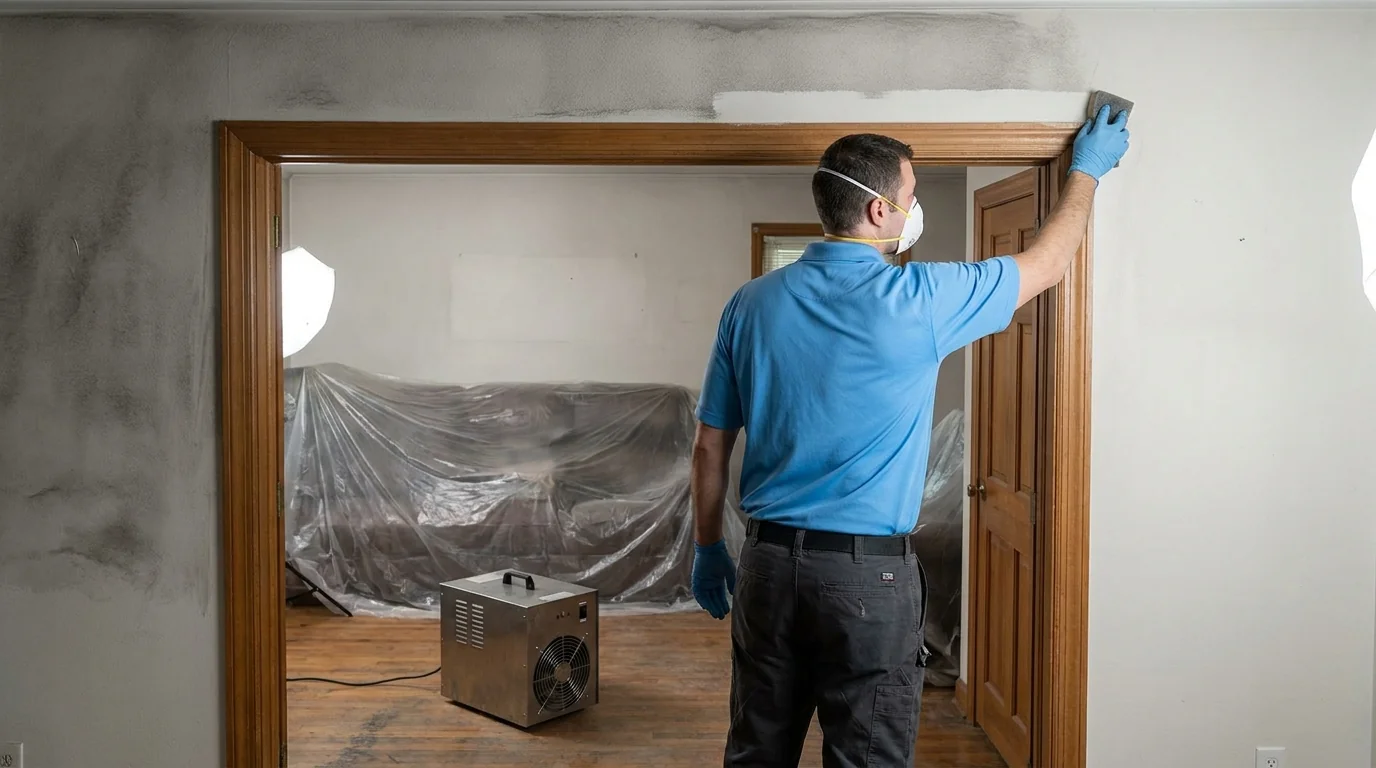
- Dry residue removal, dry chemical sponges lift loose soot from walls, ceilings, and structural surfaces before any wet cleaning begins. Introducing moisture too early smears soot and sets stains permanently.
- Chemical cleaning, alkaline cleaners neutralize acidic smoke residue on hard surfaces; protein-fire residue from kitchen fires requires an enzymatic treatment.
- Duct cleaning and deodorization, forced-air systems are cleaned mechanically and then treated with hydroxyl generators or thermal fogging to break down odor-causing compounds in the ductwork and wall cavities.
- Content pack-out and cleaning, soft goods, clothing, and furnishings are inventoried and transported to a controlled cleaning facility when on-site cleaning is not sufficient.
- Structural repairs and repainting, affected drywall or plaster is repaired, sealed with an odor-blocking primer, and refinished.
As an IICRC Certified Firm (#210213), the work is documented to the S700 standard for smoke and fire damage, which matters when the insurance adjuster reviews the scope.
Reaching Livingston from Kenilworth
The Restoration Group operates out of Kenilworth, and Livingston sits roughly 20 minutes west via Route 22 and I-78 under normal traffic conditions. The team is available around the clock, so a call at 2 a.m. from a home near Memorial Park or the West Essex Trail corridor gets the same response as a midday call. For commercial losses near the Livingston Mall or Saint Barnabas, a larger crew and additional equipment can be staged quickly given the direct highway access from Kenilworth.
Livingston Insurance Coordination
Most smoke damage claims in Livingston are filed under the fire peril of a standard HO-3 homeowners policy. The documentation package, moisture readings, photo logs, scope of work, and itemized content inventory, is prepared in the format carriers expect, which reduces back-and-forth with adjusters and keeps the project timeline on track. For the newer high-value homes in Cedar Hill and Riker Hill where contents values are substantial, a detailed pack-out inventory with condition notes protects the homeowner’s claim from underpayment.
Local Note
One pattern that comes up repeatedly in Livingston’s older split-levels: the return-air duct often runs through an unfinished utility space shared with the water heater and furnace. When a fire starts in that mechanical area, a common ignition point, soot gets pulled directly into the return before the system shuts down. By the time the homeowner notices the smell in the upstairs bedrooms, the ductwork has already distributed fine particulate through the entire house. Crews working in Livingston’s 1960s-era homes check that utility chase first, because missing it means the odor comes back within weeks even after a thorough surface cleaning.
If your home or business in Livingston has smoke damage from a fire, a suppression system discharge, or a neighboring structure fire, call The Restoration Group at (855) 650-7422. The crew is available 24/7, and the sooner soot is addressed, the more of the structure and contents can be saved.
Serving Livingston from our Fair Lawn headquarters — ★ 4.8 · 166 Google reviews
“Great workers, so nice and efficient! And Ottavio is the best” - Emma, October 2026Read our reviews on Google →
Smoke Damage Restoration in Livingston: Service Coverage
Frequently Asked Questions
How fast can you arrive for smoke damage restoration in Livingston?
How quickly can The Restoration Group reach a home in the Northland or Collins sections of Livingston?
Livingston has a lot of 1960s split-levels with plaster walls — does that change how smoke cleanup works?
A fire started in my neighbor's house near Riker Hill Art Park and smoke came through my soffit vents — is that covered under my homeowners policy?
Why does smoke smell come back weeks after a cleaning in Livingston homes with forced-air heating?
Does smoke damage restoration at a commercial property near Livingston Mall require a different process than residential work?
Will my homeowners insurance cover smoke damage restoration in Livingston?
Smoke Damage Restoration response in Livingston
Most Livingston calls see a technician on-site within 60 minutes from our Fair Lawn headquarters.
Nearby & Related
- 24/7 Emergency Smoke Damage Restoration in Kenilworth
- Restoration Services in Livingston
- 24/7 Emergency Fire Damage Restoration in Livingston
- Mold Remediation in Livingston
- 24/7 Emergency Smoke Damage Restoration in Bayonne
- 24/7 Emergency Smoke Damage Restoration in Bloomfield
- Contact The Restoration Group