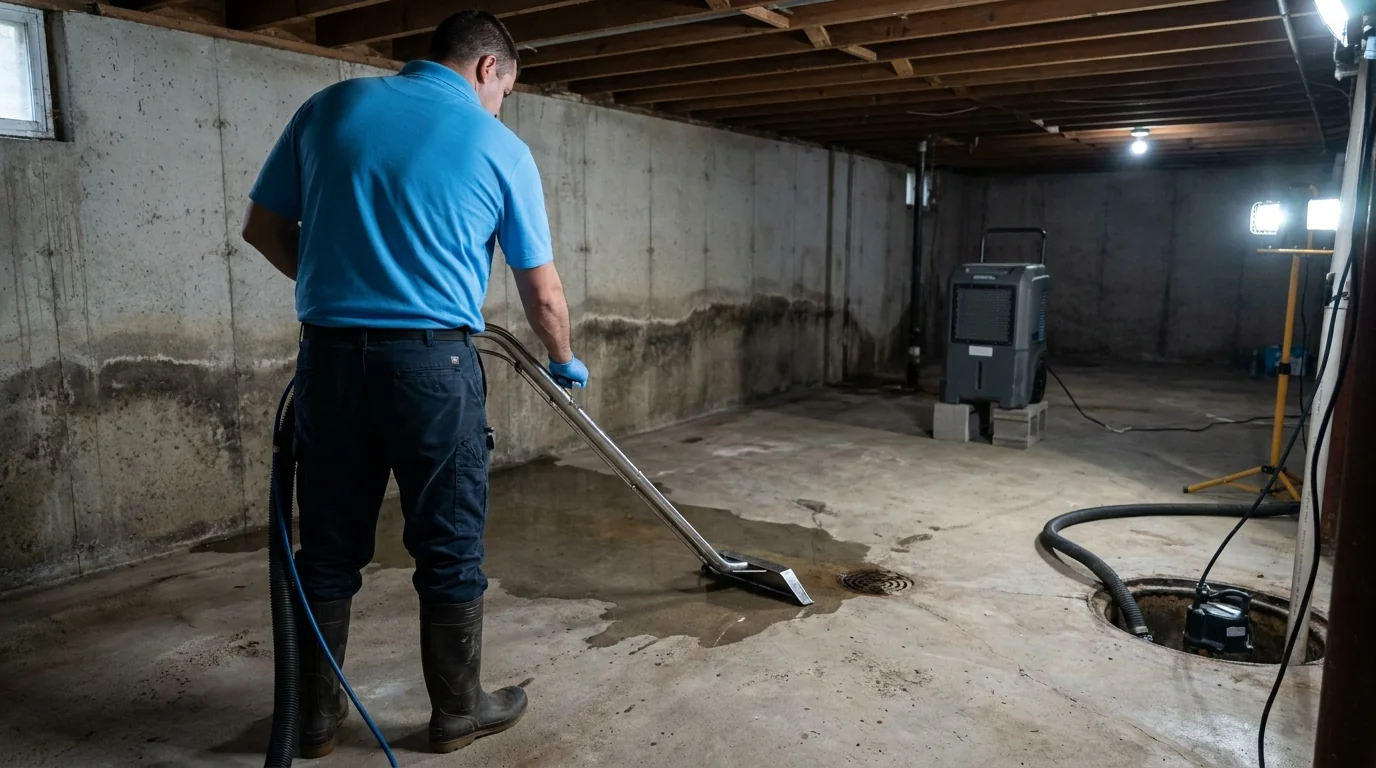
24/7 Emergency Basement Flooding Cleanup in Maplewood
24/7 emergency basement flooding cleanup in Maplewood, NJ. IICRC-certified, insurance billing accepted. Call (855) 650-7422.
Our IICRC-certified technicians are dispatched from our Fair Lawn, NJ headquarters and are typically on-site in Maplewood within 60 minutes of your call.
When the East Branch of the Rahway River swells after a heavy storm, the way it did during Ida in 2021, sending water rushing through Maplewood Village and onto low-lying streets throughout the 07040, basements in this town don’t just get damp, they fill. The Restoration Group responds to flooded basement calls around the clock, and we know what that water is up against when it hits a 1920s stone foundation: original plaster walls, cast-iron drains that back up before the sump even trips, and finished lower levels that homeowners have spent real money on.
Why Maplewood Basements Flood More Than Most
Maplewood’s housing stock is one of the most beautiful in Essex County and one of the most flood-vulnerable. The Tudors, colonials, and craftsman bungalows built between roughly 1910 and 1940, concentrated in neighborhoods like Hilton and Jefferson, were constructed with rubble-stone or poured-concrete foundations that were never designed to hold back the hydrostatic pressure that builds up in New Jersey’s clay-heavy soil after a prolonged rain event. Weeping tile, if it exists at all, is often collapsed or clogged. Sump pits were frequently added decades after original construction and may not be sized for a serious storm.
Beyond groundwater seepage, the aging plumbing in these homes is a second failure point. Knob-and-tube-era supply lines and original cast-iron waste stacks corrode from the inside out. A pinhole in a supply line behind a finished basement wall can saturate framing and insulation for days before anyone notices the musty smell. Add in the fact that many Maplewood homes have converted their basements into living space, home offices, playrooms, in-law suites, and the dollar exposure from a single flooding event climbs fast.
Our Basement Flooding Cleanup Process in Maplewood
When we arrive at a flooded basement in Maplewood, the first priority is stopping active water intrusion if the source is still running, shutting a supply valve, clearing a blocked floor drain, or coordinating with the homeowner on sump pump power. Then we assess standing water depth and begin extraction using truck-mounted and portable wet-vac units capable of pulling hundreds of gallons per hour.
After bulk water removal, the drying phase is where Maplewood homes require extra attention. Original plaster walls, common throughout the Tuscan and The Fields neighborhoods, behave very differently from modern drywall. Plaster is dense and releases absorbed moisture slowly, which means drying timelines run longer than they would in a newer home. We set calibrated desiccant and refrigerant dehumidifiers and position high-velocity air movers to create the airflow patterns the IICRC S500 standard calls for in Category 2 and Category 3 water losses. Moisture readings are logged at every visit so you have a documented drying record, something insurers require and that protects you if a secondary mold issue is ever disputed later.
If flooring, baseboards, or lower sections of wall need to come out to allow structural drying, we document everything photographically before demolition begins. Nothing is removed without your sign-off.
Reaching Maplewood from Kenilworth
Our crews stage out of Kenilworth, which puts us on Route 22 East to I-78 East and into Maplewood in under 30 minutes under normal conditions, faster during off-peak hours. We cover the full township, from the train-station corridor and Maplewood Village commercial blocks to the quieter residential streets that climb toward South Mountain Reservation. Because we operate 24/7, a sump failure at 2 a.m. during a nor’easter gets the same dispatch priority as a midday pipe burst.
Insurance Coordination for Maplewood Homeowners
Basement flooding claims in New Jersey hinge on cause: a sudden pipe failure is typically covered under standard homeowners policies, while gradual seepage or surface flooding from a river overflow may fall under separate flood insurance (NFIP or private). We photograph the loss thoroughly, document water source and migration patterns, and prepare the scope of work in a format that most major carriers accept directly. We can communicate with your adjuster on your behalf, which reduces the back-and-forth that delays drying approvals and prolongs damage.
Local Note: Stone Foundations and Hidden Moisture Migration
One pattern we see repeatedly in Maplewood’s older homes, particularly the Tudors near Maplewood Village and the colonials in the Hilton neighborhood, is moisture that travels horizontally through rubble-stone foundation walls before appearing on the finished side. A homeowner will point to a wet spot on the interior wall and assume the source is directly behind it. Often it isn’t: water entered the foundation 8 to 12 feet away, wicked through the stone and mortar, and emerged at the lowest point of the finished wall. If a restoration crew doesn’t trace the actual migration path with a thermal camera and pin-type moisture meter before setting drying equipment, they’ll dry the visible wet spot and miss the saturated framing cavity next to it. We map the full moisture boundary before any equipment placement.
If your basement has taken on water, whether from the Rahway River backing up, a failed sump, or a burst pipe behind the wall, call The Restoration Group at (855) 650-7422. We’ll assess the damage, explain exactly what needs to happen, and get drying equipment running the same day.
Serving Maplewood from our Fair Lawn headquarters — ★ 4.8 · 166 Google reviews
“Well, the restoration group I would say they are always prompt in terms of arriving on time. they came and They did what they had to do. very friendly and they were able to explain to me the process what they were doing and what it was for. I did appreciate that. most importantly I needed to get a…” - Viergina, September 2026Read our reviews on Google →
Basement Flooding Cleanup in Maplewood: Service Coverage
Frequently Asked Questions
How fast can you arrive for basement flooding cleanup in Maplewood?
Are homes near the East Branch of the Rahway River in Maplewood at higher risk for basement flooding, and does that affect the cleanup process?
How does the original plaster construction in Maplewood's older homes affect basement drying timelines?
My Maplewood home has a stone rubble foundation. Can you dry the basement without tearing out the foundation walls?
Does basement flooding in Maplewood typically fall under homeowners insurance or flood insurance?
How quickly can The Restoration Group reach the Hilton or Jefferson neighborhoods in Maplewood for a flooded basement call?
Basement Flooding Cleanup response in Maplewood
Most Maplewood calls see a technician on-site within 60 minutes from our Fair Lawn headquarters.
Nearby & Related
- 24/7 Emergency Basement Flooding Cleanup in Kenilworth
- Restoration Services in Maplewood
- 24/7 Emergency Fire Damage Restoration in Maplewood
- Mold Remediation in Maplewood
- 24/7 Emergency Basement Flooding Cleanup in Bayonne
- 24/7 Emergency Basement Flooding Cleanup in Bloomfield
- Contact The Restoration Group