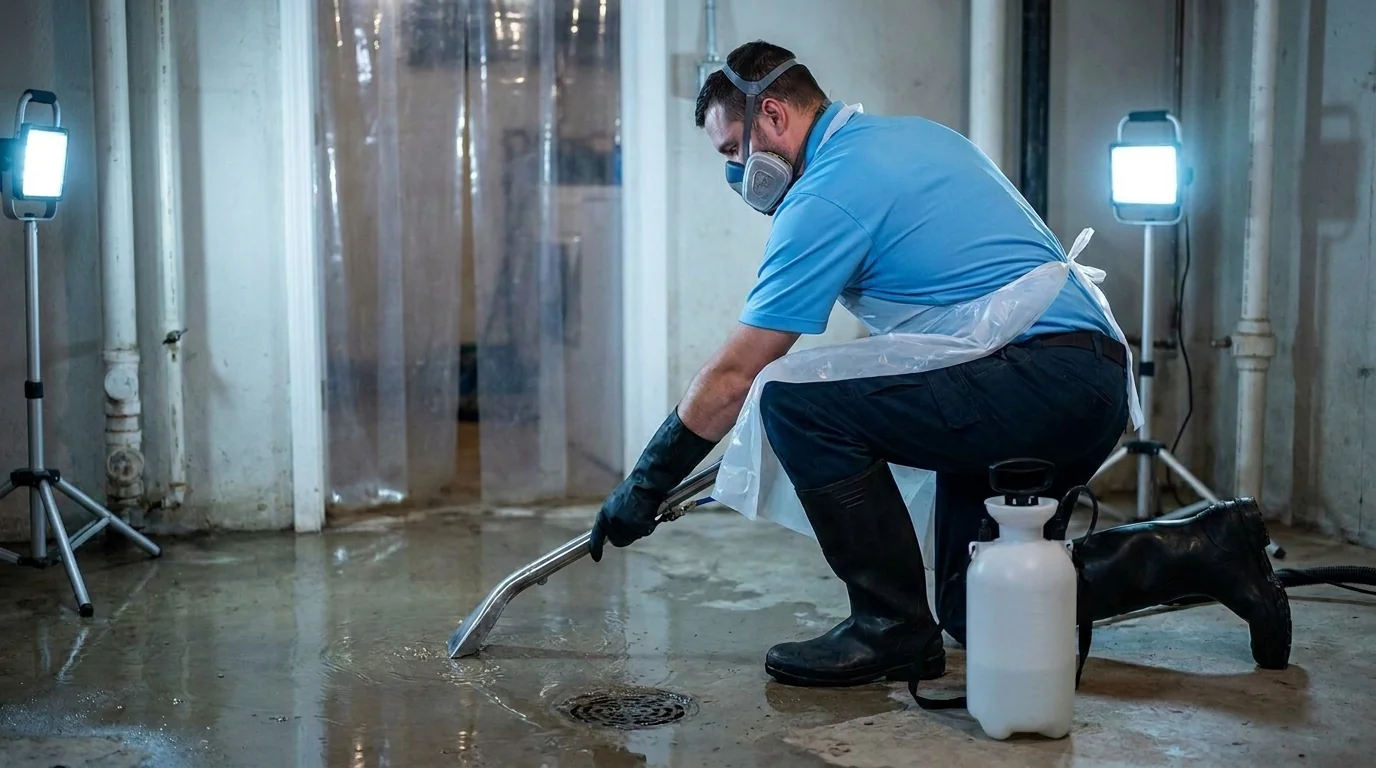
24/7 Emergency Sewage Cleanup and Sanitization in Maplewood
24/7 emergency sewage cleanup and sanitization in Maplewood, NJ. IICRC-certified, insurance billing accepted. Call (855) 650-7422.
Our IICRC-certified technicians are dispatched from our Fair Lawn, NJ headquarters and are typically on-site in Maplewood within 60 minutes of your call.
Sewage backup in Maplewood? We answer 24/7. Call now and our crew can be on-site within 60 minutes to contain the contamination and start the cleanup.
When the East Branch of the Rahway River overtops its banks during a major storm, the way it did through Maplewood Village and the low-lying streets near Memorial Park during Hurricane Ida in 2021, the flooding doesn’t just bring water. It pushes raw sewage backward through floor drains, toilets, and laundry standpipes in the finished basements that are standard in Maplewood’s 1910s–1930s Tudors and colonials. That contamination is a Category 3 biohazard. It requires more than a wet-vac and a fan, it requires a structured extraction, disinfection, and drying protocol handled by people who know what they’re doing. Call The Restoration Group at (855) 650-7422 any time, day or night.
Why Maplewood Homes Are Particularly Vulnerable to Sewage Backups
The housing stock in the 07040 ZIP code is part of what makes Maplewood so architecturally distinctive, and part of what makes sewage events so damaging when they happen. Many homes in the Hilton and Jefferson neighborhoods were built before modern PVC plumbing existed. Their original cast-iron drain lines are now 80 to 100 years old. Cast iron corrodes from the inside out; root intrusion from the mature oaks and maples that line these streets accelerates the process. When a main sewer line partially collapses or a root mass blocks flow, the path of least resistance is backward, into the basement.
Stone foundations common in this housing stock are porous by design. They were built to “breathe,” not to hold back a hydrostatic surge from a saturated yard after a nor’easter. When groundwater and sewer pressure combine, finished basement spaces, the home office, the playroom, the laundry area, take the hit. Original plaster walls and wood subfloors absorb contaminated water quickly, and the contamination spreads further than it looks on the surface.
Septic systems are less common in Maplewood’s denser residential blocks, but homes on larger lots toward the South Mountain Reservation boundary occasionally run private systems. A septic overflow behaves differently from a municipal sewer backup, the tank contents are more concentrated, and the affected area often extends into the yard, but the indoor cleanup protocol is equally rigorous.
Our Sewage Cleanup and Sanitization Process in Maplewood
Every sewage call starts with a containment assessment before anyone moves material around. Tracking Category 3 water through a house, from the basement up the stairs into the kitchen, is a common mistake that turns a contained loss into a whole-house remediation. We establish a contamination boundary first.
From there, the process follows a defined sequence:
- Extraction, Standing sewage and contaminated water is removed using truck-mounted and portable extraction equipment. We don’t leave it to gravity.
- Removal of unsalvageable materials, Saturated drywall, insulation, and flooring that has absorbed Category 3 water cannot be dried in place. It comes out. In Maplewood’s older homes, this often means original hardwood subfloor sections and plaster-over-lath walls that have wicked contamination up into the framing cavity.
- Disinfection, All structural surfaces in the affected area are treated with EPA-registered disinfectants rated for sewage contamination. This is not a general-purpose cleaner, it targets the bacteria, viruses, and pathogens present in raw sewage.
- Drying and dehumidification, Commercial desiccant dehumidifiers and air movers run until moisture readings in structural materials return to baseline. In Maplewood’s plaster-walled basements, this takes longer than it would in a newer home with fiberglass-batted drywall construction.
- Post-remediation verification, We document moisture readings and surface conditions before closing out the job.
As an IICRC Certified Firm (#210213), our process follows the S500 standard for water damage and the guidelines for sewage contamination, not a shortcut version of it.
Reaching Maplewood from Kenilworth
Our Kenilworth headquarters puts us roughly 20 minutes from most Maplewood addresses under normal traffic conditions via Route 22 East to Springfield Avenue. The Tuscan neighborhood and the streets around the Maplewood Train Station are straightforward to access; the narrower side streets in the Hilton area near the Rahway River corridor can slow staging, particularly after a storm event when debris or emergency vehicles are already on scene. We’re available around the clock, sewage doesn’t wait for business hours, so if you’re calling at 2 a.m. after discovering a backup, someone answers.
Maplewood Insurance Coordination for Sewage Losses
Sewer backup coverage in New Jersey is typically a rider on a standard homeowner’s policy, not included in base coverage. Many Maplewood homeowners discover this for the first time when they file a claim. We work directly with your adjuster, providing itemized documentation, moisture logs, photographs, material removal records, and scope of work, that supports your claim file. We bill carriers directly when the policy allows it. If your policy doesn’t include sewer backup coverage, we’ll give you a clear written estimate so you understand the out-of-pocket cost before work begins.
Local Note: What Maplewood’s Plaster Walls Mean for Sewage Cleanup Timelines
In most newer construction, a sewage-affected basement wall is drywall over fiberglass batt, you cut it out, bag it, and the framing behind it dries relatively quickly. In the Tudors and colonials throughout Maplewood Village and the Hilton neighborhood, you’re often dealing with plaster-over-wood-lath construction. Plaster is dense and holds moisture longer than drywall, but the real issue is the lath behind it: thin wood strips that absorb contaminated water and are difficult to dry in place once saturated. In a Category 3 sewage event, saturated lath almost always has to come out. Homeowners are sometimes surprised by the extent of demolition, it looks more aggressive than they expected, but leaving contaminated organic material inside a wall cavity creates a mold problem within days. We explain this before we start cutting, not after.
If you’re dealing with a sewage backup anywhere in Maplewood, whether it’s a sewer line backup in a finished basement off Jefferson Avenue or a septic overflow near the South Mountain Reservation, call (855) 650-7422. We’ll assess the situation, explain the scope, and get the work started.
Serving Maplewood from our Fair Lawn headquarters — ★ 4.8 · 166 Google reviews
“Well, the restoration group I would say they are always prompt in terms of arriving on time. they came and They did what they had to do. very friendly and they were able to explain to me the process what they were doing and what it was for. I did appreciate that. most importantly I needed to get a…” - Viergina, September 2026Read our reviews on Google →
Sewage Cleanup and Sanitization in Maplewood: Service Coverage
Frequently Asked Questions
How fast can you arrive for sewage cleanup and sanitization in Maplewood?
How quickly can The Restoration Group reach the Hilton or Jefferson neighborhoods in Maplewood after a sewage backup call?
Maplewood has a lot of older homes with finished basements — does that change how sewage cleanup is handled?
Does Maplewood's history of Rahway River flooding — like what happened during Ida — make sewer backups more likely during storms?
Is sewage backup covered by standard homeowner's insurance in New Jersey, and how does The Restoration Group help with the claim?
What's the difference between raw sewage removal and standard water damage cleanup, and why does it matter for Maplewood homes?
Sewage Cleanup and Sanitization response in Maplewood
Most Maplewood calls see a technician on-site within 60 minutes from our Fair Lawn headquarters.
Nearby & Related
- 24/7 Emergency Sewage Cleanup and Sanitization in Kenilworth
- Restoration Services in Maplewood
- 24/7 Emergency Fire Damage Restoration in Maplewood
- Mold Remediation in Maplewood
- 24/7 Emergency Sewage Cleanup and Sanitization in Bayonne
- 24/7 Emergency Sewage Cleanup and Sanitization in Bloomfield
- Contact The Restoration Group