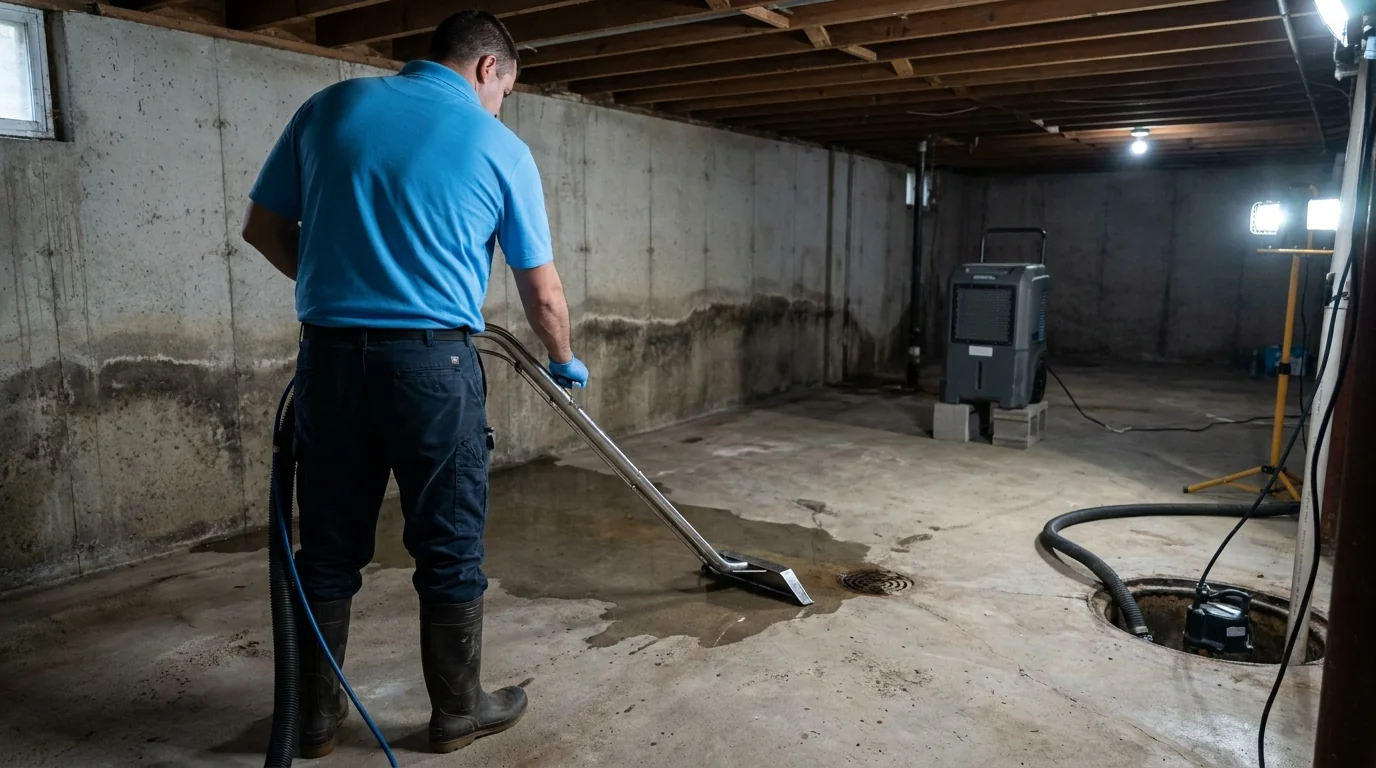
24/7 Emergency Basement Flooding Cleanup in Montclair
24/7 emergency basement flooding cleanup in Montclair, NJ. IICRC-certified, insurance billing accepted. Call (855) 650-7422.
Our IICRC-certified technicians are dispatched from our Fair Lawn, NJ headquarters and are typically on-site in Montclair within 60 minutes of your call.
When the Third River backs up during a hard rain or an aging cast-iron drain finally gives out beneath a century-old Tudor, the water doesn’t wait for business hours. Montclair basements, many of them finished living spaces under Victorians and center-hall colonials built before World War II, can take on inches of water faster than a sump pump can cycle. The Restoration Group responds 24/7, dispatching from Kenilworth with truck-mounted extraction equipment calibrated for the kind of deep, sediment-laden flooding that Montclair’s topography and older housing stock produce.
Why Montclair Properties Flood More Than Neighboring Towns
Montclair sits on the eastern slope of the Watchung ridge, and that hillside grade is the root cause of most basement flooding calls in town. When a significant storm rolls through, the kind Ida delivered in September 2021, stormwater accelerates downhill and overwhelms sump systems in minutes, particularly in lower-lying pockets like Frog Hollow and the South End where the Yantacaw Creek tributaries run close to the surface. Sewer mains in those neighborhoods surcharge under that load, pushing sewage backward through floor drains into finished basements.
The housing stock compounds the problem. Montclair’s grand Victorians and Estate Section colonials were built with cast-iron drain stacks and galvanized supply lines that are now 80 to 120 years old. Cast iron corrodes from the inside out; a line can look intact from the exterior while flaking away internally, until one cold snap or heavy use causes a catastrophic failure. Finished basements, home theaters, in-law suites, home offices, mean that when water enters, it’s not just a concrete floor at stake. It’s framing, drywall, carpet, and personal property.
Our Basement Flooding Cleanup Process in Montclair
The first priority on any flooded basement call is source control. If the water is still entering, whether from a failed sump, a cracked foundation wall, or a backed-up floor drain, we identify and isolate the source before extraction begins. Pumping a basement that’s still taking on water is a losing effort.
Once inflow is stopped, truck-mounted extractors pull standing water fast. For finished spaces, that means careful attention to carpet seams, wall base, and any built-in cabinetry where water wicks upward invisibly. We use thermal imaging cameras to map moisture migration behind plaster and drywall, critical in Montclair’s older homes, where plaster walls can absorb and hold water for days without showing surface staining.
Drying follows a structured protocol aligned with IICRC S500 standards. Refrigerant and desiccant dehumidifiers are placed based on the cubic footage of the affected space, and air movers are positioned to create a drying vortex rather than simply blowing air around. Moisture readings are logged at each visit so you have a documented drying record, something most insurance carriers require before they’ll approve a rebuild estimate.
If the flooding involved sewage backup, common in the South End and Frog Hollow during surcharge events, the cleanup protocol shifts to Category 3 water remediation. That means full PPE, antimicrobial treatment of all affected surfaces, and disposal of porous materials that cannot be safely restored.
Getting to Montclair from Kenilworth
Kenilworth to Montclair runs roughly 12 miles via Route 22 East to the Garden State Parkway north, or through Springfield and Maplewood on local roads depending on traffic. We’re on call around the clock, so whether a pipe bursts at 2 a.m. in Upper Montclair (07043) or a sump fails during a Friday afternoon storm near Watchung Plaza, a crew can be rolling within minutes of your call to (855) 650-7422.
For properties near Montclair State University’s border or along the Bloomfield Avenue corridor, where mixed-use buildings and older retail spaces add commercial complexity, we coordinate staging with property managers and, where needed, confirm access with building superintendents before arrival.
Local Note: Plaster Walls and Hidden Moisture in Montclair’s Older Homes
Here’s something that surprises homeowners in Montclair’s Estate Section and older Upper Montclair neighborhoods: plaster walls dry significantly more slowly than modern drywall, and they do it quietly. A plaster wall can read damp on a moisture meter for five to seven days after the visible water is gone, because the lime-and-sand matrix releases moisture gradually rather than all at once. We account for this by extending the drying phase and taking daily readings rather than pulling equipment on a fixed schedule. Pulling dehumidifiers too early in a plaster-walled basement is one of the most common reasons secondary mold growth appears two weeks after a “completed” job, we’ve seen it in homes near Anderson Park and along the Watchung Plaza district, and we don’t cut that corner.
If your basement has been flooded and you’re not sure whether the drying is truly finished, call (855) 650-7422. As an IICRC Certified Firm (#210213) and NJ Licensed Home Improvement Contractor, The Restoration Group documents every step, moisture logs, photo evidence, and drying reports, so you have what you need for your insurance claim and for your own peace of mind.
Serving Montclair from our Fair Lawn headquarters — ★ 4.8 · 166 Google reviews
“(Translated by Google) Excellent work. The staff were responsible, friendly, and above all, very clean. I was very satisfied and I recommend them 100%. (Original) Excelente trabajo.el personal responsables,amables y sobre todo muy limpios para trabajar .quedé satisfecha y lo recomiendo al 💯.” - Dessy, September 2026Read our reviews on Google →
Basement Flooding Cleanup in Montclair: Service Coverage
Frequently Asked Questions
How fast can you arrive for basement flooding cleanup in Montclair?
Are Frog Hollow and South End basements at higher risk for sewage backup during storms?
How does Montclair's older housing stock affect basement drying timelines?
My home in the 07042 ZIP code has a finished basement — does that change what gets removed versus saved?
What caused so many Montclair basements to flood during Hurricane Ida, and could it happen again?
How do you document basement flooding cleanup for an insurance claim in Montclair?
Basement Flooding Cleanup response in Montclair
Most Montclair calls see a technician on-site within 60 minutes from our Fair Lawn headquarters.
Nearby & Related
- 24/7 Emergency Basement Flooding Cleanup in Kenilworth
- Restoration Services in Montclair
- 24/7 Emergency Fire Damage Restoration in Montclair
- Mold Remediation in Montclair
- 24/7 Emergency Basement Flooding Cleanup in Bayonne
- 24/7 Emergency Basement Flooding Cleanup in Bloomfield
- Contact The Restoration Group