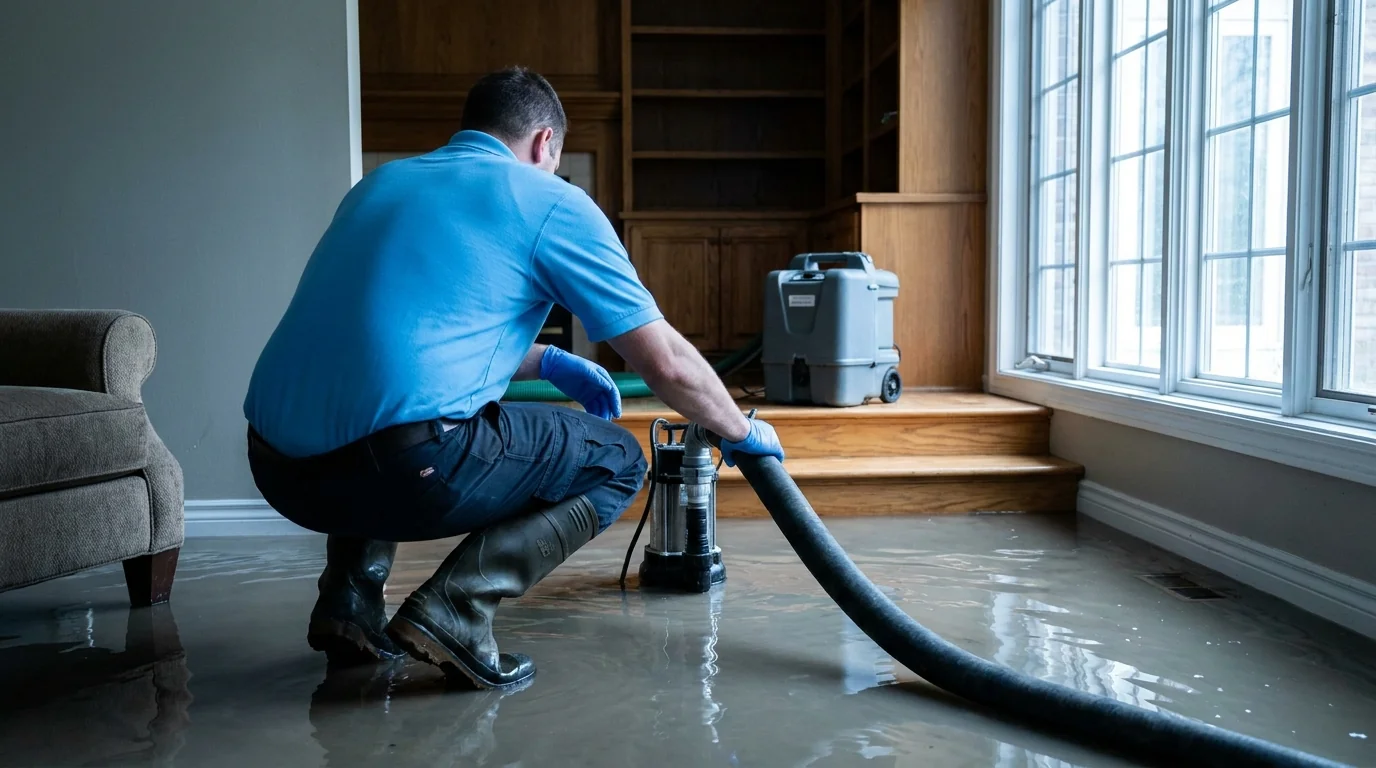
24/7 Emergency Flood Damage Restoration in Montclair
24/7 emergency flood damage restoration in Montclair, NJ. IICRC-certified, insurance billing accepted. Call (855) 650-7422.
Our IICRC-certified technicians are dispatched from our Fair Lawn, NJ headquarters and are typically on-site in Montclair within 60 minutes of your call.
When Tropical Storm Ida tore through Essex County in September 2021, Frog Hollow and the South End bore some of the worst of it, basements filled in minutes, sewer lines backed up into finished lower levels, and the Third River (Yantacaw) jumped its banks with almost no warning. That kind of flooding doesn’t just soak a carpet; it saturates century-old plaster, wicks into the framing of Victorian-era homes, and turns a finished basement into a standing-water hazard within the hour. The Restoration Group responds to flood damage calls in Montclair around the clock, dispatching from Kenilworth with IICRC-certified crews equipped for exactly this kind of loss.
Why Montclair Properties See Flood Damage Differently
Montclair’s housing stock is part of what makes flood losses here more complicated than a typical suburban water claim. The grand Tudors and center-hall colonials in the Estate Section, the Victorians near Watchung Plaza, and the older row-style homes in the South End were built in an era before modern waterproofing membranes and sump redundancy. Many have plaster-and-lath walls that absorb water slowly but release it even more slowly, a wall that reads dry on a surface pin meter can still be holding moisture deep in the substrate weeks after the event.
The topography compounds the problem. Montclair sits on the eastern slope of the Watchung ridge, and storm runoff from higher elevations funnels downhill fast. When a heavy system stalls over the area, that hillside grading overwhelms residential sump pumps in neighborhoods like Upper Montclair before homeowners realize anything is wrong. Cast-iron drain lines common in pre-1950 homes corrode and crack, and sewer backups during high-flow events push contaminated water into finished spaces, a Category 3 loss that requires a different remediation protocol than a clean-water pipe burst.
Our Flood Damage Restoration Process in Montclair
Every flood job starts with a moisture mapping survey before a single piece of equipment is placed. In Montclair’s older homes, that means probing plaster walls, checking beneath original hardwood floors, and inspecting the rim-joist cavities where water migrates invisibly after a basement flood. We photograph and document the full scope before extraction begins, partly because it’s the right way to work, and partly because thorough documentation is what separates a smooth insurance claim from a disputed one.
Extraction comes next: truck-mounted units pull standing water from basements and ground-floor rooms, followed by targeted drying with commercial-grade desiccant and refrigerant dehumidifiers calibrated to the actual cubic footage of the space. Drying timelines in Montclair’s plaster-wall homes routinely run longer than the industry average for drywall construction, plaster releases absorbed moisture gradually, and pulling equipment too early is one of the most common reasons a flood job ends in a mold callback weeks later. We monitor moisture readings daily and don’t close out a drying phase until the numbers hit the IICRC S500 standard for the material type.
For sewer-backup losses, which were widespread after Ida and remain common during heavy rain events along the Yantacaw corridor, affected materials are treated as contaminated. That means antimicrobial treatment, controlled demolition of saturated porous materials, and air scrubbing before any reconstruction begins.
Reaching Montclair from Kenilworth
Kenilworth sits roughly 10 miles southwest of Montclair via Route 22 to the Garden State Parkway or through Springfield Avenue into the township. Our crews are available 24/7, so a call at 2 a.m. after a sump failure in Upper Montclair (07043) or a sewer backup on the South End (07042) gets the same response as a daytime call. We’re familiar with the narrow residential streets near Anderson Park and the tighter access points in Frog Hollow, we stage equipment to avoid blocking driveways or neighboring properties, which matters in a neighborhood where homes sit close together on older lots.
Montclair Insurance Coordination
Flood and water damage claims in Montclair often involve two separate policies: standard homeowners coverage for sudden and accidental discharge (a burst pipe, a failed appliance) and a separate flood insurance policy, either through the NFIP or a private carrier, for ground-surface flooding events. The Ida losses caught many homeowners without flood coverage because they didn’t realize their homeowners policy excluded rising water. We can’t advise on your coverage gaps, but we document losses in the format adjusters need: moisture logs, photo sets, scope reports, and drying records. That documentation is what supports your claim regardless of which policy applies.
Local Note
One thing that catches homeowners off guard in Montclair’s older Victorians and Tudors: original slate roofs and the wide copper gutters common on Estate Section homes can hold standing water at the fascia line during a storm, and that water eventually finds its way through deteriorated flashing into finished attic spaces or top-floor walls. A basement flood after a heavy rain is obvious. Water infiltration at the roofline is often invisible until it shows up as a stain on a plaster ceiling two floors above, or until a moisture probe catches it during a post-flood inspection. We flag those secondary intrusion points when we see them, because a dry basement and a wet attic in the same storm event is a pattern we’ve seen more than once in this town.
If your Montclair home is showing signs of flood damage, standing water, a sewage smell, buckled floors, or walls that feel damp days after a storm, call The Restoration Group at (855) 650-7422. We’ll assess the full scope, start drying immediately, and handle the documentation your insurance carrier will need.
Serving Montclair from our Fair Lawn headquarters — ★ 4.8 · 166 Google reviews
“(Translated by Google) Excellent work. The staff were responsible, friendly, and above all, very clean. I was very satisfied and I recommend them 100%. (Original) Excelente trabajo.el personal responsables,amables y sobre todo muy limpios para trabajar .quedé satisfecha y lo recomiendo al 💯.” - Dessy, September 2026Read our reviews on Google →
Flood Damage Restoration in Montclair: Service Coverage
Frequently Asked Questions
How fast can you arrive for flood damage restoration in Montclair?
Are homes in Frog Hollow and the South End at higher risk for sewer backups during flooding?
How does Montclair's older plaster-wall construction affect flood drying timelines?
Does the hillside grading in Upper Montclair make sump pump failures more likely during storms?
What's the difference between a homeowners insurance claim and a flood insurance claim for a Montclair flood loss?
How quickly can The Restoration Group reach a flood emergency in Montclair?
Flood Damage Restoration response in Montclair
Most Montclair calls see a technician on-site within 60 minutes from our Fair Lawn headquarters.