Contents Restoration & Pack-Out in Newark
24/7 contents restoration & pack-out in Newark, NJ. IICRC-certified, insurance billing accepted. Call (855) 650-7422.
Our IICRC-certified technicians are dispatched from our Fair Lawn, NJ headquarters and are typically on-site in Newark within 60 minutes of your call.
When a basement floods in the Ironbound or a kitchen fire chars the top two floors of a Forest Hill colonial, the damage you see on the walls is rarely the whole story. Furniture, clothing, documents, electronics, and irreplaceable keepsakes absorb smoke, soot, and water in ways that aren’t obvious until the odor returns weeks later or a photograph buckles inside a frame. Contents restoration and pack-out is the discipline of treating those objects, not just the structure, and in a city built on dense pre-war housing stock, getting it right requires a process tuned to Newark’s specific conditions.
Why Newark Properties Face Distinct Contents Challenges
Newark’s housing is overwhelmingly pre-1960 construction: brick multifamily buildings, wood-frame two- and three-families, and the grander colonials that line the streets of Forest Hill. In that kind of stock, a single riser failure can push water through three floors before anyone notices. Combined sewer systems, common across much of the city, back up into ground-floor units during heavy rainfall, leaving furniture and stored belongings exposed to Category 3 contaminated water. Hurricane Ida demonstrated how hard the Ironbound’s low-lying blocks along the Passaic River can flood; basements that took on sewage-laden water require a different decontamination protocol than a clean-water pipe burst.
Smoke behaves differently in dense urban construction as well. When fire travels between closely set buildings, smoke and soot infiltrate neighboring units through shared wall cavities, attic spaces, and HVAC chases, meaning contents in units that never caught fire still carry embedded odor and fine particulate that standard cleaning won’t resolve.
Our Pack-Out and Restoration Process
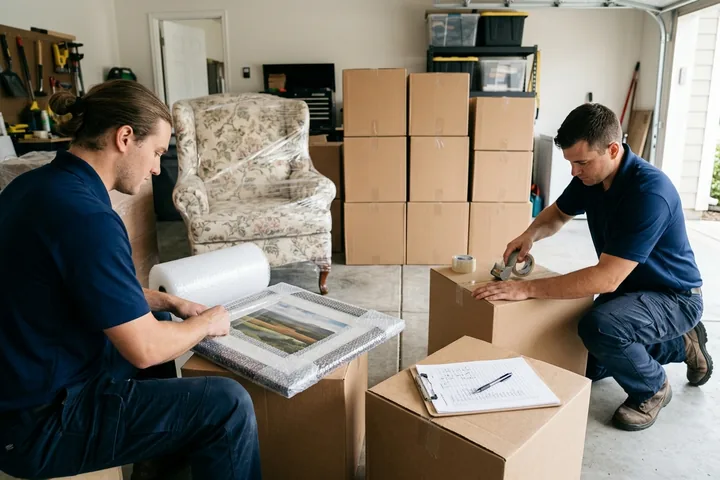
The first step on any Newark job is a room-by-room contents inventory before anything is moved. Every item is photographed, catalogued, and assigned a condition code, this documentation is what your insurance adjuster needs to process a contents claim accurately, and it protects you if questions arise later.
Items that can be safely restored are packed using materials rated for the specific contaminant type, dry-cleaning bags for soot-affected textiles, sealed plastic bins for water-damaged goods, and transported to a climate-controlled facility where the actual restoration work happens off-site. This matters in Newark’s dense neighborhoods, where on-site drying and cleaning space is often limited to a single room or a narrow hallway. Working off-site also keeps the structure accessible for simultaneous structural drying or remediation.
At the facility, contents go through ultrasonic cleaning, ozone or hydroxyl treatment for odor, freeze-drying for documents and photographs, and HEPA-filtered dry-cleaning for textiles. Items that cannot be restored are documented with replacement cost values so your adjuster can process them without dispute. Once the structure is cleared, contents are returned, unwrapped, and placed according to the original inventory.
Reaching Newark from Kenilworth
The Restoration Group operates out of Kenilworth, roughly fifteen minutes from Newark via the Garden State Parkway or McCarter Highway depending on traffic. That proximity matters when a pipe bursts at midnight in a University Heights apartment building or a fire suppression system discharges in a Downtown Newark office, the crew and equipment can be moving before the situation deteriorates further. Because hours are 24/7, there is no waiting until morning to get an assessment started.
For larger properties, the kind of institutional and commercial accounts concentrated near Newark Penn Station and the arena district, we coordinate pack-out logistics in advance so that elevator access, loading dock schedules, and tenant notification requirements are handled before the trucks arrive.
Insurance Documentation for Newark Claims
Contents claims in New Jersey tend to generate more line-item disputes than structural claims, partly because adjusters apply depreciation schedules differently to personal property. The itemized inventory we produce, with photographs, condition codes, and restoration-versus-replacement determinations, is formatted to align with how carriers document contents losses. We work directly with adjusters and can provide supplemental documentation if a scope-of-loss dispute arises mid-claim. Landlords managing multi-unit buildings in ZIP codes like 07105 or 07103 often need separate documentation for each tenant’s belongings; we can structure the inventory accordingly.
Local Note
In Newark’s older brick multifamily buildings, smoke and soot from a fire on one floor routinely migrate into the units above through the gap between the plaster ceiling and the structural floor deck, a space that wasn’t sealed in pre-war construction the way modern fire-stop assemblies require. Residents on unaffected floors sometimes discover weeks later that upholstered furniture and clothing carry embedded odor. If your building had a fire anywhere in the stack, it’s worth having contents on adjacent floors assessed before assuming they’re clean.
If your home or property in Newark has suffered water, fire, or sewage damage and you’re worried about what happens to everything inside, call The Restoration Group at (855) 650-7422. We’ll inventory, pack, restore, and return your belongings, and document every step for your insurance claim.
Serving Newark from our Fair Lawn headquarters — ★ 4.8 · 167 Google reviews
“Well, the restoration group I would say they are always prompt in terms of arriving on time. they came and They did what they had to do. very friendly and they were able to explain to me the process what they were doing and what it was for. I did appreciate that. most importantly I needed to get a…” - Viergina, September 2026Read our reviews on Google →
Contents Restoration & Pack-Out in Newark: Service Coverage
Frequently Asked Questions
How fast can you arrive for contents restoration & pack-out in Newark?
How quickly can The Restoration Group reach the Ironbound for a contents pack-out after a flood?
The Passaic flooded our Forest Hill basement during a heavy storm — are contents salvageable after sewage-contaminated water?
My building near Newark Penn Station has multiple tenant units affected by the same fire — can you inventory each unit separately for insurance purposes?
What happens to documents and photographs during a pack-out — can water-damaged paper records be saved?
Newark's older apartment buildings have units where smoke from a lower-floor fire drifted upstairs — do residents on unaffected floors need a contents assessment?
Contents Restoration & Pack-Out response in Newark
Most Newark calls see a technician on-site within 60 minutes from our Fair Lawn headquarters.