24/7 Emergency Sewage Cleanup and Sanitization in Parsippany
24/7 emergency sewage cleanup and sanitization in Parsippany, NJ. IICRC-certified, insurance billing accepted. Call (844) 808-8838.
Our IICRC-certified technicians are dispatched from our Fair Lawn, NJ headquarters and are typically on-site in Parsippany within 60 minutes of your call.
Dealing with a sewage backup in Parsippany? Call now for emergency service. Sewage cleanup in this township almost always involves one of two patterns: a municipal sanitary line surcharging into a finished basement near the lake communities, or a cast-iron lateral failing under a postwar cape in the older sections of town. Either way, raw sewage carries bacteria and pathogens that spread fast through carpet pad, drywall, and subfloor, and the cleanup has to be handled as a contamination event, not just a water loss.
Why Parsippany Properties See Sewage Backups
Parsippany-Troy Hills sits low along the Whippany River and Troy Brook, and the Lake Hiawatha section in particular took on serious water during Ida, Irene, and Floyd. When those waterways and the stormwater system surcharge during heavy rain, municipal sanitary lines in low-lying blocks can back up through basement floor drains and laundry hookups faster than a sump pump can keep pace. Separately, the ranches and split-levels built around Lake Parsippany and Powder Mill in the 1950s and 60s are reaching the end of their original cast-iron drain life, and a cracked or root-clogged lateral under the slab can send sewage up through a basement bathroom with no storm involved at all. In the tightly spaced Victorian cottages of Mount Tabor, shared or aging lot-line sewer connections add another failure point that’s less common in the newer construction around the Waterview commercial district.
Our Sewage Cleanup and Sanitization Process in Parsippany
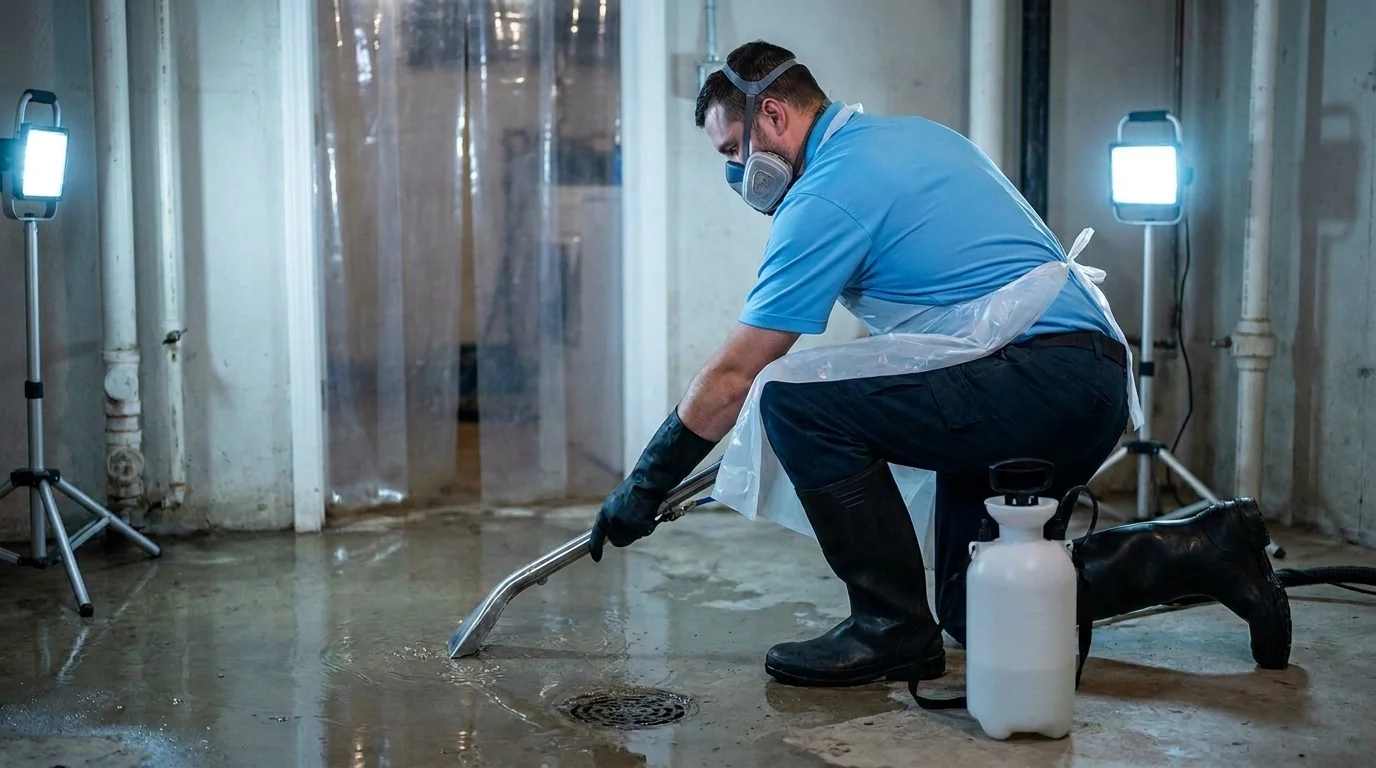
The first step is always identifying the water category correctly. Category 3 water (sewage) requires removal of porous materials it has touched, not just drying them, so affected carpet, pad, and often the bottom few inches of drywall come out rather than get dried in place. We extract standing waste water, remove contaminated materials, and then clean and disinfect the structure, framing, and slab per IICRC S500 guidelines before any drying equipment goes in. In older Parsippany basements with finished rec rooms, that often means pulling paneling or drywall along the full perimeter to check what the water wicked into behind the wall, since cast-iron failures tend to leak slowly for a while before anyone notices the smell. Air scrubbers and negative air setups run through the sanitization phase to manage odor and airborne contaminants while the structure dries.
Reaching Parsippany from Fair Lawn
We run crews out of Fair Lawn into Parsippany regularly, typically via Route 80 or Route 46 into the township, which puts us close to the Waterview corridor and the I-80/287 interchange area without much detour. For calls in Lake Hiawatha, Rainbow Lakes, or Troy Hills, we coordinate directly with whoever’s on-site, homeowner or property manager, to confirm access before the truck arrives, since several of those blocks have narrow driveways or shared access that affect where we can stage extraction equipment.
Local note
One thing that trips up a lot of homeowners in the Lake Parsippany and Lake Hiawatha tracts: a sewage backup tied to a municipal line surcharge during a storm event is typically a sewer backup claim under a homeowner’s policy rider, not a standard flood claim, and the distinction matters for what gets covered. We document the source of the backup, whether it’s a municipal surcharge or a private lateral failure, as part of the sanitization job so that distinction is clear when the claim gets filed.
If sewage has come up through a drain, toilet, or foundation crack anywhere in Parsippany, from a cape near Lake Parsippany to a commercial property off Route 46, treat it as a contamination issue and get it handled before the water sits any longer. We’re IICRC Certified Firm #210213, licensed as a New Jersey Home Improvement Contractor, and we answer 24/7, so call (844) 808-8838 and we’ll get the details needed to respond.
Serving Parsippany from our Fair Lawn headquarters — ★ 4.8 · 171 Google reviews
“Everyone was professional. However the communication was not the best.” - Ashley, November 2026Read our reviews on Google →
Sewage Cleanup and Sanitization in Parsippany: Service Coverage
Frequently Asked Questions
How fast can you arrive for sewage cleanup and sanitization in Parsippany?
How does a Lake Hiawatha home's flood history affect sewage cleanup after a backup?
Are the cast-iron drains common around Lake Parsippany and Powder Mill more prone to sewage backups?
Do Mount Tabor's older homes complicate sewage cleanup access?
What's the difference between a sewage cleanup and a standard water damage job?
Is a sewage backup from a township line surcharge covered differently than a private lateral failure?
Will my homeowners insurance cover sewage cleanup and sanitization in Parsippany?
Sewage Cleanup and Sanitization response in Parsippany
Most Parsippany calls see a technician on-site within 60 minutes from our Fair Lawn headquarters.
Nearby & Related
- 24/7 Emergency Sewage Cleanup and Sanitization in Kenilworth
- Restoration Services in Parsippany
- 24/7 Emergency Fire Damage Restoration in Parsippany
- Mold Remediation in Parsippany
- 24/7 Emergency Sewage Cleanup and Sanitization in Bayonne
- 24/7 Emergency Sewage Cleanup and Sanitization in Bloomfield
- Contact The Restoration Group