24/7 Emergency Water Damage Restoration in Passaic
24/7 emergency water damage restoration in Passaic, NJ. IICRC-certified, insurance billing accepted. Call (855) 650-7422.
Our IICRC-certified technicians are dispatched from our Fair Lawn, NJ headquarters and are typically on-site in Passaic within 60 minutes of your call.
Water damage emergency in Passaic? We answer 24/7. Call now and our crew can be on-site within 60 minutes to stop the water and start drying your property.
The Passaic River has flooded this city twice in living memory, Irene in 2011 swamped riverfront blocks, and Ida in 2021 pushed water into basements and first floors across the city’s low-lying neighborhoods before residents had time to move anything off the floor. But most water damage calls in Passaic 07055 have nothing to do with storms. They come from a cast-iron drain that finally gives out in a century-old three-family on the Third Ward side of town, a sprinkler head that discharges overnight in a Main Avenue storefront, or a slow roof leak that has been soaking the top-floor ceiling joists of a brick walkup for months before anyone notices the stain. When water gets into these buildings, it moves fast and hides deep.
Why Passaic Properties See Water Damage Differently
Passaic is one of New Jersey’s densest small cities, and its housing stock tells the story. The majority of residential buildings were constructed before 1950, two- and three-family frame houses, brick multi-family walkups, and attached rowhomes that were built before modern moisture barriers existed. Knob-and-tube wiring remnants are still found inside wall cavities on older blocks, which means water intrusion near electrical systems requires careful documentation before any drying equipment goes in. Cast-iron drain stacks corrode from the inside out, and when they fail, often without warning, the sewage backup contaminates not just the basement floor but the subfloor framing above it.
The rental density compounds everything. In buildings with four or six units, a leak from a second-floor bathroom can travel through floor assemblies and show up in a first-floor ceiling before the upstairs tenant even knows there’s a problem. Unventilated basements in these buildings are already at elevated humidity; add standing water from a sump failure or a backed-up floor drain, and mold can begin colonizing porous surfaces within 24 to 48 hours.
The Main Avenue commercial corridor adds a different category of loss. Mixed-use storefronts with apartments above them face sprinkler discharge events, roof membrane failures, and HVAC condensate overflows, losses that affect both the commercial tenant below and the residential unit above, often under separate insurance policies.
Our Water Damage Restoration Process in Passaic
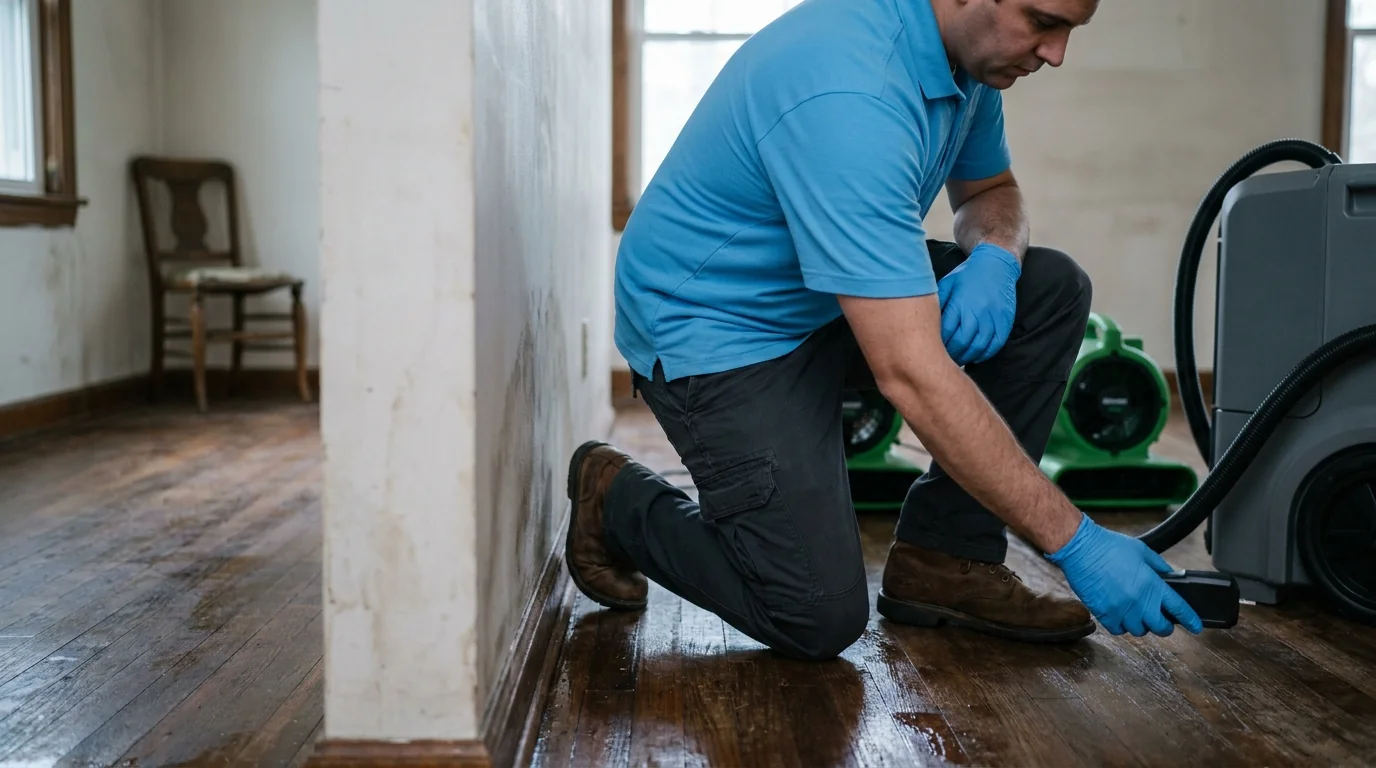
Every job starts with moisture mapping, not assumptions. We use thermal imaging cameras and calibrated moisture meters to trace where water has traveled, inside wall cavities, under flooring, into subfloor assemblies, before a single piece of drying equipment is placed. In Passaic’s older brick and plaster construction, water wicks laterally through masonry and plaster lath in ways that don’t follow the same path it would in modern drywall. Missing that lateral migration is how jobs get closed out too early and mold shows up six weeks later.
Once the affected area is mapped, we extract standing water using truck-mounted and portable extraction units, then establish a drying system calibrated to the specific materials present. Plaster walls, original hardwood flooring, and old-growth dimensional lumber subfloors all have different equilibrium moisture content targets and different drying timelines than modern materials. We monitor daily with logged moisture readings so the drying phase has a documented endpoint, not a guess.
For sewage-involved losses, which are common in Passaic’s aging drain infrastructure, affected materials are treated as Category 3 contamination. That means antimicrobial treatment, controlled demolition of non-salvageable porous materials, and air scrubbing before reconstruction begins.
Reaching Passaic from Kenilworth
The Restoration Group operates out of Kenilworth, NJ, and Passaic is a direct run up Route 9 or the Garden State Parkway to Route 21 North, typically under 30 minutes under normal conditions. We respond 24 hours a day, seven days a week, including overnight and weekend calls. Whether the call comes from a landlord managing a building near Third Ward Park or a property manager handling a commercial loss on the Main Avenue corridor, we dispatch the same way regardless of the hour.
For multi-unit buildings, which describe most of Passaic’s residential stock, we coordinate access with building owners or supers on arrival so we’re not waiting at a locked vestibule while water continues to spread.
Passaic Insurance Coordination
Most standard homeowner and landlord policies cover sudden and accidental water damage; gradual leaks and flood events are treated differently, and Passaic properties near the river may carry separate NFIP flood policies. We document the loss thoroughly from the first hour on-site, photographs, moisture readings, scope of affected materials, in a format that supports your adjuster’s review. We bill carriers directly on most claims, which means you’re not fronting the full cost of emergency services while the claim processes. If your building has multiple units under separate policies, we can help clarify which scope items fall under which coverage.
Local Note
In Passaic’s older multi-family walkups, particularly the brick three-families common in the Fourth Ward and around the Prospect Park border, the interior wall construction often combines plaster over wood lath with no vapor barrier behind it. When water gets into those wall assemblies, the plaster face can feel dry to the touch within a day or two while the lath and stud cavity behind it stays saturated for a week or more. Crews that rely on surface readings alone will call those walls dry when they aren’t. We drill small inspection ports and read deep-cavity moisture before signing off on any wall assembly in these building types.
If water has reached your property in Passaic, whether it’s a burst pipe in a walkup, a sewer backup in a basement rental, or a commercial loss on Main Avenue, call The Restoration Group at (855) 650-7422. We’re available around the clock, and we bring the documentation and drying process that older Passaic buildings actually require.
Serving Passaic from our Fair Lawn headquarters — ★ 4.8 · 166 Google reviews
“Well, the restoration group I would say they are always prompt in terms of arriving on time. they came and They did what they had to do. very friendly and they were able to explain to me the process what they were doing and what it was for. I did appreciate that. most importantly I needed to get a…” - Viergina, September 2026Read our reviews on Google →
Water Damage Restoration in Passaic: Service Coverage
Frequently Asked Questions
How fast can you arrive for water damage restoration in Passaic?
How quickly can The Restoration Group reach a water damage emergency in Passaic?
Are homes in Passaic's Third Ward and Fourth Ward more vulnerable to water damage because of their age?
My Passaic rental property flooded from a sewer backup — is that covered differently than a pipe burst?
How long does structural drying typically take in Passaic's older plaster-wall buildings?
Does flooding near the Passaic River affect what type of insurance claim I should file?
Water Damage Restoration response in Passaic
Most Passaic calls see a technician on-site within 60 minutes from our Fair Lawn headquarters.