24/7 Emergency Flood Damage Restoration in Piscataway
24/7 emergency flood damage restoration in Piscataway, NJ. IICRC-certified, insurance billing accepted. Call (855) 650-7422.
Our IICRC-certified technicians are dispatched from our Fair Lawn, NJ headquarters and are typically on-site in Piscataway within 60 minutes of your call.
Flooding emergency in Piscataway? We answer 24/7. Call now and our crew can be on-site within 60 minutes to pump out the water and stop the damage from spreading.
When the Raritan River crests its banks along River Road, the flooding that follows isn’t a slow seep, it’s a surge that pushes silt-laden water into finished basements, saturates crawl spaces, and soaks the subfloor framing of split-levels and postwar capes before most homeowners realize how far it’s traveled. Piscataway’s position along the river made it one of the hardest-hit communities during Ida in 2021, and the same geography that made Johnson Park a beautiful greenway turns the flatlands east of it into a retention basin when storm systems stall over Central Jersey.
Why Piscataway Properties See Flood Damage Differently
The housing stock here creates complications you won’t find everywhere. Older tracts in Possumtown and the Stelton corridor were built in the postwar decades with galvanized steel supply lines and cast-iron drain stacks, materials that have long since corroded or scaled to near-closure. When a flood event stresses those systems, a pipe that was holding on suddenly isn’t. Finished basements in those same homes were built without modern vapor barriers, so floodwater doesn’t just pool on the floor; it wicks into framed partition walls and insulated ceiling assemblies that were never designed to dry out.
Society Hill’s townhome and condo developments present a different challenge: shared wall assemblies and common mechanical chases mean water that enters one unit can migrate laterally before anyone notices. Structural drying in those buildings requires coordinating access across multiple units and, often, working with HOA management on building-wide moisture mapping before any one owner can close out their claim.
On the commercial side, the Centennial Avenue and Stelton commercial corridors include warehouse and lab-space tenants where an overnight sprinkler discharge or roof-leak event can compromise inventory and sensitive equipment. The Rutgers Livingston and Busch campuses add another layer, student housing sees plumbing failures year-round, and response timing matters when academic schedules are in play.
Our Flood Damage Restoration Process in Piscataway
Every job starts with a full moisture survey, thermal imaging and pin-type meters across every affected surface, because visible water is rarely the whole story. In Piscataway’s older split-levels, we routinely find elevated readings inside wall cavities two rooms away from the visible flood line.
From there, the process follows the IICRC S500 standard for water damage restoration:
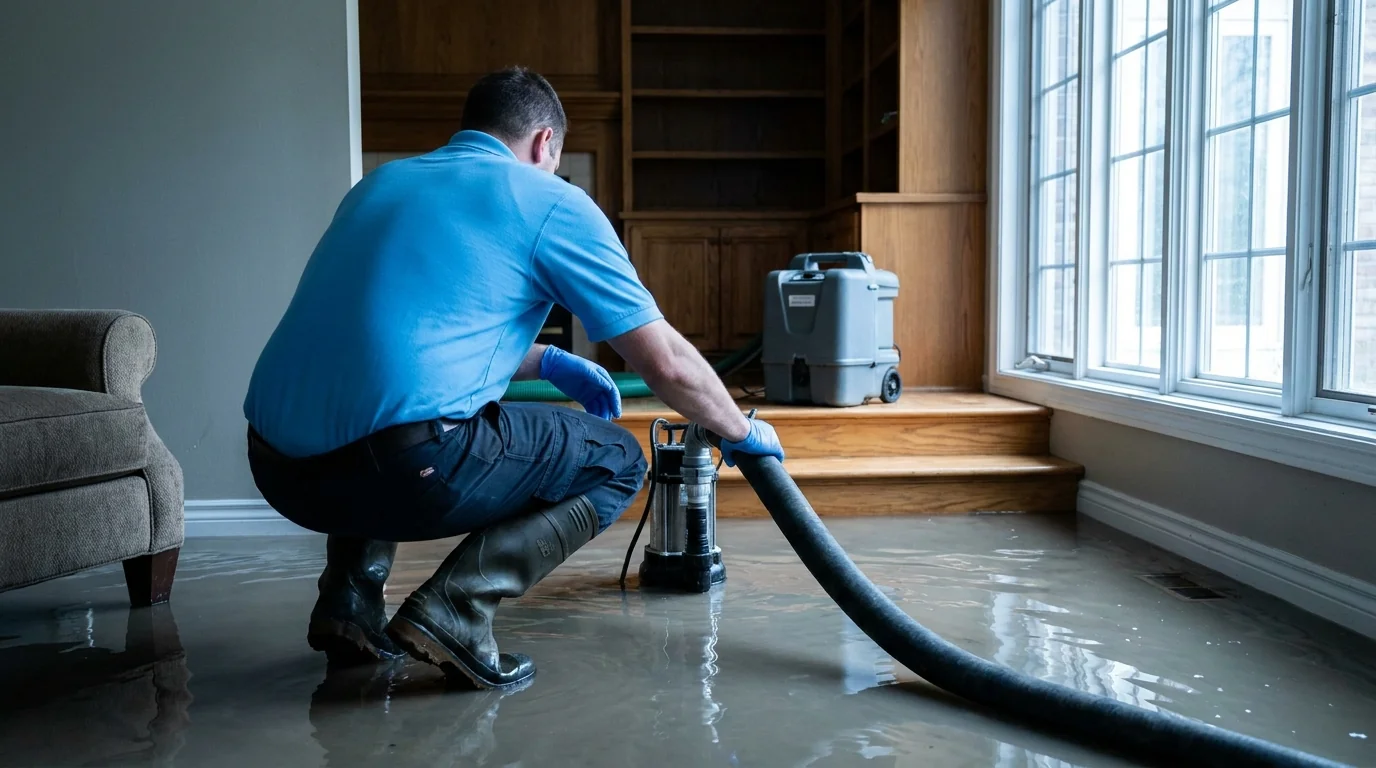
- Water extraction: truck-mounted and portable extractors pull standing water from hard floors, carpet, and subfloor assemblies. In basements with poured concrete slabs, we use weighted extraction tools to draw water from the slab surface before it migrates into block foundation walls.
- Controlled demolition: saturated drywall, insulation, and flooring that cannot be dried in place are removed to the flood cut line, typically 12 inches above the highest moisture reading. This is not cosmetic; it’s how you stop secondary mold colonization, which can begin within 24 to 48 hours in New Jersey’s summer humidity.
- Structural drying: commercial-grade desiccant dehumidifiers and high-velocity air movers run in a calibrated drying system. We log temperature, relative humidity, and material moisture content daily and adjust equipment placement until readings reach dry standard.
- Post-dry verification: before any rebuild begins, we document final moisture readings across all affected materials. That documentation matters for your insurance adjuster and protects you if a moisture-related issue surfaces later.
Reaching Piscataway from Kenilworth
The Restoration Group operates 24/7 out of Kenilworth, NJ, and Piscataway is a direct run down Route 1 or the Garden State Parkway to Route 287. We serve all of Piscataway’s ZIP codes, 08854 and 08855, including River Road addresses that can be tricky to access when local roads flood. If you’re in the Society Hill development or along the Johnson Park corridor and standing water is still present when you call, let us know, we’ll confirm access routes before dispatch.
Piscataway Insurance Coordination
Flood losses in Piscataway often involve both a standard homeowner’s policy (for sudden and accidental discharge) and a separate NFIP flood policy if the property sits in or near a FEMA-mapped floodplain along the Raritan. We document the loss thoroughly, moisture logs, photo evidence, material quantities, and work directly with your adjuster regardless of which policy applies. For Society Hill HOA properties, we’re familiar with the dual-track process of coordinating the unit owner’s claim alongside the association’s master policy.
Local Note
One thing we’ve learned working in Piscataway’s older neighborhoods: cast-iron drain stacks in Possumtown and Stelton-area homes often have decades of scale buildup that restricts flow to a fraction of the original diameter. During a flood event, that means even modest water intrusion can back up into the lowest fixture in the house, usually a basement utility sink or floor drain, long before the main stack shows any sign of trouble. If you’re seeing sewage-tinged water mixed with your flood loss, that’s a combination event that requires a different scope of work and different safety protocols than a clean-water flood alone. Tell us when you call so we can bring the right equipment and PPE from the start.
If your home or property in Piscataway has taken on floodwater, whether from the Raritan, a failed sump, or a storm drain that couldn’t keep up, call The Restoration Group at (855) 650-7422. We’re available around the clock, and the sooner extraction and drying begin, the narrower the window for mold to take hold.
Serving Piscataway from our Fair Lawn headquarters — ★ 4.8 · 166 Google reviews
“Well, the restoration group I would say they are always prompt in terms of arriving on time. they came and They did what they had to do. very friendly and they were able to explain to me the process what they were doing and what it was for. I did appreciate that. most importantly I needed to get a…” - Viergina, September 2026Read our reviews on Google →
Flood Damage Restoration in Piscataway: Service Coverage
Frequently Asked Questions
How fast can you arrive for flood damage restoration in Piscataway?
How quickly can The Restoration Group reach River Road or the Johnson Park area after a Raritan River flood event?
My home in Possumtown has a finished basement with cast-iron drains. Does that affect how you handle a flood cleanup?
I own a unit in Society Hill. Does the HOA complicate the flood restoration process?
My Piscataway home flooded during a storm. How do I know if I need an NFIP flood policy claim versus my homeowner's insurance?
How long does structural drying typically take in a postwar split-level or cape in Piscataway?
Flood Damage Restoration response in Piscataway
Most Piscataway calls see a technician on-site within 60 minutes from our Fair Lawn headquarters.
Nearby & Related
- 24/7 Emergency Flood Damage Restoration in Kenilworth
- Restoration Services in Piscataway
- 24/7 Emergency Fire Damage Restoration in Piscataway
- Mold Remediation in Piscataway
- 24/7 Emergency Flood Damage Restoration in Bayonne
- 24/7 Emergency Flood Damage Restoration in Bloomfield
- Contact The Restoration Group