24/7 Emergency Water Damage Restoration in Piscataway
24/7 emergency water damage restoration in Piscataway, NJ. IICRC-certified, insurance billing accepted. Call (855) 650-7422.
Our IICRC-certified technicians are dispatched from our Fair Lawn, NJ headquarters and are typically on-site in Piscataway within 60 minutes of your call.
Water damage emergency in Piscataway? We answer 24/7. Call now and our crew can be on-site within 60 minutes to stop the water and start drying your property.
The Raritan River doesn’t forget Piscataway. Residents along River Road and in the Johnson Park flatlands still talk about the night Ida rolled through in 2021, basements filling faster than sump pumps could cycle, finished floors buckling before morning. But riverine flooding isn’t the only water story here. Burst galvanized supply lines in postwar split-levels off Stelton Road, sprinkler discharges in the Centennial Avenue warehouse corridor, and slow roof leaks soaking the attics of Society Hill townhomes all generate calls that need a fast, methodical response, not a crew that shows up with a few box fans.
Why Piscataway Properties See Repeated Water Damage
The township’s geography sets up a recurring pattern. The low-lying ground between the Raritan River and Route 1 drains poorly during sustained rain, and homes closest to Johnson Park have flooded in three named storms since 1999. That history matters for drying: saturated clay subsoil stays wet long after standing water is removed, which means moisture continues wicking into slab edges and lower wall cavities for days if drying equipment isn’t positioned correctly.
The housing stock adds its own complications. Tracts built through the 1950s and 60s, common in the Possumtown and Arbor sections, often still have galvanized steel supply lines that corrode from the inside out. A line that looks intact can fail suddenly, dumping water into a finished basement over a weekend. Cast-iron drain stacks in those same homes develop cracks and root intrusion that back up during heavy rain events. When the water finally surfaces, it’s often been traveling through wall cavities for hours before anyone notices.
On the commercial side, the Stelton commercial corridor and the research and warehouse campuses near Rutgers’ Busch and Livingston areas generate a different category of loss: overnight sprinkler activations, HVAC condensate overflows, and roof-membrane failures that saturate drop ceilings and subfloor assemblies across large square footages before staff arrive in the morning.
Our Water Damage Restoration Process in Piscataway
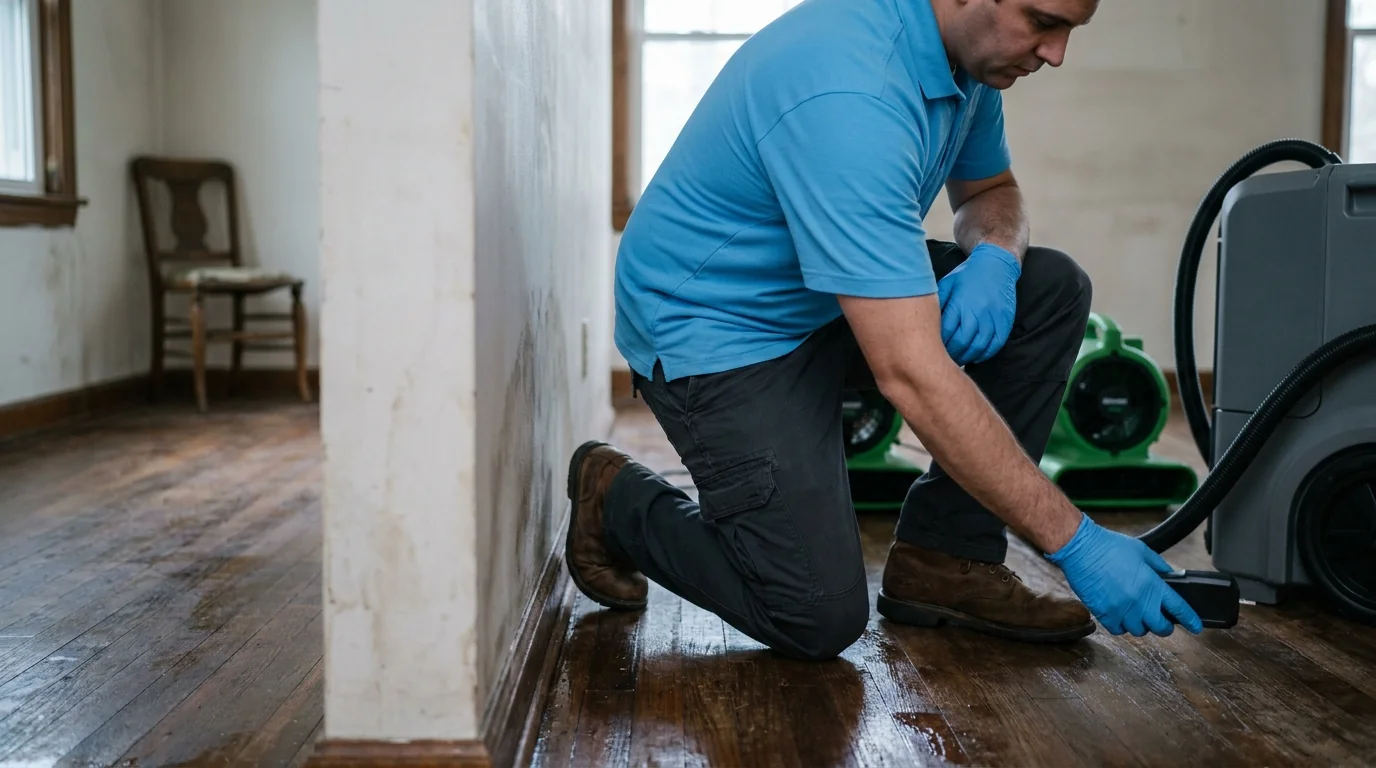
Every job starts with moisture mapping, thermal imaging and calibrated moisture meters across walls, floors, and ceilings to find water that has migrated beyond the visible wet area. In older Piscataway homes with plaster-over-lath construction, this step is especially important: plaster absorbs water more slowly than drywall but releases it slowly too, and a wall that reads dry at the surface can still be holding significant moisture two inches in.
Once the affected zone is defined, water extraction comes first. Truck-mounted extraction units pull standing water and saturated carpet padding quickly; for hard-surface floors with water trapped in the subfloor assembly, we use specialty extraction tools that draw moisture through the flooring material rather than requiring immediate tear-out. Structural drying follows with commercial-grade desiccant or refrigerant dehumidifiers and high-velocity air movers, positioned based on the specific room geometry and material types, not a one-size layout.
We monitor drying progress with daily readings and adjust equipment until materials reach the target moisture content defined by the IICRC S500 standard. Documentation, photos, moisture logs, equipment placement records, is compiled throughout, which matters both for insurance claims and for any permit-required inspections if structural repairs follow.
Reaching Piscataway from Kenilworth
The Restoration Group operates out of Kenilworth, which puts Piscataway well within our regular service corridor. From Kenilworth, crews typically route via Route 28 to the Garden State Parkway south, or cut across to Route 1 depending on traffic and the specific address. Society Hill and the River Road corridor are straightforward runs; addresses near the Rutgers campuses on the Busch side are equally accessible via Hoes Lane or Sutphen Road. Because we’re available around the clock, a call at 2 a.m. after a sump failure gets the same crew response as a mid-morning pipe burst, reach us at (855) 650-7422.
Local Note: What Ida Left Behind in the ZIP
One thing that’s easy to miss on Piscataway jobs in the 08854 ZIP: homes that flooded during Ida and were dried out quickly sometimes have residual moisture trapped behind finished basement walls that were never opened. Owners patched and painted, but the framing behind never fully dried. When we get a call for what looks like a new loss in those areas, we always check for pre-existing elevated moisture readings before scoping the current damage, because billing a new claim for a problem that predates it creates complications with carriers and can affect coverage. It’s a conversation worth having before work starts, not after.
If you’re dealing with water damage anywhere in Piscataway, whether it’s a Possumtown split-level with a failed supply line, a Society Hill condo with an upstairs neighbor’s overflow, or a commercial space in the Stelton corridor after an overnight sprinkler event, call (855) 650-7422. The Restoration Group is IICRC Certified (Firm #210213), licensed by the NJ Division of Consumer Affairs as a Home Improvement Contractor, and available 24/7 to respond, document, and dry.
Serving Piscataway from our Fair Lawn headquarters — ★ 4.8 · 166 Google reviews
“Well, the restoration group I would say they are always prompt in terms of arriving on time. they came and They did what they had to do. very friendly and they were able to explain to me the process what they were doing and what it was for. I did appreciate that. most importantly I needed to get a…” - Viergina, September 2026Read our reviews on Google →
Water Damage Restoration in Piscataway: Service Coverage
Frequently Asked Questions
How fast can you arrive for water damage restoration in Piscataway?
Are homes near the Raritan River in Piscataway harder to dry after a flood?
How quickly can The Restoration Group reach Society Hill or the River Road area of Piscataway?
Do the older split-levels and capes in Possumtown or Arbor require different water extraction methods?
How does water extraction work differently in a large commercial space, like a warehouse or lab building near the Stelton corridor?
Will my insurance cover water damage from a burst pipe in my Piscataway home, and how does the claims process work?
Water Damage Restoration response in Piscataway
Most Piscataway calls see a technician on-site within 60 minutes from our Fair Lawn headquarters.
Nearby & Related
- 24/7 Emergency Water Damage Restoration in Kenilworth
- Restoration Services in Piscataway
- 24/7 Emergency Fire Damage Restoration in Piscataway
- Mold Remediation in Piscataway
- 24/7 Emergency Water Damage Restoration in Bayonne
- 24/7 Emergency Water Damage Restoration in Bloomfield
- Contact The Restoration Group