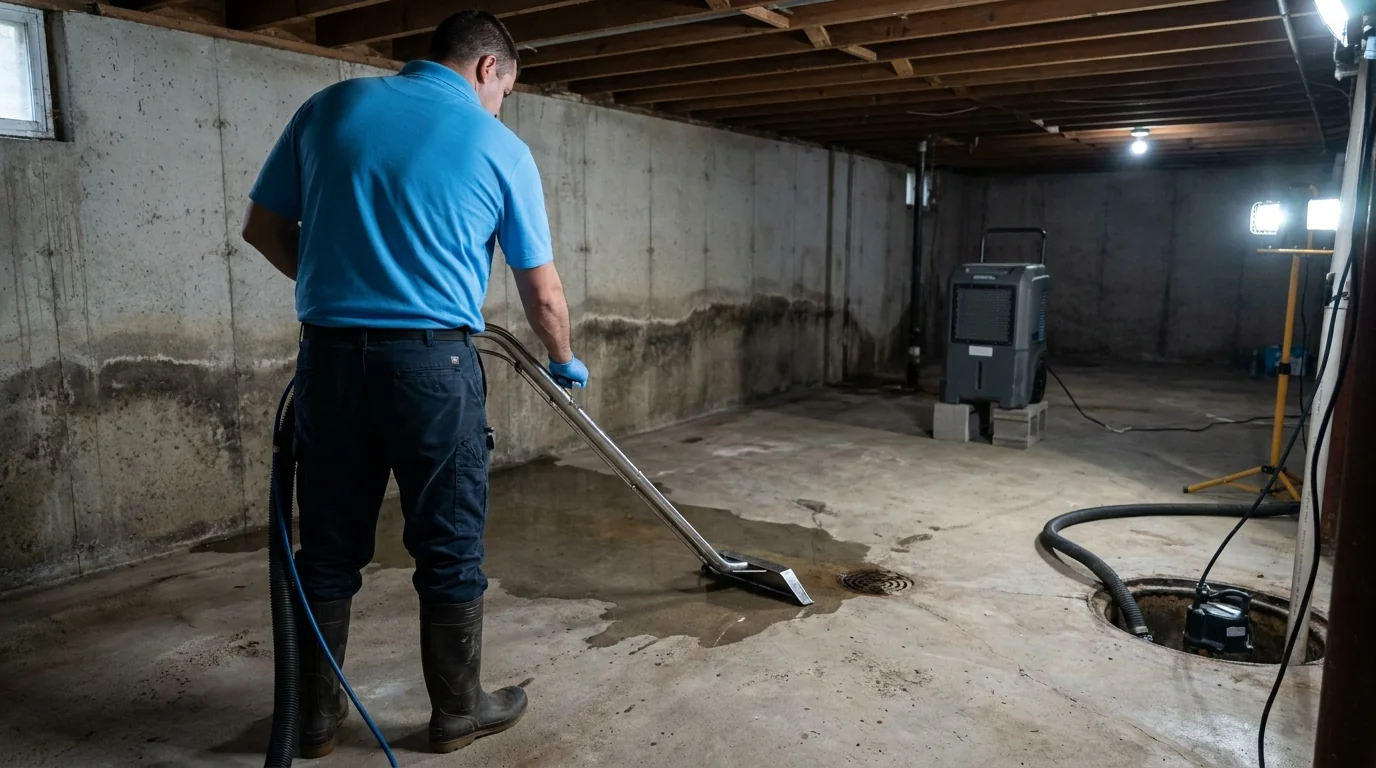
24/7 Emergency Basement Flooding Cleanup in Ridgewood
24/7 emergency basement flooding cleanup in Ridgewood, NJ. IICRC-certified, insurance billing accepted. Call (855) 650-7422.
Our IICRC-certified technicians are dispatched from our Fair Lawn, NJ headquarters and are typically on-site in Ridgewood within 60 minutes of your call.
When the Ho-Ho-Kus Brook overtopped its banks during Hurricane Ida in 2021, basements across Ridgewood filled faster than sump pumps could respond, and many of those basements were finished spaces beneath century-old Victorians and Tudors with stone foundations never designed to hold back that kind of hydrostatic pressure. If you’re dealing with standing water in your basement right now, The Restoration Group is available 24/7 and dispatches from Kenilworth to the 07450 ZIP code around the clock.
Why Ridgewood Basements Flood, and Why They’re Harder to Dry
Ridgewood’s housing stock is part of what makes it one of Bergen County’s most desirable villages, and part of what makes basement flooding here a more complicated problem than in newer suburban developments. The grand colonials and Tudors throughout the Heights and Old Country Club neighborhoods were built in the 1910s through 1940s, with deep, often fully finished basements that homeowners have converted into family rooms, home offices, and in-law suites. Stone rubble and poured concrete foundations from that era develop hairline cracks over decades, and when the water table rises after heavy rain or the Saddle River backs up, water finds every one of them.
Beyond the brook flooding that put Ridgewood on the national news during Ida, the village faces a quieter but equally persistent threat: aging galvanized and cast-iron supply lines inside those same historic homes. A pinhole leak behind a finished basement wall can saturate insulation and framing for weeks before anyone notices the smell. Dense mature tree cover throughout the West Side and Willard neighborhoods also means root intrusion into older clay sewer laterals is a recurring cause of basement backups, a problem that shows up as a drain overflow rather than a dramatic flood, but causes the same category of structural damage.
Our Basement Flooding Cleanup Process in Ridgewood
Every flooded basement job starts with moisture mapping, not guesswork. Before a single piece of equipment is placed, a technician walks the space with a thermal imaging camera and calibrated moisture meters to identify where water has traveled, under tile, behind paneling, into the subfloor above. In Ridgewood’s older finished basements, water routinely wicks into plaster-and-lath partition walls that were never meant to get wet, and those materials hold moisture differently than modern drywall.
Once the scope is documented, we extract standing water using truck-mounted and portable extraction units, then establish a structured drying system calibrated to the actual cubic footage and material types in the space. IICRC S500-compliant drying protocols govern how many air movers and dehumidifiers are placed and how long the system runs, we don’t pull equipment early because the floor feels dry to the touch. Moisture readings are logged at every visit so you have a written record for your insurance adjuster. When contamination is present, from a sewer backup or groundwater intrusion, affected materials are removed, the space is treated with EPA-registered antimicrobials, and clearance readings are documented before any rebuild begins.
Getting to Ridgewood from Kenilworth
From our Kenilworth base, the most direct route to Ridgewood runs north on Route 9W and Garden State Parkway to Route 17 north, putting our crew at the Ridgewood train station area or Van Neste Square in well under an hour under normal conditions. For addresses deeper into the Heights or near the Ridgewood Country Club, we route through Franklin Turnpike to avoid the bottleneck at the downtown East Ridgewood Avenue corridor. Because we operate 24/7, middle-of-the-night calls from homeowners who wake up to a flooded basement don’t wait for a morning shift change, a crew can be en route within the hour.
Ridgewood Insurance Coordination
Most standard homeowners policies cover sudden and accidental water losses, a burst pipe, a failed sump pump, an appliance supply line failure, but exclude gradual seepage and surface water flooding. That distinction matters in Ridgewood, where many losses involve both: a sump pump overwhelmed by brook flooding may be a covered equipment failure even if the underlying cause was rising groundwater. We document the loss thoroughly, photographs, moisture logs, scope of affected materials, and provide your carrier with the structured format adjusters expect. We bill most major carriers directly, which means you’re not fronting the full restoration cost while waiting for a claim to settle.
Local Note
Homes in the Heights and Old Country Club sections of Ridgewood frequently have basement walls finished with original horsehair plaster over wood lath, a material combination that absorbs water slowly but releases it even more slowly during the drying phase. In our experience working in Bergen County’s older housing stock, plaster-and-lath assemblies can require 30 to 50 percent more drying time than modern drywall under identical conditions, and pulling equipment on a standard timeline risks leaving residual moisture that feeds mold growth inside the wall cavity. If your home was built before 1950, tell the technician at the initial assessment, it changes the drying plan.
If water is in your basement right now, call (855) 650-7422. The Restoration Group responds to basement flooding emergencies throughout Ridgewood 24 hours a day, documents everything your insurance carrier needs, and doesn’t consider the job done until the moisture readings confirm it.
Serving Ridgewood from our Fair Lawn headquarters — ★ 4.8 · 166 Google reviews
“Hired the Restoration Group after mold and flood in our house. Their 24 hour line was always available. They came right away and were prompt completing the work. Everyone was friendly.” - Amanda, October 2026Read our reviews on Google →
Basement Flooding Cleanup in Ridgewood: Service Coverage
Frequently Asked Questions
How fast can you arrive for basement flooding cleanup in Ridgewood?
How quickly can The Restoration Group reach a flooded basement in the Heights or Old Country Club area of Ridgewood?
Ridgewood had serious flooding near the Ho-Ho-Kus Brook during Hurricane Ida — does groundwater or brook flooding affect what my insurance covers?
My Ridgewood home was built in the 1920s and has a finished basement with plaster walls. Does that change the drying process?
Is a basement backup from a sewer lateral different from a regular flood, and does it affect cleanup in Ridgewood's older neighborhoods?
How long does basement drying typically take for a finished basement in Ridgewood, and when can I start rebuilding?
Basement Flooding Cleanup response in Ridgewood
Most Ridgewood calls see a technician on-site within 60 minutes from our Fair Lawn headquarters.
Nearby & Related
- 24/7 Emergency Basement Flooding Cleanup in Kenilworth
- Restoration Services in Ridgewood
- 24/7 Emergency Fire Damage Restoration in Ridgewood
- Mold Remediation in Ridgewood
- 24/7 Emergency Basement Flooding Cleanup in Bayonne
- 24/7 Emergency Basement Flooding Cleanup in Bloomfield
- Contact The Restoration Group