24/7 Emergency Storm Damage Restoration in Ridgewood
24/7 emergency storm damage restoration in Ridgewood, NJ. IICRC-certified, insurance billing accepted. Call (855) 650-7422.
Our IICRC-certified technicians are dispatched from our Fair Lawn, NJ headquarters and are typically on-site in Ridgewood within 60 minutes of your call.
Storm damage emergency in Ridgewood? We answer 24/7. Call now and our crew can be on-site within 60 minutes to secure the property and stop further damage.
When Tropical Storm Ida pushed up through Bergen County in September 2021, the Ho-Ho-Kus Brook overtopped its banks and sent water surging into basements along the village’s lower-lying streets, a reminder that Ridgewood’s charm comes with real exposure. The mature oaks and sycamores that shade the Heights and Old Country Club neighborhoods drop limbs onto slate and clay-tile roofs that were never designed to absorb that kind of impact, and a single compromised roof section can soak the plaster ceilings and finished basements of a century-old Tudor before the rain stops. When a storm hits 07450, The Restoration Group responds around the clock, call (855) 650-7422.
Why Ridgewood Properties Face Distinct Storm Damage Risks
Ridgewood’s housing stock is overwhelmingly pre-1950, and that shapes how storm damage behaves here. The grand Victorians and stately colonials near Van Neste Square were built with dense old-growth framing that holds up well structurally, but their original slate roofs, flat porch ceilings, and multi-wythe brick chimneys create specific failure points during nor’easters and fast-moving summer squalls. When a slate tile cracks or a chimney cap dislodges, water follows the path of least resistance, often straight down into a finished basement that took years and significant money to renovate.
The proximity of the Saddle River and Ho-Ho-Kus Brook compounds the problem. Storm surge and flash flooding don’t just enter through the roof; they push up through floor drains and window wells in the low-lying areas near the brook corridor. Homes on streets that feed toward the brook can take on water from two directions simultaneously, top-down from roof damage and bottom-up from groundwater intrusion, which demands a coordinated response rather than a single-trade fix.
Dense tree canopy is the third factor. The West Side and Willard sections of the village have some of Bergen County’s most established tree cover, and large-diameter limbs, or whole trees, landing on roofs, fences, and outbuildings are a routine part of any significant storm event here.
Our Storm Damage Restoration Process in Ridgewood
Every job starts with a full structural and moisture assessment before any materials are moved. In a historic Ridgewood home, that means probing plaster walls and original hardwood floors with non-invasive moisture meters to map the full extent of saturation, because water in a 1920s Tudor travels differently than it does in a 1990s colonial. Plaster is dense and slow to release moisture; if it isn’t fully dried before reconstruction begins, mold colonization can follow within 24 to 48 hours.
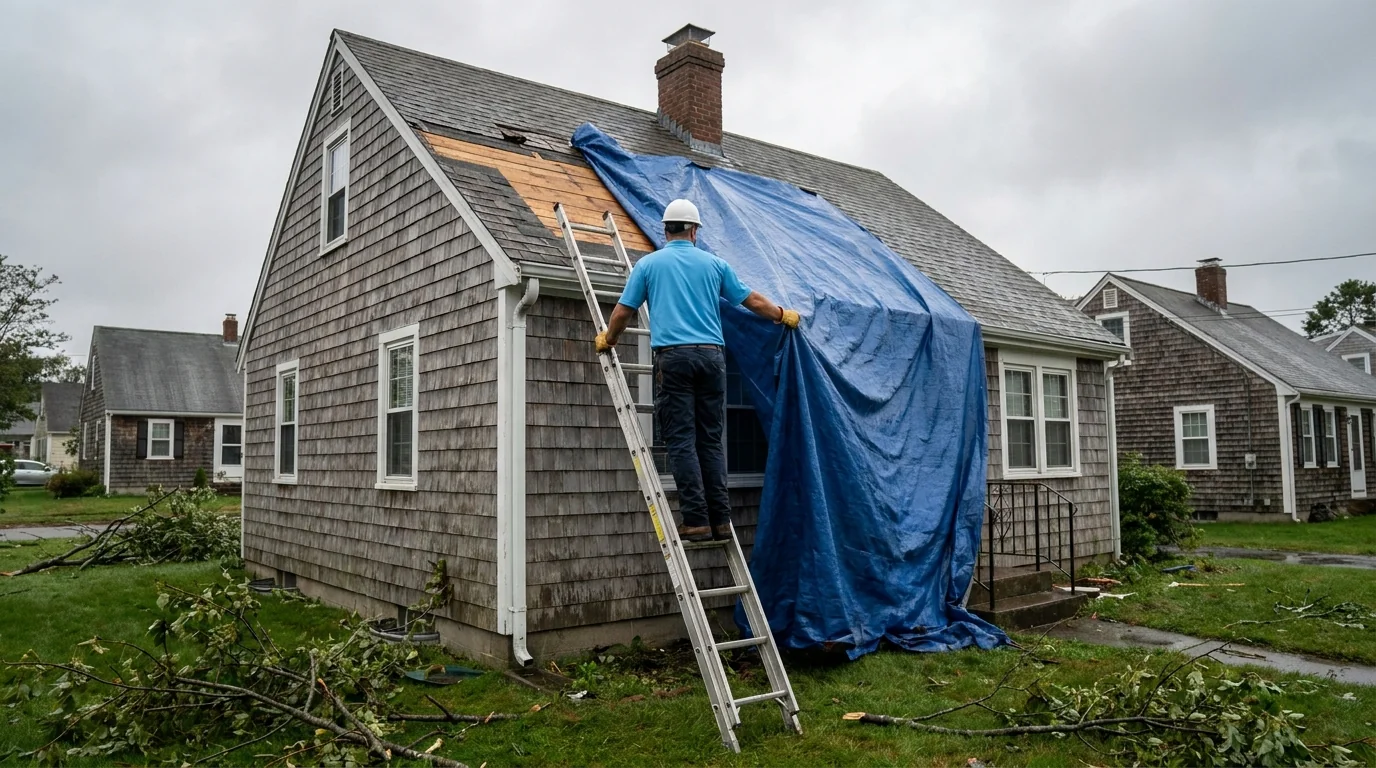
Once the scope is documented, with photographs, moisture readings, and written notes formatted for insurance carriers, we move to emergency stabilization: tarping compromised roof sections, boarding openings left by fallen limbs, and extracting any standing water. Structural drying follows using commercial-grade desiccant dehumidifiers and high-velocity air movers calibrated to the volume and material composition of each space. Our process follows the IICRC S500 and S520 standards, and as an IICRC Certified Firm (#210213), our documentation holds up to carrier scrutiny.
Reconstruction, roofing, framing, drywall, trim, and finish work, is handled under our NJ Licensed Home Improvement Contractor credential, so homeowners deal with one point of contact from first call through final walkthrough.
Reaching Ridgewood from Kenilworth
The Restoration Group is based in Kenilworth, and Ridgewood is a direct run up Route 17 North, typically under 30 minutes in normal traffic conditions. We operate 24/7, so a tree through a roof at 2 a.m. gets the same response as a midday call. For addresses near the Ridgewood train station or the East Ridgewood Avenue corridor, we stage equipment on side streets to avoid blocking the downtown circulation pattern, particularly when multiple crews are working the same storm event across the village.
Ridgewood Insurance Coordination
Storm damage claims in Ridgewood frequently involve multiple coverage lines, wind, flood, and sometimes umbrella policies, because a single event can cause roof damage, interior water intrusion, and basement flooding simultaneously. We document each damage category separately so your adjuster can apply the correct coverage to each line item. For homes in the historic district near Van Neste Square, we also note material specifications (slate, original hardwood, plaster) in the scope of loss, since like-for-like replacement costs more than standard materials and that difference should be reflected in the claim.
Local Note
Homes in the Old Country Club and Heights sections of Ridgewood frequently have original slate roofs that are 80 to 100 years old. After a storm, a slate roof can look intact from the ground while several tiles have cracked or shifted just enough to let water wick under the underlayment. We routinely find active moisture intrusion in attic sheathing on these properties with no visible exterior damage, which is why a post-storm inspection that includes attic access and a thermal imaging pass is standard practice for us on any Ridgewood job, not an upsell.
If your home or business in Ridgewood has taken storm damage, whether it’s a downed limb on a slate roof, a flooded basement near the brook, or wind-driven rain through a failed window seal, call The Restoration Group at (855) 650-7422. We’re available around the clock and can begin emergency stabilization the same day.
Serving Ridgewood from our Fair Lawn headquarters — ★ 4.8 · 166 Google reviews
“Hired the Restoration Group after mold and flood in our house. Their 24 hour line was always available. They came right away and were prompt completing the work. Everyone was friendly.” - Amanda, October 2026Read our reviews on Google →
Storm Damage Restoration in Ridgewood: Service Coverage
Frequently Asked Questions
How fast can you arrive for storm damage restoration in Ridgewood?
How quickly can The Restoration Group reach the Heights or Old Country Club neighborhoods after a major storm?
Ridgewood has a lot of historic homes with original slate roofs — does that change how you approach storm damage restoration?
Our basement flooded during a storm near the Ho-Ho-Kus Brook corridor — is that covered differently than roof damage?
What does the drying process look like inside a plaster-walled Ridgewood home after storm water intrusion?
Can a storm damage claim in Ridgewood cover both the tree removal and the structural repairs to my roof?
Will my homeowners insurance cover storm damage restoration in Ridgewood?
Storm Damage Restoration response in Ridgewood
Most Ridgewood calls see a technician on-site within 60 minutes from our Fair Lawn headquarters.