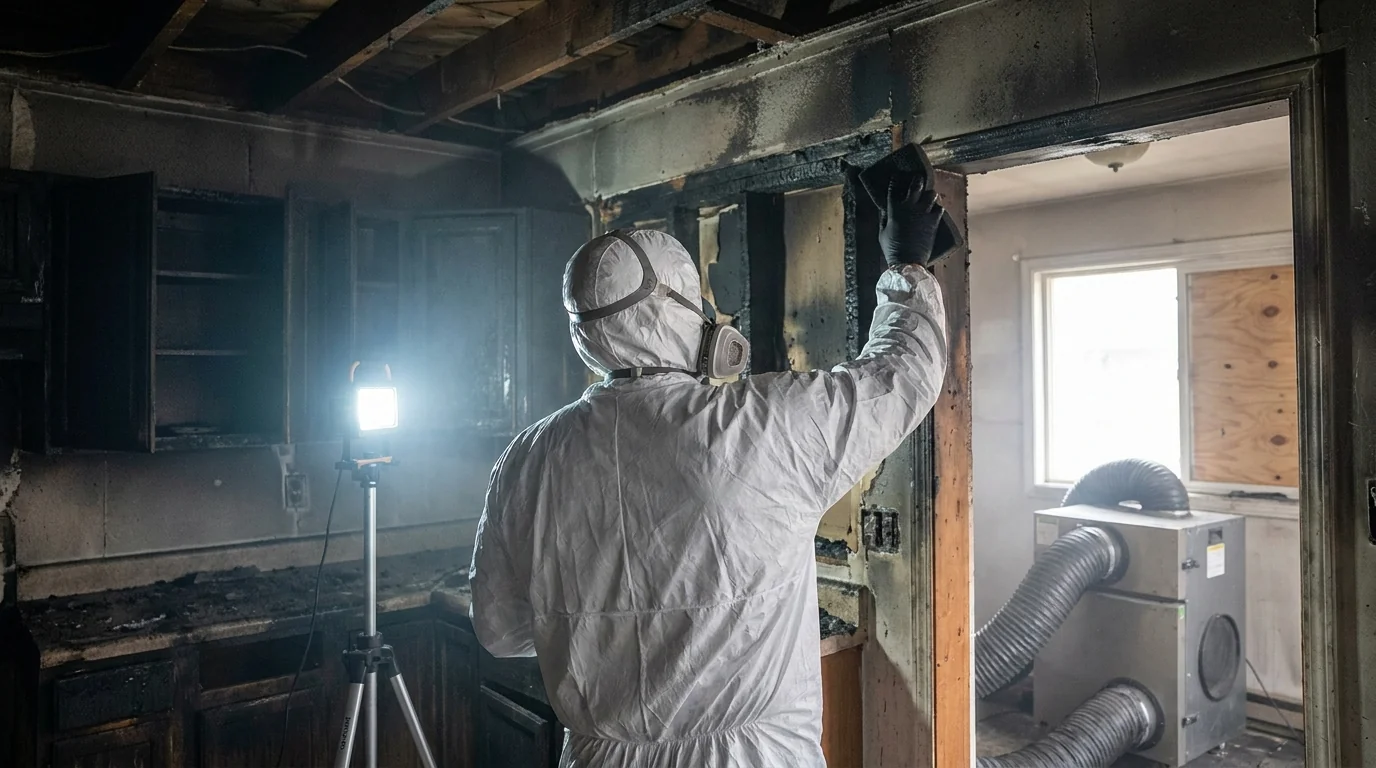
24/7 Emergency Fire Damage Restoration in Staten Island
24/7 emergency fire damage restoration in Staten Island, NY. IICRC-certified, insurance billing accepted. Call (855) 650-7422.
Our IICRC-certified technicians are dispatched from our Fair Lawn, NJ headquarters and are typically on-site in Staten Island within 60 minutes of your call.
Fire damage emergency in Staten Island? We answer 24/7. Call now and our crew can be on-site within 60 minutes to secure the property and start the recovery.
When a kitchen fire tears through a postwar Cape Cod in Great Kills or smoke from an electrical fault saturates the plaster walls of a century-old frame house in Port Richmond, the damage compounds fast, and Staten Island’s dense, mixed-age housing stock means no two fire jobs look alike. Soot migrates through forced-air ductwork within hours, acidic smoke residue begins etching metal fixtures and window glass, and the lingering odor can penetrate the original horsehair plaster found in many pre-1950 homes across the borough. Getting the right crew on-site quickly is the difference between a contained restoration and a full gut.
Why Staten Island Properties See Distinct Fire Damage Challenges
Staten Island’s housing ranges from early-1900s wood-frame colonials near St. George and Port Richmond to dense postwar Cape Cods and split-levels throughout the South Shore, to newer townhome clusters closer to the Staten Island Mall corridor. That variety creates layered fire and smoke damage patterns that differ from borough to borough.
Older homes, particularly those built before 1960, commonly feature original plaster-and-lath wall assemblies, balloon-frame construction, and uninsulated interior cavities. In a balloon-frame house, fire and smoke travel vertically inside the wall cavity from the basement to the attic with almost no resistance, meaning visible char on a first-floor wall may be the smallest part of the story. Smoke odor compounds this: plaster is highly porous and absorbs volatile organic compounds from smoke more aggressively than modern drywall, requiring more aggressive deodorization protocols, thermal fogging, hydroxyl generation, or ozone treatment, rather than surface cleaning alone.
Statens Island’s climate adds another layer. High summer humidity, combined with the moisture introduced during fire suppression, accelerates secondary mold colonization, mold can begin establishing within 24 to 48 hours in wet, soot-contaminated materials. Coordinating fire cleanup and moisture mitigation simultaneously is essential, not sequential.
Our Fire and Smoke Restoration Process on Staten Island
Every job starts with a structured assessment before any debris is moved. We document the full extent of char, smoke migration, and water intrusion from suppression, photographing affected materials room by room, which also creates the foundation of your insurance claim file.
From there, the process follows a defined sequence:
1. Emergency board-up and stabilization. Broken windows, compromised rooflines, and open wall sections are secured to prevent weather intrusion and unauthorized entry, important in densely populated neighborhoods where adjacent properties are close.
2. Controlled demolition of unsalvageable materials. Char-damaged framing, saturated insulation, and smoke-saturated drywall or plaster are removed. In older homes, this phase requires testing for lead paint and asbestos before any disturbance, both are common in Staten Island’s pre-1978 housing stock. Our IICRC Certified Firm (#210213) protocols address hazardous material handling as part of scope.
3. Structural drying. Water from suppression is extracted and affected cavities are dried using commercial desiccant dehumidifiers and air movers. We monitor moisture readings daily until substrates reach target levels.
4. Smoke and soot remediation. Hard surfaces are cleaned with pH-appropriate agents matched to the soot type, wet smoke from slow-burning fires leaves a different residue than dry smoke from fast, high-temperature fires. Ductwork is inspected and cleaned if smoke infiltrated the HVAC system.
5. Deodorization. Odor is treated at the molecular level, not masked. For plaster-heavy homes, we extend dwell times and may run hydroxyl generators over multiple days.
6. Reconstruction. Framing, insulation, drywall, and finishes are rebuilt to pre-loss condition, coordinated with your insurance adjuster’s scope.
Reaching Staten Island from Our Base
The Restoration Group operates 24/7 and maintains crews that can reach Staten Island via the Goethals Bridge or Bayonne Bridge from our Kenilworth, NJ base, with routing adjusted for time of day and traffic on the New Jersey Turnpike approach. For addresses in the 10306 ZIP code, covering New Dorp, South Beach, and the East Shore, we also coordinate with our local contacts familiar with the neighborhood grid. Once on-site, our crews work continuously through assessment and stabilization; we do not schedule and wait.
Insurance Coordination for Staten Island Fire Claims
Fire claims on Staten Island typically run through standard homeowner’s policies, but scope disputes are common, particularly around smoke migration into areas that show no visible char, and odor remediation costs that adjusters sometimes flag as discretionary. We document smoke migration paths, provide moisture and air quality readings, and write itemized scopes that align with Xactimate line items, which most carriers use. We communicate directly with your adjuster throughout the process so you are not translating between two technical parties.
Local Note
In Staten Island’s older frame neighborhoods, Port Richmond, St. George, and parts of New Dorp, balloon-frame construction is more common than most homeowners realize. Unlike platform framing, balloon frames have continuous stud cavities running from the sill plate to the roof rafters, with no fire blocking between floors. After a fire, we probe these cavities with borescope cameras before closing walls, because smoldering material can persist inside a cavity for hours after surface flames are out. It is a step that adds time to the assessment but has prevented rekindles on jobs where the initial fire appeared fully extinguished.
If your home on Staten Island has sustained fire or smoke damage, call The Restoration Group at (855) 650-7422. We answer around the clock, and our crews can mobilize toward the island immediately, whether the fire was in a South Beach townhome or a century-old colonial near the St. George Ferry Terminal.
Serving Staten Island from our Fair Lawn headquarters — ★ 4.8 · 166 Google reviews
“Prompt, knowledgeable, skillful and honest. Highly recommend. They remediated within 24 hours. Total peace of mind restored. Worth every penny.” - Anne, October 2026Read our reviews on Google →
Fire Damage Restoration in Staten Island: Service Coverage
Frequently Asked Questions
How fast can you arrive for fire damage restoration in Staten Island?
How quickly can The Restoration Group reach South Beach or New Dorp after a fire call?
Staten Island has a lot of older homes — does balloon-frame construction change how you handle fire damage?
Do pre-1978 homes in Staten Island require special handling during fire debris removal?
Why does smoke odor persist so long in some Staten Island homes even after visible soot is cleaned?
Will my insurance adjuster accept the scope you write for a Staten Island fire claim?
Fire Damage Restoration response in Staten Island
Most Staten Island calls see a technician on-site within 60 minutes from our Fair Lawn headquarters.
Nearby & Related
- 24/7 Emergency Fire Damage Restoration in Kenilworth
- Restoration Services in Staten Island
- Mold Remediation in Staten Island
- 24/7 Emergency Water Damage Restoration in Staten Island
- 24/7 Emergency Fire Damage Restoration in Bayonne
- 24/7 Emergency Fire Damage Restoration in Bloomfield
- Contact The Restoration Group