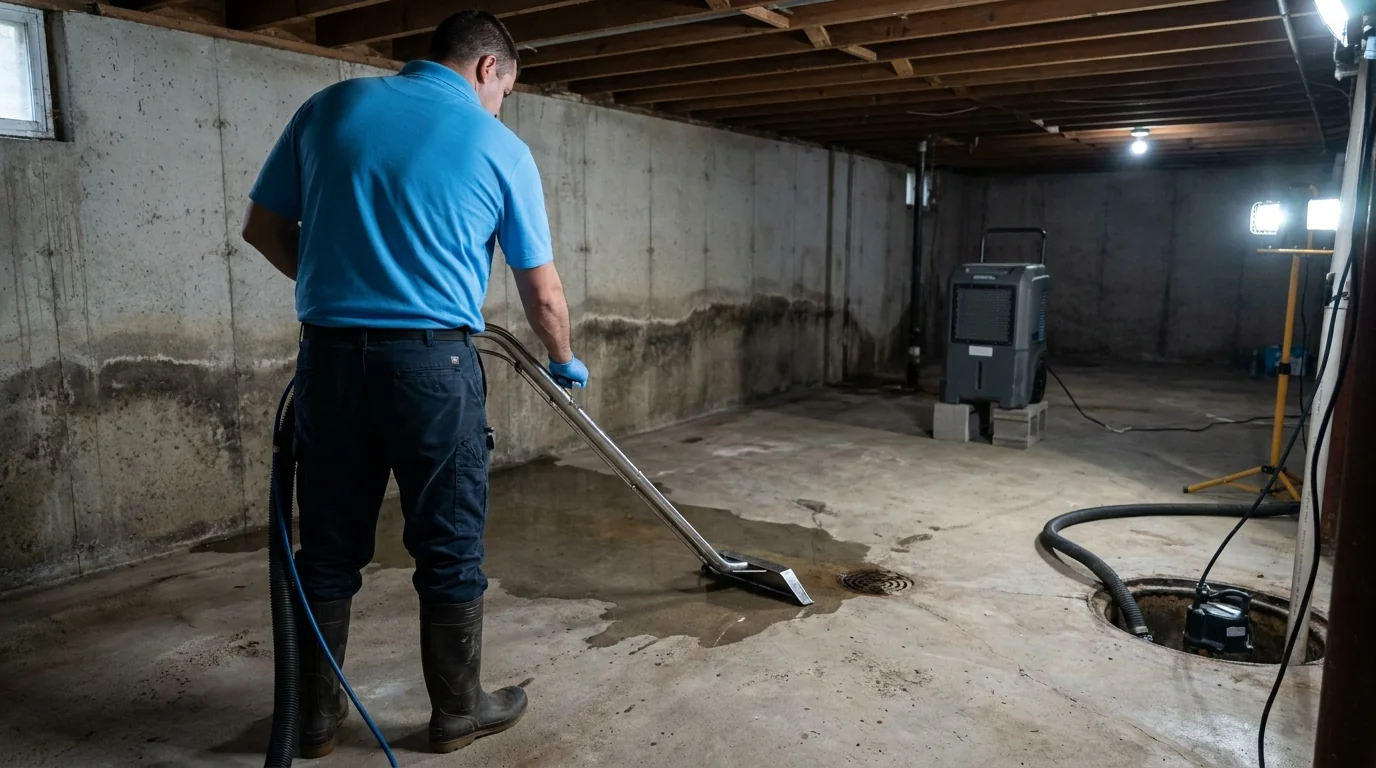
24/7 Emergency Basement Flooding Cleanup in Teaneck
24/7 emergency basement flooding cleanup in Teaneck, NJ. IICRC-certified, insurance billing accepted. Call (855) 650-7422.
Our IICRC-certified technicians are dispatched from our Fair Lawn, NJ headquarters and are typically on-site in Teaneck within 60 minutes of your call.
When Tropical Storm Ida tore through Bergen County in September 2021, finished basements across Teaneck filled in hours, not because of roof failures or burst pipes, but because the Hackensack River and Teaneck Creek backed up simultaneously, overwhelming the township’s combined sewer system and pushing raw water up through floor drains in homes that had stayed dry for decades. If your basement is wet right now, that same geography is likely working against you. The Restoration Group responds 24/7 and can be on-site to begin water removal before standing water migrates into wall cavities and subfloor assemblies.
Why Teaneck Properties See Basement Flooding Issues
Teaneck’s housing stock tells the story before you even look at a weather map. The majority of homes in neighborhoods like West Englewood and The Grange were built between the 1920s and 1940s, brick Tudors, center-hall colonials, and cape-style homes with full basements that were finished long after original construction. Those older basements typically rely on cast-iron floor drains connected to combined sewer lines that carry both stormwater and sanitary waste in the same pipe. When a heavy rain event saturates the ground and the municipal system surges, water doesn’t just seep through foundation walls, it actively backflows through those drains.
The low-lying terrain compounds the problem. Teaneck Creek winds through the western and central portions of the township before draining toward the Hackensack River on the eastern edge. Properties within a few blocks of the creek corridor, including areas near Votee Park and the Bryant School neighborhood, sit in natural collection zones where the water table rises quickly during extended rain. Hydrostatic pressure builds against foundation walls faster here than on higher ground, and even a hairline crack in a poured-concrete or block foundation can admit hundreds of gallons overnight.
Finished basements add a third layer of risk. What looks like drywall and carpet is often a moisture trap, materials that wick water silently for 24 to 48 hours before visible damage appears at the surface. By the time a homeowner notices the smell, microbial growth can already be colonizing the paper face of drywall behind the framing.
Our Basement Flooding Cleanup Process in Teaneck
Every job starts with a moisture mapping inspection before any equipment is staged. We use thermal imaging and calibrated moisture meters to trace exactly how far water has traveled, under slab edges, into wall bases, and beneath any floating floor systems. In Teaneck’s older homes, this step is especially important because original concrete block foundations absorb and redistribute water differently than poured concrete, and the moisture profile inside the block cavities won’t show up on the surface for hours.
Once the scope is documented, truck-mounted extraction removes standing water from the floor. For sewer-backup events, which account for a significant share of Teaneck basement losses, we treat all affected surfaces as a Category 3 contaminated-water loss per the IICRC S500 standard, meaning porous materials that absorbed backflow water are removed rather than dried in place. That includes carpet, pad, and the lower sections of drywall.
Drying follows with commercial-grade desiccant and refrigerant dehumidifiers paired with high-velocity air movers positioned to create a directed airflow pattern through the space. We monitor daily with calibrated readings and adjust equipment placement until the structural materials, framing, subfloor, and remaining wall assemblies, reach target moisture levels. Typical drying cycles in Teaneck basements run three to five days depending on the volume of water and how long it was present before extraction began.
Reaching Teaneck from Kenilworth
The Restoration Group is headquartered in Kenilworth, NJ, and serves Teaneck around the clock. The most direct route runs up Route 9W or the Garden State Parkway to I-80 east, then north on Route 4 into Bergen County, a corridor our crews run regularly for Bergen County losses. Teaneck’s 07666 ZIP code is well within our primary service area, and because we dispatch 24/7, a call placed at 2 a.m. after a sump pump failure gets the same response as a midday call.
For properties near Cedar Lane or along Teaneck Road, access is generally straightforward. Tighter residential blocks in West Teaneck and the Whittier area can require parking coordination for our trailer-mounted equipment, but our dispatch team notes access details when you call so the crew arrives prepared.
Local Note
One pattern we see specifically in Teaneck’s pre-war brick homes: the original cast-iron cleanout plugs on floor drains are sometimes corroded or missing entirely, which means a standard backwater valve cannot be seated without a plumber addressing the cleanout first. If your basement flooded through the floor drain and you’re planning to install a backwater valve as a preventive measure after cleanup, which Bergen County strongly recommends following Ida, confirm the drain condition before the plumber quotes the job. We flag this during our post-drying walkthrough because it affects both the remediation scope and your long-term flood risk.
If your basement is flooded or still holding water, call The Restoration Group at (855) 650-7422. We serve Teaneck and all of Bergen County 24 hours a day, and we’ll walk you through the insurance documentation process from the first call so nothing gets missed before the adjuster arrives.
Serving Teaneck from our Fair Lawn headquarters — ★ 4.8 · 166 Google reviews
“Great workers, so nice and efficient! And Ottavio is the best” - Emma, October 2026Read our reviews on Google →
Basement Flooding Cleanup in Teaneck: Service Coverage
Frequently Asked Questions
How fast can you arrive for basement flooding cleanup in Teaneck?
My basement flooded near Teaneck Creek — is that likely a sewer backup or groundwater intrusion, and does it change what needs to be removed?
How quickly can The Restoration Group reach a flooded basement in West Englewood or The Grange?
Teaneck's older homes often have finished basements with original framing — does that affect the drying timeline?
Will my homeowner's insurance cover basement flooding cleanup in Teaneck, and does it matter whether the water came from the street or a burst pipe?
What equipment do you use for basement water removal, and is it different for Teaneck's slab-on-grade versus full-basement homes?
Basement Flooding Cleanup response in Teaneck
Most Teaneck calls see a technician on-site within 60 minutes from our Fair Lawn headquarters.