24/7 Emergency Storm Damage Restoration in Teaneck
24/7 emergency storm damage restoration in Teaneck, NJ. IICRC-certified, insurance billing accepted. Call (855) 650-7422.
Our IICRC-certified technicians are dispatched from our Fair Lawn, NJ headquarters and are typically on-site in Teaneck within 60 minutes of your call.
Storm damage emergency in Teaneck? We answer 24/7. Call now and our crew can be on-site within 60 minutes to secure the property and stop further damage.
When a nor’easter or fast-moving summer storm rolls through Bergen County, Teaneck’s older housing stock takes the hit differently than newer suburban construction. The 1920s–40s brick Tudors and center-hall colonials that line streets through the Grange and West Englewood were built before modern storm-strapping codes, and their wide canopy trees, gorgeous in October, become projectiles when wind gusts hit 60 mph. Add the low-lying corridors along Teaneck Creek and the Hackensack River, and a single severe weather event can mean a fallen oak through a roof, a flooded finished basement, and a compromised cast-iron drain line all at once. The Restoration Group responds 24/7 and can be on-site in Teaneck from our Kenilworth base to begin stabilizing your property before secondary damage compounds the loss.
Why Teaneck Properties See Disproportionate Storm Damage
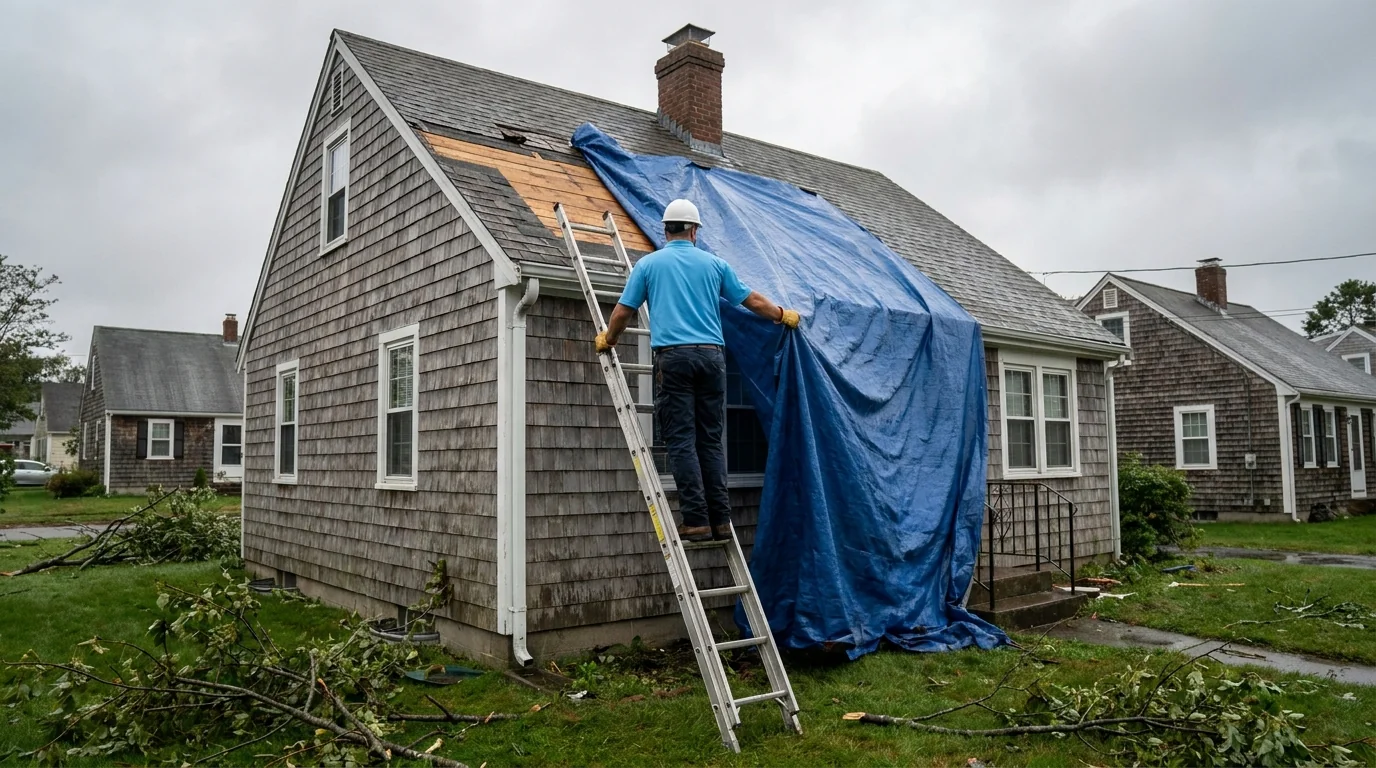
Teaneck’s geography sets it up for layered storm losses. The creek that winds through the Teaneck Creek Conservancy and the low-grade lots east toward the Hackensack River have almost no natural buffer once rainfall exceeds an inch per hour, a threshold Ida crossed dramatically in September 2021, when basements across the 07666 ZIP flooded faster than sump pumps could cycle. But flooding isn’t the only risk. The same mature oak and maple canopy that makes neighborhoods like Whittier and the Bryant School area desirable also means significant tree-fall exposure during high-wind events. A single large limb punching through a roof creates an immediate water intrusion path; if that roof opening isn’t tarped within hours, interior framing, insulation, and plaster ceilings absorb rain and begin the 24–48 hour clock toward mold colonization.
The housing stock itself matters here. Pre-war brick construction is durable against wind but rigid, it doesn’t flex, so mortar joints crack under impact and water migrates laterally through the masonry in ways that don’t show up until days after the storm. Finished basements, common in Teaneck’s mid-century colonials, turn a sewer backup or surface flood into a full contents-and-structure loss rather than a simple slab cleanup.
Our Storm Damage Restoration Process in Teaneck
Every storm job starts with a full-perimeter inspection before any interior work begins. We’re looking at roof decking, fascia, gutters, foundation grading, and any point where water found an entry path. On Teaneck’s older homes, that often means checking masonry joints on the street-facing elevation and probing around chimney flashings, two spots that fail quietly and let water travel inside walls for days before a homeowner notices a stain.
Once the entry points are documented and emergency tarping or board-up is complete, we move to moisture mapping. We use thermal imaging and pin-type meters to trace how far water has migrated into wall cavities, subfloor assemblies, and ceiling joists. For homes with plaster-and-lath construction, still common in the Grange and Cedar Lane district neighborhoods, moisture readings require more probe points because plaster holds water unevenly and can read dry at the surface while the lath behind it stays saturated.
Structural drying follows IICRC S500 protocols, with commercial desiccant dehumidifiers and high-velocity air movers positioned to pull moisture from the building assembly rather than just the air. Debris removal, structural repairs, and finish restoration close out the job. As an NJ Licensed Home Improvement Contractor, we handle the repair scope directly, you’re not coordinating a separate general contractor.
Reaching Teaneck from Kenilworth
Our Kenilworth headquarters puts us roughly 20 miles from Teaneck via I-78 East to the New Jersey Turnpike or Route 9W, with Route 3 as an alternate approach into Bergen County. Because we operate around the clock, dispatch is available whenever a storm makes landfall, whether that’s a 2 a.m. nor’easter or a Sunday afternoon tornado warning. We stage equipment for multi-property events, which matters in a dense township like Teaneck where a single storm can generate calls from the Cedar Lane commercial corridor, residential blocks near Votee Park, and student housing near Fairleigh Dickinson University simultaneously.
Local Note: What Teaneck’s Cast-Iron Drains Mean for Storm Cleanup
Here’s something that comes up repeatedly on storm jobs in older Teaneck neighborhoods: the cast-iron drain stacks in pre-war homes are often 70–90 years old, and a sudden surge of stormwater or sewer backup during a heavy rain event can crack or separate joints that were already corroded. We’ve arrived at jobs where the visible flood damage pointed to a roof leak or surface water, but the real contamination source was a fractured drain line in the basement wall, a Category 3 sewage situation that requires different handling than clean rainwater. If your basement flooded during a storm and you notice any odor beyond mustiness, flag that for our crew immediately. It changes the PPE requirements, the cleaning protocols, and what materials can be dried versus what must be removed.
Call The Restoration Group at (855) 650-7422 any time a storm leaves your Teaneck home or building exposed. The sooner structural openings are sealed and wet materials are documented, the better your insurance position and the lower the total restoration cost.
Serving Teaneck from our Fair Lawn headquarters — ★ 4.8 · 166 Google reviews
“Great workers, so nice and efficient! And Ottavio is the best” - Emma, October 2026Read our reviews on Google →
Storm Damage Restoration in Teaneck: Service Coverage
Frequently Asked Questions
How fast can you arrive for storm damage restoration in Teaneck?
How quickly can The Restoration Group reach a home in the Grange or West Englewood after a storm?
My Teaneck basement flooded during a storm — how do I know if it's clean rainwater or a sewer backup?
Does Teaneck's older plaster-and-lath construction affect how long storm drying takes?
Will my homeowner's insurance cover storm damage to my Teaneck home, including tree removal from the roof?
Are homes near Teaneck Creek or the Hackensack River at higher risk during storm events, and does that affect the restoration approach?
Storm Damage Restoration response in Teaneck
Most Teaneck calls see a technician on-site within 60 minutes from our Fair Lawn headquarters.