Crawl Space Encapsulation in Kenilworth
24/7 crawl space encapsulation in Kenilworth and surrounding areas. IICRC-certified, insurance billing accepted. Call (855) 650-7422.
If you’ve noticed a musty smell coming up through your floor vents, insulation sagging and falling away from the subfloor, or a spike in humidity on the first floor that your HVAC can’t seem to fix, the source is often sitting a few feet below your living space. Vented crawl spaces in older Kenilworth and Union County homes pull in warm, humid outside air all summer, which condenses on cooler floor joists and ductwork. Left alone, that moisture cycle rots wood, invites mold, and feeds pests. Encapsulation seals the space off from that exchange entirely.
What Crawl Space Encapsulation actually involves
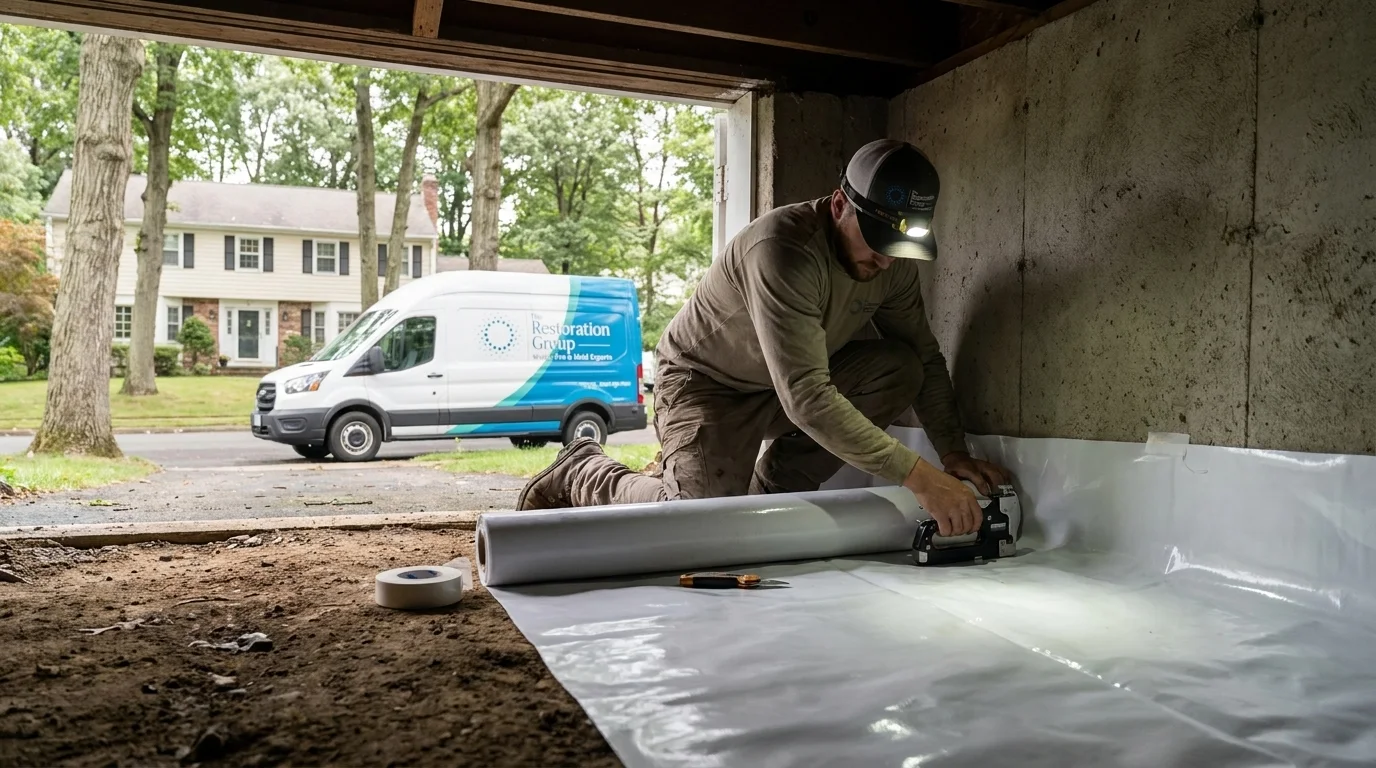
Encapsulation means lining the crawl space floor, walls, and sometimes the ceiling with a heavy-gauge vapor barrier (typically 10 to 20 mil reinforced polyethylene), sealing all vents and penetrations, and conditioning the space so it behaves like part of the building envelope rather than a vented crawl exposed to outside air. Depending on the home’s moisture load and grading, that can include a sump pump or French drain for bulk water, a dehumidifier sized to the cubic footage of the space, and spray foam or rigid insulation at the rim joist. For an average single-family crawl space in this area, the work typically runs one to three days once access, framing condition, and moisture source are confirmed.
Our process
- Moisture and structural assessment. We check for standing water, active leaks, wood rot, and existing mold before anything gets sealed in. A moisture meter reading on joists and subfloor tells us whether we’re dealing with humidity alone or a bulk water source that needs addressing first.
- Source correction. If grading, a downspout, or a plumbing leak is feeding the problem, that gets fixed before encapsulation, not after. Sealing moisture inside an unresolved leak just traps it.
- Vapor barrier installation. The liner is fitted to the floor and up the foundation walls, seams taped, and the material mechanically fastened or adhered at the walls so it doesn’t shift or tear over time.
- Vent and penetration sealing. Foundation vents, old duct penetrations, and gaps around pipes are sealed so the space is no longer exchanging air with the outside.
- Dehumidification and verification. A dehumidifier is installed and sized to the space, and we verify relative humidity has dropped to a stable range before closing out the job.
What separates a good Crawl Space Encapsulation response from a bad one
The most common shortcut is installing a vapor barrier without addressing the actual moisture source, whether that’s a grading issue, a cracked foundation wall, or an undersized sump pump. The liner traps that moisture instead of stopping it, and homeowners end up with a sealed, humid crawl space that’s worse than the vented one they started with. Another frequent miss is skipping the rim joist insulation, which leaves the one place where conditioned and unconditioned air still meet. Adjusters reviewing a related water or mold claim will also want documentation of the moisture reading before and after the work, photos of the sealed vents and seams, and a sump pump that’s rated for the actual water volume on-site, not a generic undersized unit.
What does Crawl Space Encapsulation cost?
Costs vary by square footage, how much existing damage or mold needs remediation first, and whether drainage or a sump system is required. These are typical industry ranges, not a quote: every crawl space is different, and The Restoration Group provides a written scope and price before any work begins. Homeowners insurance generally does not cover encapsulation as a standalone upgrade, but it may contribute toward the portion of the work tied to repairing storm or plumbing-related water damage that made the space unsafe.
| Scenario | Typical range |
|---|---|
| Small crawl space, vapor barrier only | $1,500 - $3,000 |
| Mid-size home, barrier plus sealing and vents | $3,000 - $5,500 |
| Full encapsulation with dehumidifier | $5,000 - $8,500 |
| Add drainage matting or French drain | $1,500 - $4,000 additional |
| Add sump pump system | $1,000 - $2,500 additional |
| Pre-existing mold remediation required | $1,500 - $4,000 additional |
Seasonal & regional considerations
New Jersey’s humid summers are the main driver of crawl space moisture here, with outside dew points regularly exceeding the temperature of framing members below grade, which is exactly the condition that produces condensation. Winter brings the opposite risk: homes with older, unsealed foundations lose more heat through an open crawl space, which shows up as cold floors and higher heating bills. Encapsulation addresses both ends of that cycle at once, which is part of why it tends to pay for itself over a few heating and cooling seasons rather than just solving a summer odor problem.
Service area
We handle crawl space encapsulation for homeowners in Kenilworth and throughout the surrounding Union County communities, including Cranford, Roselle Park, Springfield, and Union Township. Housing stock in this area ranges from early-20th-century foundations to newer construction, and the right approach depends on the age and condition of what’s underneath the house.
If your crawl space smells musty, feels damp to the touch, or has visible mold on joists or insulation, get a written scope before the problem spreads into your subfloor. Call (855) 650-7422 to schedule a crawl space assessment.
Frequently Asked Questions
Does homeowners insurance cover crawl space encapsulation?
Will encapsulation stop a musty smell in my house?
How long does a dehumidifier need to run after encapsulation?
Can I encapsulate a crawl space that already has standing water or active mold?
What's the difference between a vapor barrier and full encapsulation?
Looking for the best crawl space encapsulation company in Fair Lawn?
The Restoration Group provides crawl space encapsulation in Fair Lawn, NJ and the surrounding area, and has served local property owners since 2021. Customers rate us 4.8 out of 5 stars across 166 Google reviews. We answer calls 24/7 — call (844) 808-8838 for immediate help.
Need Crawl Space Encapsulation now?
We respond 24/7 across Fair Lawn and surrounding NJ cities.
Related Coverage
- Our Restoration Services
- Contact The Restoration Group
- Restoration Services in Avenel
- Restoration Services in Bayonne
- Restoration Services in Bloomfield
- Restoration Services in Bridgewater
- Restoration Services in Brooklyn
- Restoration Services in Carteret
- Restoration Services in Chatham
- Restoration Services in Clark
- Restoration Services in Clifton
- Restoration Services in Colonia
- Restoration Services in Cranford
- Restoration Services in East Brunswick