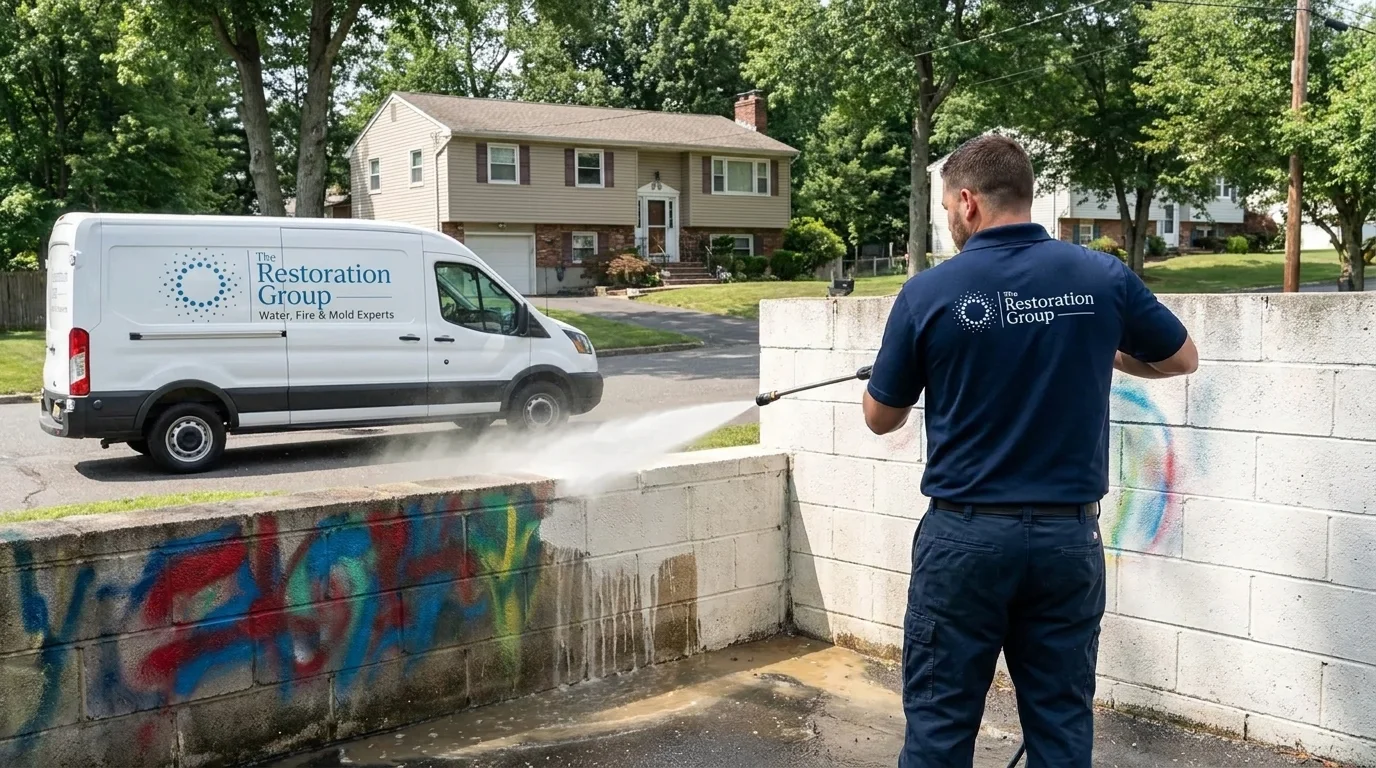
Vandalism and Graffiti Removal in Kenilworth
Vandalism and graffiti removal in Kenilworth. Board-up, insurance-documented cleanup, graffiti off brick, concrete, and glass. Call (855) 650-7422.
You walk up to your storefront and the roll-down gate is covered in tags, or you arrive at a rental to find a window smashed and the interior tossed. Vandalism is jarring in a way other property damage is not, because someone did it on purpose. Beyond the shock, there is a practical clock running: an open window invites weather and a second intrusion, fresh paint sets deeper into masonry every day it sits, and the police report and insurance documentation have to be handled correctly before anything gets cleaned up. Vandalism and graffiti removal is the work of securing the property, documenting the loss, and restoring the surfaces without trading one kind of damage for another.
What vandalism and graffiti removal actually involves
Vandalism is rarely a single problem. A break-in usually means a broken window or forced door that has to be secured, plus interior cleanup, plus permanent repairs. A tagging incident might be spray paint across brick, etched or scratched glass, and a kicked-in panel all at once. Treating it as one job, securing, documenting, cleaning, and repairing, is what keeps the loss contained and the insurance claim consistent.
Graffiti removal is a surface-by-surface problem. Porous masonry, brick, block, concrete, and stucco, absorbs paint below the surface, so it calls for poultice or gel removers and controlled low-pressure or hot-water washing rather than high-pressure blasting that can permanently etch soft brick and blow out mortar joints. Smooth surfaces, painted siding, coated metal, and glass, respond to solvents or careful mechanical methods. Using the wrong product or too much pressure is how a wall ends up with a paint shadow, or damage worse than the original tag. Identifying the substrate before any chemical is applied is the whole game.
Break-in and forced-entry damage adds a security dimension. Before permanent glass or door repairs can be scheduled, the opening has to be boarded and made weather-tight so the interior is protected in the meantime, the same emergency board-up work that follows a storm or fire.
Our process
-
Secure the property first. If a window is broken, a door is forced, or a wall is opened, the opening is boarded and made weather-tight before anything else. Plywood is cut to fit and fastened into solid framing, not siding or trim, so the property is protected against weather and further intrusion while repairs are scheduled.
-
Document the loss for the police and insurance. Every affected surface, broken pane, forced entry point, and area of graffiti is photographed in the condition it was found, before cleanup begins. This documentation supports the police report and goes to your insurance adjuster. Carriers almost always require a police incident or case number for a vandalism claim, so that report is filed early, and the written scope establishes exactly what was damaged.
-
Substrate-appropriate graffiti removal. Each tagged surface is identified, brick, concrete, stucco, painted siding, metal, or glass, and matched to the correct removal method: poultice or gel remover and low-pressure washing on porous masonry, solvent or mechanical methods on smooth and coated surfaces. The goal is complete removal without etching, ghosting, or surface damage.
-
Cleanup of contents and interior. After a break-in, overturned or damaged contents, broken glass, and debris are cleaned up and cleared. Where the incident involved bodily fluids or hazardous residue, cleanup follows biohazard protocols rather than ordinary cleaning.
-
Permanent repairs. Glass is replaced, doors and frames are repaired, damaged drywall is patched, and surfaces are repainted or refinished so the property is returned to pre-loss condition, not just cleaned up around the damage. Final documentation of the completed work goes to your insurance file.
What separates a good vandalism response from a bad one
The most common failure in graffiti removal is reaching for a pressure washer on porous masonry. High pressure removes the paint and a layer of the brick face with it, leaving a lighter patch and open pores that soak up the next tag even faster. Soft brick, historic masonry, and aged mortar joints are especially easy to ruin. A good operator tests a small area, matches the remover to the substrate, and uses the lowest pressure that does the job.
The second failure is cleaning up before documenting. Once graffiti is removed or a broken window is swapped out, the evidence of the loss is gone, and a carrier reviewing the claim has nothing to verify against. Photographs taken before any work begins, tied to the police report, are what keep a vandalism claim from being disputed or reduced.
For break-ins specifically, leaving an opening unsecured overnight to wait for a glass company turns one loss into two: weather intrusion and, too often, a repeat entry. Securing first and repairing second is the sequence that protects the property and the claim.
What does vandalism and graffiti removal cost?
Cost depends on the surface, the size of the affected area, whether securing and repairs are needed alongside cleanup, and how set the graffiti is. The ranges below are typical market figures for this kind of work, not The Restoration Group quotes, and are meant to give you a sense of scale before an on-site assessment.
| Scenario | Typical range |
|---|---|
| Small graffiti removal, smooth surface (single tag) | $150 - $500 |
| Graffiti removal from porous masonry (per wall section) | $400 - $1,500+ |
| Emergency board-up of a broken window or door (per opening) | $150 - $450 |
| Glass or storefront pane replacement | $250 - $1,200+ per pane |
| Interior cleanup and debris removal after a break-in | $300 - $1,500 |
| Full vandalism restoration (secure, clean, repair) | Scoped per incident |
Every incident is different, and a large tagged wall or a multi-point break-in scopes very differently from a single spray-painted door. The Restoration Group provides a written scope of work before any work begins, and when the loss is covered by a vandalism or malicious-mischief policy, that scope and the supporting photos are built to match what your adjuster needs.
Seasonal and regional considerations
Dense commercial corridors across Union County and the NYC metro, retail strips, warehouse districts, and transit-adjacent blocks, see graffiti and vandalism at a higher rate than quieter residential streets, and a tagged storefront that sits untouched tends to draw more of the same. Prompt removal is both a cleanup and a deterrent.
Northern New Jersey’s freeze-thaw cycle adds a masonry wrinkle. Aggressive removal that opens up the face of brick or concrete leaves the surface more porous, and moisture that soaks in and then freezes over the winter can spall the masonry and worsen mortar-joint deterioration. That is another reason low-pressure, substrate-appropriate methods matter here specifically, the goal is to remove the paint without leaving the wall more vulnerable to the next hard freeze.
Service area
The Restoration Group is based in Kenilworth, NJ and handles vandalism and graffiti removal for homeowners, landlords, property managers, and businesses throughout Union County and the surrounding region, including Union, Elizabeth, Cranford, Westfield, and Newark, as well as the wider NYC metro area. As an IICRC Certified Firm (#210213), we handle vandalism work as a coordinated scope, securing, documenting, cleaning, and repairing, so a single loss does not turn into a scramble across multiple vendors.
If your property has been tagged, broken into, or vandalized, the right first steps are to secure the opening and document the damage before it is cleaned up. Call The Restoration Group at (855) 650-7422, we are available 24/7 and can walk you through what to photograph and what to do before the crew arrives.
Frequently Asked Questions
Does insurance cover vandalism and graffiti cleanup?
Can graffiti be removed from brick and concrete without damaging the surface?
How fast should graffiti be removed after it appears?
Do you handle both the cleanup and the repairs after a break-in?
Do you serve commercial properties as well as homes?
Looking for the best vandalism and graffiti removal company in Fair Lawn?
The Restoration Group provides vandalism and graffiti removal in Fair Lawn, NJ and the surrounding area, and has served local property owners since 2021. Customers rate us 4.8 out of 5 stars across 167 Google reviews. We answer calls 24/7 — call (844) 808-8838 for immediate help.
Need Vandalism and Graffiti Removal now?
We respond 24/7 across Fair Lawn and surrounding NJ cities.