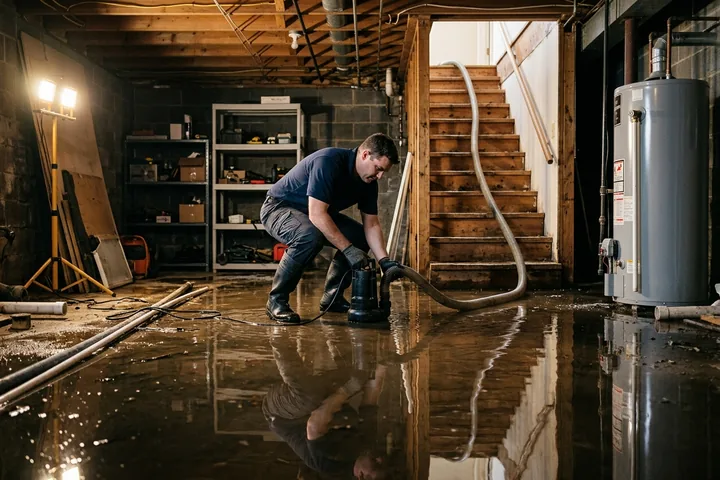
Basement Flood Cleanup in Bloomfield
24/7 basement flood cleanup in Bloomfield, NJ. IICRC-certified, insurance billing accepted. Call (855) 650-7422.
Our IICRC-certified technicians are dispatched from our Fair Lawn, NJ headquarters and are typically on-site in Bloomfield within 60 minutes of your call.
When the Third River backs up after a heavy summer storm, basements in Watsessing and Brookdale don’t get a warning, they get water. Bloomfield’s dense grid of 1900s-to-1930s colonials, two-families, and Tudors was built long before modern waterproofing standards, and most of those homes sit on finished basements that were never designed to shed a sewer surcharge or a sump-pump failure. When a flood hits, the clock starts immediately: standing water in a finished basement can begin supporting mold colonization within 24 to 48 hours, and saturated original subfloor can buckle before the weekend is over.
Why Bloomfield Properties See Basement Flood Events More Than Most
Bloomfield’s geography sets the stage. The Second River and the Third River (also called the Yantacaw) both thread through the western and southern parts of town, and their watersheds drain a significant portion of Essex County. During Tropical Storm Ida in 2021, both corridors overwhelmed the combined sewer system, pushing sewage backward into basement floor drains across Watsessing and the Brookdale Park neighborhood. That kind of event, a sanitary sewer backup rather than a clean-water pipe burst, is classified as a Category 3 loss, meaning the water carries pathogens and requires a different response than a broken supply line.
Beyond storm events, the housing stock itself is a factor. Galvanized steel supply lines common in pre-1940 construction corrode from the inside out, narrowing over decades until a fitting finally lets go. Cast-iron waste lines crack at the joints as the ground shifts. In a home where the basement ceiling is finished drywall over original framing, a slow leak behind the wall can travel undetected until the floor is already saturated. These aren’t rare edge cases in 07003, they’re the routine pattern.
Our Basement Flood Cleanup Process in Bloomfield
The first priority on any flooded basement call is source control and water category identification. A burst galvanized supply line and a sewer backup look similar from the stairs, but they require different protective protocols, different disposal procedures, and different documentation for your insurance carrier. Once the source is confirmed and contained, water extraction begins, typically with truck-mounted or portable extraction units capable of pulling standing water from carpet, subfloor, and the cavities between floor joists.
After bulk extraction, the drying phase is calibrated to the specific materials in the space. Bloomfield’s older homes frequently combine concrete block foundation walls, original hardwood or fir subfloor, plaster-and-lath partition walls, and modern drywall finishes added during later renovations. Each material holds and releases moisture at a different rate. Thermal imaging cameras help locate moisture that hasn’t surfaced yet, saturated insulation inside a finished wall, for example, reads dry at the surface but stays wet at the stud for days. Drying equipment placement and air movement are adjusted daily based on psychrometric readings until all monitored assemblies reach acceptable moisture levels per the IICRC S500 standard.
If the loss involved a sewer backup or any Category 3 water, affected porous materials, drywall, insulation, carpet, are removed and disposed of rather than dried in place. That’s not a judgment call; it’s the standard.
Reaching Bloomfield from Kenilworth
The Restoration Group operates 24/7 and dispatches from Kenilworth, NJ. Bloomfield is accessible via the Garden State Parkway to Route 21 north, or through Springfield Avenue and Bloomfield Avenue depending on traffic. The Broad Street and Bloomfield Avenue commercial corridors, where restaurant and retail water losses tend to happen overnight, are reachable without navigating residential side streets. For residential calls in North Center or Brookside, routing through Bloomfield Center keeps response straightforward even during peak hours.
Bloomfield Insurance Coordination
Most homeowner policies in New Jersey cover sudden and accidental water losses, a burst pipe, a washing machine line failure, but sewer backup coverage is typically a separate rider, and not every Bloomfield homeowner carries it. That distinction matters because the remediation scope and cost for a Category 3 sewer backup is meaningfully higher than for a clean-water loss. The Restoration Group documents the loss with photographs, moisture readings, and written scope before work begins, and bills carriers directly where coverage applies. If your policy doesn’t include sewer backup, that documentation still matters, it establishes what happened, when, and what was affected, which protects you if a dispute arises later.
Local Note
In Bloomfield’s older two-family and colonial homes, finished basement ceilings are often a patchwork of original plaster sections and newer drywall added when the space was converted, sometimes decades apart. After a flood, those two materials dry on completely different timelines. Plaster releases moisture slowly and can hold elevated readings for days after the adjacent drywall has already reached equilibrium. Pulling drying equipment too early because the drywall reads dry, while the plaster section two feet away is still saturated, is a common mistake that leads to mold growth inside the ceiling assembly. Monitoring both materials separately, and not closing out the drying phase until all assemblies are confirmed dry, is the only way to avoid a callback.
If your basement took on water, whether from the last storm, a failed sump pump, or a pipe that finally gave out, call The Restoration Group at (855) 650-7422. We respond 24/7, and we’ll tell you exactly what you’re dealing with before any work begins.
Serving Bloomfield from our Fair Lawn headquarters — ★ 4.8 · 160 Google reviews
“Great customer service. I was kept well informed throughout the entire process. I received nothing but respect and sympathy from everyone I dealt with.” — Ryan, July 2026Read our reviews on Google →
Basement Flood Cleanup in Bloomfield: Service Coverage
Frequently Asked Questions
How fast can you arrive for basement flood cleanup in Bloomfield?
Are basements in the Watsessing and Brookdale areas more likely to have sewer backup damage than clean-water losses?
How quickly can The Restoration Group reach a flooded basement in Bloomfield's 07003 ZIP code?
My Bloomfield home was built in the 1920s — does that affect how long basement drying takes?
Does homeowner's insurance in New Jersey typically cover sewer backup flooding in a finished basement?
What's the difference between extracting water from a finished Bloomfield basement versus an unfinished one?
Basement Flood Cleanup response in Bloomfield
Most Bloomfield calls see a technician on-site within 60 minutes from our Fair Lawn headquarters.