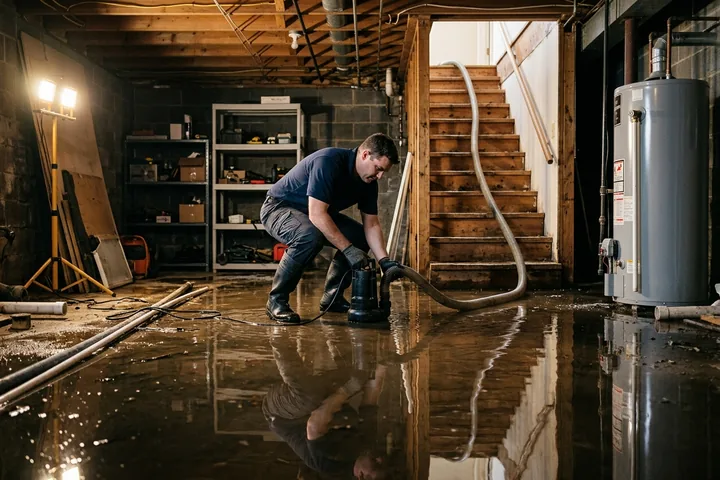
Basement Flood Cleanup in Kenilworth
24/7 basement flood cleanup in Kenilworth and surrounding areas. IICRC-certified, insurance billing accepted. Call (855) 650-7422.
Standing water in a basement doesn’t announce itself slowly, one morning there’s an inch of water covering the floor, and by the time you’ve located the shutoff valve and called for help, the drywall is already wicking moisture up from the bottom. Basements flood through three distinct pathways: groundwater intrusion through foundation cracks or window wells, sewer or drain backups that push contaminated water up through floor drains, and interior failures like a burst water heater or washing machine supply line. Each source carries a different contamination level, and treating them the same way is where cleanup goes wrong.
What basement flood cleanup actually involves
The work starts before a single pump is staged. Knowing where the water came from determines the personal protective equipment the crew wears, the containment measures required, and whether salvageable materials can stay in place or must be removed. A sewer backup carries Category 3 (grossly contaminated) water, the same materials you might leave in place after a clean-water pipe break become a biohazard disposal question when sewage is involved.
Once the source is classified, extraction begins. Truck-mounted or portable submersible pumps pull standing water, followed by high-CFM wet vacuums that pull residual moisture from floor joints and the base of walls. The concrete slab itself is porous and holds water longer than it looks, a floor that reads dry underfoot can still be releasing vapor that feeds mold growth in the wall cavity above it.
Structural drying follows extraction. Axial air movers are positioned to create a vortex pattern across the floor and against wall bases; low-grain refrigerant (LGR) dehumidifiers pull the evaporated moisture out of the air before it can resettle. Moisture readings are logged at every session, typically every 24 hours, using penetrating and non-penetrating meters on concrete, framing, and any remaining drywall. Drying is complete when readings reach established “dry standard” baselines, not when the space looks or smells dry.
Our process
-
Source identification and water classification, Before equipment is staged, the technician traces the water to its origin and classifies it (Category 1 clean water, Category 2 gray water, or Category 3 sewage/groundwater). This classification drives every decision that follows, including what materials can be dried in place and what must be removed.
-
Extraction and debris removal, Submersible pumps remove bulk standing water; wet vacuums and squeegees address residual pooling. Saturated materials that cannot be dried, insulation batts, lower sections of paper-faced drywall, carpet and pad in contact with Category 2 or 3 water, are removed and bagged before drying equipment is set.
-
Structural drying with daily moisture monitoring, Air movers and LGR dehumidifiers run continuously. A technician returns each day to log moisture readings across a pre-mapped grid of measurement points. Readings are documented in writing and shared with your insurance adjuster as part of the claim record. Equipment is adjusted or repositioned as drying progresses.
-
Antimicrobial treatment, Once surfaces reach target moisture levels, EPA-registered antimicrobial agents are applied to concrete, framing, and any remaining surfaces that were in contact with floodwater. For Category 3 losses, this step includes the subfloor and any exposed framing that was submerged.
-
Final clearance and scope documentation, A final moisture survey confirms that all readings have reached dry standard. The completed drying log, photo documentation, and scope of affected materials are compiled for your insurance carrier. If reconstruction is needed, new drywall, flooring, or framing, a written scope is provided before that phase begins.
What separates a good basement flood response from a bad one
The most common failure in basement flood cleanup is premature equipment removal. A dehumidifier pulled two days early because the floor “feels dry” leaves residual moisture in the wall cavity where it can’t be seen. Mold colonies can begin forming within 24–48 hours on wet organic material, drywall paper, wood framing, carpet backing, so the margin for error is narrow.
A second common problem is misclassifying the water source. Groundwater that enters through a foundation crack after a heavy rain is not clean water, it has traveled through soil and may carry contaminants. Treating it as Category 1 and leaving porous materials in place is an error that shows up weeks later as odor or visible mold growth.
Insurance adjusters reviewing a basement flood claim look for a complete drying log with daily moisture readings at documented measurement points, photographs taken at each visit, and a clear record of when materials were removed and why. A claim without this documentation is harder to process and more likely to result in a disputed scope.
The Restoration Group is an IICRC Certified Firm (#210213), which means the drying process follows the IICRC S500 Standard for Professional Water Damage Restoration, the same standard your insurance carrier’s adjuster will reference when reviewing the claim.
What does basement flood cleanup cost?
Typical costs vary significantly based on the water category, the square footage affected, and whether structural materials need to be removed. Most homeowners pay somewhere in the ranges below, these are industry-typical figures, not quotes.
| Scenario | Typical range |
|---|---|
| Small basement, clean water, no material removal | $1,200 – $3,000 |
| Mid-size basement, clean water, partial drywall removal | $3,000 – $6,500 |
| Full basement, gray water (Category 2), drywall and flooring removal | $5,500 – $12,000 |
| Sewage backup (Category 3), full remediation and material removal | $7,000 – $20,000+ |
| Finished basement with contents, Category 2 or 3 water | $10,000 – $25,000+ |
Every loss is different, and The Restoration Group provides a written scope before any work begins. Standard homeowners insurance typically covers sudden and accidental water damage, a burst pipe, appliance failure, or sudden roof leak, but most policies exclude gradual seepage and rising groundwater unless a separate flood endorsement or NFIP policy is in place. Sewer backup coverage is often a separate rider; check your declarations page before assuming it’s included.
Seasonal and regional considerations
New Jersey’s freeze-thaw cycle creates predictable pressure on basement walls and foundation seals. In late winter and early spring, frost heave can open hairline cracks in block or poured concrete foundations that were watertight the previous fall. The spring snowmelt window, typically late February through April in northern and central NJ, is when groundwater intrusion calls peak.
Summer brings a different risk: extended periods of high humidity combined with air-conditioned basements create condensation on cold concrete walls and pipes, which is often misread as a leak. Identifying condensation versus active intrusion changes the remediation approach entirely.
Kenilworth and surrounding Union County communities sit on relatively flat terrain with older housing stock, many homes were built in the mid-20th century with cinder block foundations and original drain tile systems that are well past their design life. If your basement has flooded more than once, the underlying drainage infrastructure is worth evaluating alongside the immediate cleanup.
Service area
The Restoration Group is based in Kenilworth, NJ and responds to basement flood calls throughout Union County and the surrounding region, including Clark, Cranford, Roselle Park, Springfield, Westfield, and neighboring communities. Each city-specific page covers local considerations in more detail, follow the links in the service area directory to find your town.
If there’s water in your basement right now, the clock on mold growth starts when the flooding stops, not when cleanup begins. Call The Restoration Group at (855) 650-7422 to schedule your moisture assessment and get a written scope before any work starts.
Frequently Asked Questions
Does homeowners insurance cover basement flood cleanup?
How do I know if my basement flood is Category 1, 2, or 3 water?
How long does it take to dry out a flooded basement?
Does the drywall in my basement have to come out after a flood?
What should I do in my basement while waiting for the cleanup crew to arrive?
Looking for the best basement flood cleanup company in Fair Lawn?
The Restoration Group provides licensed and insured basement flood cleanup in Fair Lawn, NJ and the surrounding area, and has served local property owners since 2021. Customers rate us 4.8 out of 5 stars across 160 Google reviews. We answer calls 24/7 — call (908) 970-8533 for immediate help.
Need Basement Flood Cleanup now?
We respond 24/7 across Fair Lawn and surrounding NJ cities.
Related Coverage
- Our Restoration Services
- Contact The Restoration Group
- Basement Flood Cleanup in Bayonne
- Basement Flood Cleanup in Bloomfield
- Basement Flood Cleanup in Bridgewater
- Basement Flood Cleanup in Brooklyn
- Basement Flood Cleanup in Clark
- Basement Flood Cleanup in Clifton
- Basement Flood Cleanup in Cranford
- Basement Flood Cleanup in East Brunswick
- Basement Flood Cleanup in East Orange
- Basement Flood Cleanup in Edison
- Basement Flood Cleanup in Elizabeth
- Basement Flood Cleanup in Englewood