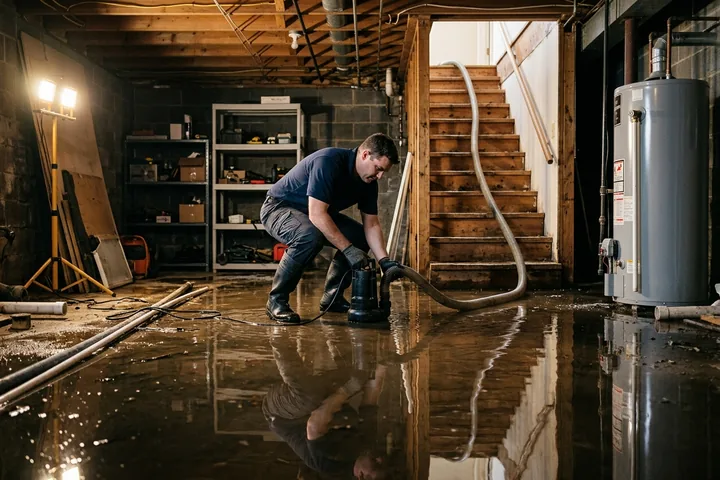
Basement Flood Cleanup in Brooklyn
24/7 basement flood cleanup in Brooklyn, NY. IICRC-certified, insurance billing accepted. Call (855) 650-7422.
Our IICRC-certified technicians are dispatched from our Fair Lawn, NJ headquarters and are typically on-site in Brooklyn within 60 minutes of your call.
Brooklyn’s basement flooding problem isn’t just about heavy rain, it’s about what happens when 19th-century masonry meets a modern storm drain system that was never designed to handle it. When a nor’easter stalls over the harbor or a remnant of a Gulf storm drops several inches in an hour (as Ida did in 2021, turning cellar stairwells into waterfalls across Park Slope and Flatbush), the garden-level apartments and below-grade storage rooms that define Brooklyn’s brownstone belt become the first casualties. The Restoration Group responds 24/7 and can be reached any hour at (855) 650-7422.
Why Brooklyn Properties Flood Differently Than Anywhere Else
Brooklyn’s housing stock is its own category. The rowhouses and attached brownstones built between roughly 1880 and 1930, dense through Brooklyn Heights, Williamsburg, and the neighborhoods radiating out from Prospect Park, were constructed with rubble-stone or brick foundations that rely on mortar joints that have had a century to soften. Those joints wick groundwater laterally through the foundation wall long before a visible crack appears. A sump pump failure during a storm isn’t just a nuisance; it’s a race against hydrostatic pressure that has been building since the soil became saturated.
Coastal neighborhoods carry a different risk profile. Canarsie and the areas near the Coney Island boardwalk sit at low elevation with high water tables, and storm surge from events like Sandy left a lasting mark on how property owners there think about below-grade space. Even years after a major storm, residual moisture in older slab-on-grade construction can feed mold colonies that don’t announce themselves until a renovation exposes the wall cavity.
Then there’s the infrastructure layer: combined sewer systems in much of Brooklyn mean that during heavy rain, stormwater and sanitary flow share the same pipe. When that system backs up, what enters a basement isn’t clean water, it’s Category 3 contaminated water that requires a different extraction and sanitation protocol than a burst supply line would.
Our Basement Flood Cleanup Process in Brooklyn
The first step on every job is water classification. Clean supply-line water, gray water from an appliance, and sewage-contaminated backflow each require a different response, and in Brooklyn’s older buildings the source isn’t always obvious on arrival. We use moisture meters and thermal imaging cameras to map saturation behind plaster walls and under original hardwood floors before any equipment goes down, because pulling up a floor prematurely in a landmarked brownstone creates a secondary problem.
Extraction comes next: truck-mounted and portable units sized to the space, with particular attention to the low spots under stairs and behind coal-room partitions that are common in pre-war construction. Once standing water is removed, the drying phase begins with industrial air movers and desiccant or refrigerant dehumidifiers calibrated to the ambient conditions. Drying logs are recorded at regular intervals, that documentation matters for insurance adjusters and, in co-op buildings, for the board’s records.
If structural materials need to come out, plaster, lath, subfloor, we work carefully. Original woodwork and period detail in Brooklyn rowhouses aren’t just aesthetic; they affect property value and, in some cases, Landmarks Preservation Commission requirements. We communicate before we cut.
Brooklyn Insurance & HOA Coordination
Brownstone owners in ZIP codes like 11201 (Brooklyn Heights, DUMBO) and 11215 (Park Slope, Windsor Terrace) often carry separate flood policies through the National Flood Insurance Program in addition to their homeowner’s policy, and the two carriers may require separate documentation packages. We photograph affected materials systematically, generate moisture logs, and produce a scope of loss that satisfies both types of adjuster.
Co-op and condo boards add another layer. Many Brooklyn co-ops require board notification before remediation work begins in a basement mechanical room or shared utility space, and some require a licensed contractor’s certificate of insurance naming the building as an additional insured before we can start. We carry documentation ready to submit to management companies and have worked through that process enough times to know what boards typically ask for before they approve access.
Commercial landlords with mixed-use buildings, ground-floor retail, residential above, basement storage, face a multi-tenant coordination problem. We can work in phases to minimize disruption to occupied units while the below-grade space is being dried.
Local Note
In Brooklyn’s pre-war rowhouses, the garden-level apartment and the true cellar below it are often separated by a wood-framed floor assembly, joists, subfloor, and finish floor, that sits directly over a masonry foundation. When that assembly gets wet from below, the surface can feel dry to the touch within a day or two while the joist ends embedded in the brick wall stay saturated for a week or more. Moisture meters read the surface; only a pin probe driven into the joist end tells you whether the wood is actually dry. We check both, because a premature close-out on a Brooklyn basement is how a mold problem starts inside a wall that nobody opens again for years.
If your basement has flooded, whether from a backed-up drain, a failed sump, a burst pipe, or storm surge, call (855) 650-7422. The Restoration Group responds 24/7 to basement flood emergencies across Brooklyn, and we bring the documentation, the equipment, and the building-specific care that older properties here require.
Serving Brooklyn from our Fair Lawn headquarters — ★ 4.8 · 160 Google reviews
“Teams were very prompt and respectful.. company responded quickly and kept in touch” — Peggy, August 2026Read our reviews on Google →
Basement Flood Cleanup in Brooklyn: Service Coverage
Frequently Asked Questions
How fast can you arrive for basement flood cleanup in Brooklyn?
How quickly can The Restoration Group reach a flooded basement in Brooklyn Heights or Park Slope?
My Brooklyn brownstone has a combined sewer — does that change how you handle the cleanup?
Are Canarsie and other low-lying Brooklyn neighborhoods at higher risk for recurring basement flooding?
My co-op board in Brooklyn requires documentation before approving remediation work in the basement. Can you provide that?
How long does it take to dry out a flooded basement in a pre-war Brooklyn rowhouse?
Will my homeowners insurance cover basement flood cleanup in Brooklyn?
Basement Flood Cleanup response in Brooklyn
Most Brooklyn calls see a technician on-site within 60 minutes from our Fair Lawn headquarters.