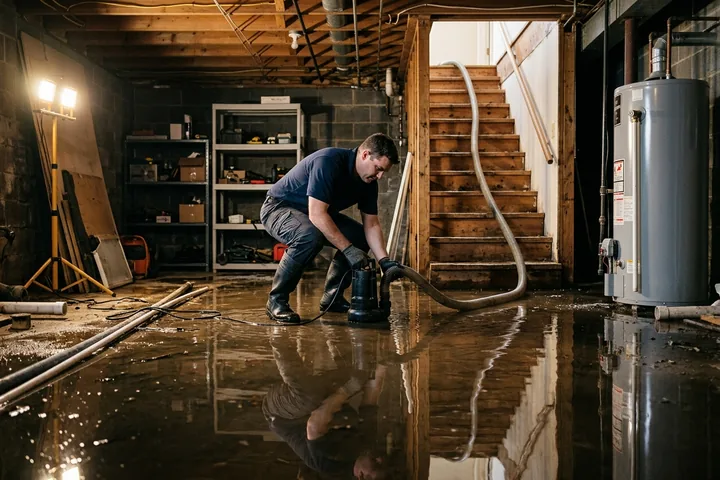
Basement Flood Cleanup in Clark
24/7 basement flood cleanup in Clark, NJ. IICRC-certified, insurance billing accepted. Call (855) 650-7422.
Our IICRC-certified technicians are dispatched from our Fair Lawn, NJ headquarters and are typically on-site in Clark within 60 minutes of your call.
When the Rahway River or Robinson’s Branch backs up after a heavy rain, basements along Valley Road and Lake Avenue can go from dry to ankle-deep in water faster than a sump pump can cycle. Clark’s postwar ranches and split-levels were built for a different era of storm intensity, and their finished basements, often the family room, the laundry, the home office, are the first thing underwater when the drainage system can’t keep up. The Restoration Group responds 24/7 to basement flood cleanup calls in Clark, NJ (07066), and the work here has a specific character that generic restoration crews don’t always anticipate.
Why Clark Basements Flood the Way They Do
Clark is a compact postwar suburb, and the housing stock tells the story. Most of the ranches, capes, and split-levels along the Westfield Avenue corridor and deeper into residential blocks were built in the 1950s and 1960s. That means cast-iron drain lines that have had sixty-plus years to corrode, offset, and root-intrude. It means copper supply lines soldered with fittings that fatigue over time. And it means finished basements, drywall, drop ceilings, carpet, wood-framed partition walls, that absorb water quickly and hide it even faster.
The geography compounds the problem. Robinson’s Branch threads through low ground near Lake Avenue, and the Rahway River forms Clark’s northern and western edges. During significant rain events, both waterways have overwhelmed the local storm system, pushing sewage backward through floor drains into basements. That’s not a clean-water loss, it’s a Category 3 contaminated-water event, and it requires a different response than a burst supply line does. Sump-pump failures during summer downpours are the most routine call, but sewer backups are the ones that do the most damage to finished spaces.
Our Basement Flood Cleanup Process in Clark
The first thing that matters on any flooded basement is water classification. A failed sump pump during a storm is typically Category 1 or 2 water. A sewer backup, common in Clark’s older drain infrastructure, is Category 3, which means the extraction process, the PPE requirements, and the disposal protocols are all different. We assess this on arrival before any equipment goes in.
Once the water source is identified and controlled, extraction begins. Standing water comes out with truck-mounted or portable extraction units, followed by targeted drying with industrial air movers and dehumidifiers calibrated to the space. In Clark’s split-levels and ranches, the basement is often partially below grade on all four sides, which limits natural airflow and extends drying time compared to a walk-out basement. Moisture readings are taken at the wall cavities, subfloor, and framing, not just the surface, because water behind drywall or under vinyl plank flooring can read dry at the surface while the structure underneath stays saturated for days.
Documentation runs parallel to the physical work: photos, moisture logs, and a written scope that your insurance adjuster can work from directly.
Reaching Clark from Kenilworth
The Restoration Group is based in Kenilworth, which sits immediately north of Clark. Garden State Parkway access and direct surface routes along Raritan Road put our crews into Clark neighborhoods quickly at any hour. Whether the call is coming from a residence near Arthur L. Johnson High School or a commercial property on the Raritan Road business district strip, the routing is straightforward. We’re available around the clock, if water is in your basement at 2 a.m., that’s when we come.
Clark Insurance Coordination
Homeowner’s insurance coverage for basement flooding in Clark depends heavily on how the water got in. A burst pipe is typically covered under a standard HO-3 policy. A sewer backup is covered only if the homeowner added a sewer backup rider, many Clark residents don’t realize they need it until they’re standing in contaminated water. Flood damage from rising groundwater or overland flow generally requires separate NFIP or private flood coverage.
We document the loss thoroughly, water source, affected materials, moisture readings, photos, and work directly with most major carriers. Knowing which coverage applies before you call your adjuster can save time; we can help you frame the loss accurately from the start.
Local Note
One thing that catches crews off guard in Clark’s older finished basements: the partition walls framing out utility areas or storage rooms are often built directly on the concrete slab with no pressure-treated bottom plate. When water sits for even a few hours, the raw lumber wicks moisture up the stud cavity well above the flood line. We check framing height on every Clark job, the visible damage line is almost never the actual damage line in these homes. Missing that means mold growth inside a wall that looks fine from the outside two weeks later.
If your basement in Clark has taken on water, from a storm, a failed sump, a broken line, or a sewer backup, call The Restoration Group at (855) 650-7422. We’ll assess the loss, classify the water, and get drying equipment in place before secondary damage compounds the problem.
Serving Clark from our Fair Lawn headquarters — ★ 4.8 · 160 Google reviews
“They were very professional, and took care of all the water in my ceiling. It was alot of work, but they were very good at what they did.” — Lisa, September 2026Read our reviews on Google →
Basement Flood Cleanup in Clark: Service Coverage
Frequently Asked Questions
How fast can you arrive for basement flood cleanup in Clark?
Are basements near Lake Avenue and Valley Road at higher risk for sewer backups during storms?
How does Clark's 1950s-60s housing stock affect basement flood cleanup compared to newer construction?
Does my homeowner's insurance cover basement flooding from the Rahway River or a sewer backup in Clark?
What's the difference between extracting a sump-pump overflow versus a sewer backup in a Clark basement?
How quickly can The Restoration Group reach a flooded basement in Clark from your Kenilworth location?
Basement Flood Cleanup response in Clark
Most Clark calls see a technician on-site within 60 minutes from our Fair Lawn headquarters.