24/7 Emergency Basement Flooding Cleanup in Clark
24/7 emergency basement flooding cleanup in Clark, NJ. IICRC-certified, insurance billing accepted. Call (855) 650-7422.
Our IICRC-certified technicians are dispatched from our Fair Lawn, NJ headquarters and are typically on-site in Clark within 60 minutes of your call.
When the Rahway River or Robinson’s Branch backs up after a heavy storm, basements along Valley Road and Lake Avenue don’t just get wet, they fill fast, often mixing groundwater with sewer overflow before a homeowner even realizes the sump pump has quit. Clark’s compact grid of 1950s and ’60s ranches, split-levels, and capes means nearly every finished basement in the 07066 ZIP code is both a living space and a liability when the water rises. The Restoration Group responds 24/7 from Kenilworth, typically reaching Clark addresses within minutes of your call.
Why Clark Properties See Basement Flooding Issues
Clark’s postwar housing stock was built fast and built to last, but the original cast-iron drain lines and copper supply runs in those homes are now 60 to 70 years old. Cast iron corrodes from the inside out, and when a joint fails during a summer downpour, the water doesn’t wait. The town’s topography compounds the problem: the low ground near Lake Avenue and the Brant Lake area sits in a natural drainage basin, and during events like Tropical Storm Ida in 2021, storm sewers running beneath those streets reversed flow entirely, pushing sewage-laced water up through floor drains into finished basements.
Sump pumps are the first line of defense in most Clark homes, but they’re also the most common single point of failure. A power blip during a thunderstorm, exactly when you need the pump most, is enough to let two or three inches accumulate before the float resets. Homes on the lower-lying streets off Valley Road are especially vulnerable because the water table rises quickly when the Robinson’s Branch is running high.
Our Basement Flooding Cleanup Process in Clark
The first thing we do on arrival is assess the water category. A failed supply line is clean water; a backed-up floor drain connected to a combined sewer is Category 3, contaminated, requiring different protective protocols and disposal procedures. In Clark, where sewer backup is a real and recurring event, we treat ambiguous sources as contaminated until testing or direct observation says otherwise.
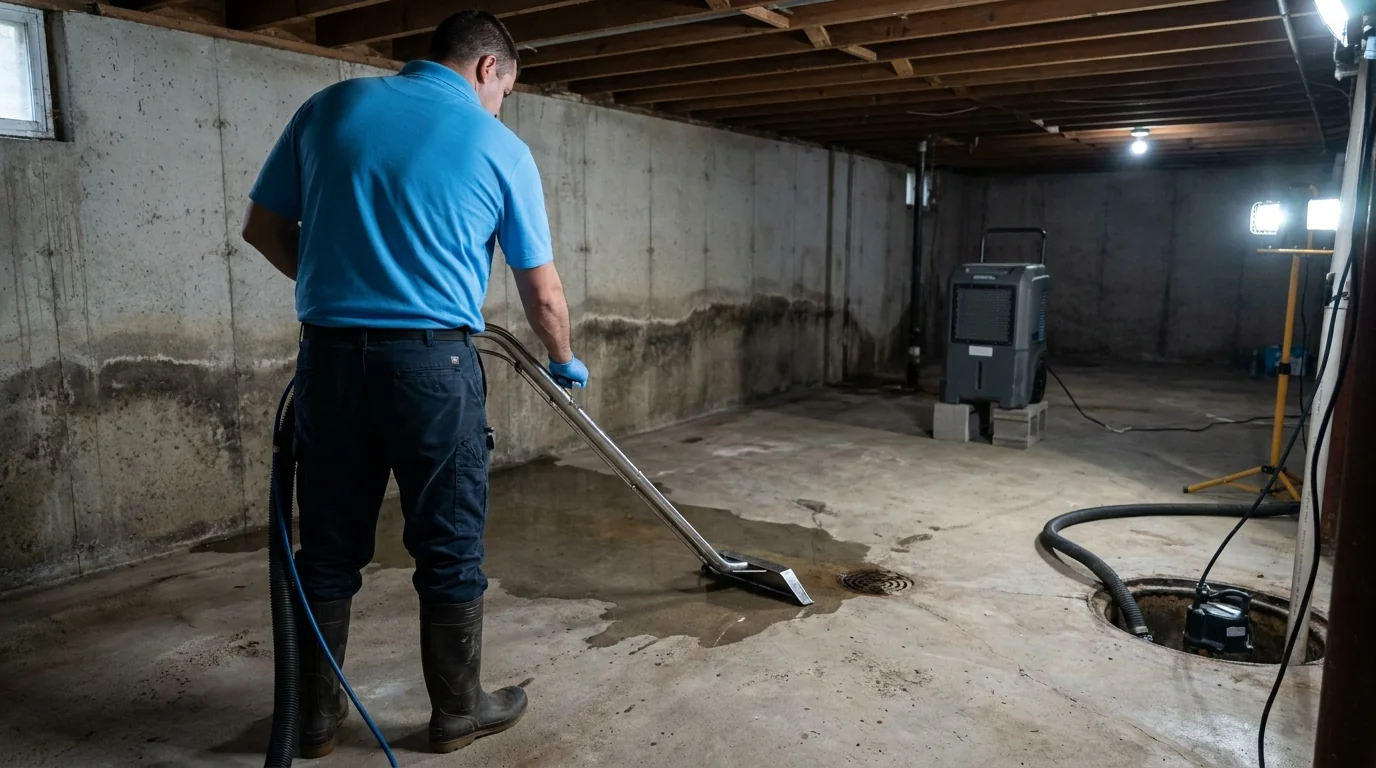
Once the source is confirmed and stopped, water removal begins with truck-mounted extraction units capable of pulling hundreds of gallons per hour. Porous materials, carpet padding, drywall below the flood line, insulation inside stud bays, are documented and removed if they cannot be dried in place within the IICRC S500 standard’s drying window. We set industrial-grade desiccant dehumidifiers and axial air movers in a calculated pattern based on the square footage and construction of the space, then monitor moisture readings daily until the structure reaches its dry standard.
For Clark’s finished basements, that often means pulling baseboards and drilling small evaporation holes at the base of drywall to let wall cavities dry without a full tearout, a technique that saves material and shortens rebuild time significantly.
Reaching Clark from Kenilworth
The Restoration Group’s base in Kenilworth sits roughly three miles from Clark’s center, with direct access via Kenilworth Boulevard to Westfield Avenue or a quick run down the Garden State Parkway to Exit 135. On a clear run, our crews are loading equipment onto the truck before most homeowners have finished describing the problem. Because we operate around the clock, a call at 2 a.m. after a sump failure during a nor’easter gets the same dispatch as a midday burst pipe near the Raritan Road business district.
Clark Insurance Coordination
Most standard homeowner policies in New Jersey distinguish sharply between sudden-and-accidental water damage (a burst pipe) and flood or sewer backup, and Clark residents near the Rahway River corridor have learned that lesson the hard way. We document the loss thoroughly from the moment we arrive: photos, moisture readings, a written scope of affected materials, and a detailed drying log. That documentation is what insurance adjusters need to process a claim efficiently, and it’s what protects you if a dispute arises about pre-existing conditions versus storm-related damage.
If your policy includes sewer backup endorsement, which is a separate rider many Clark homeowners added after Ida, we’ll work directly with your carrier’s adjuster and provide the paperwork in the format most carriers require.
Local Note
One thing we’ve learned working Clark’s postwar split-levels: the half-level below the main floor is often framed with a concrete block perimeter wall rather than poured concrete, and block walls wick moisture laterally through their cores long after standing water is gone. Moisture meters at the surface of a block wall can read dry while the interior cells are still saturated. We probe multiple points and extend drying time accordingly, skipping that step is how mold gets a foothold inside a wall that looked fine on the day the job closed.
If your Clark basement has taken on water, whether it’s a sump failure off Brant Lake Drive, a drain backup near the Westfield Avenue corridor, or a supply line break anywhere in town, call The Restoration Group at (855) 650-7422. We’ll assess the damage, explain exactly what needs to happen, and get the drying equipment running the same day.
Serving Clark from our Fair Lawn headquarters — ★ 4.8 · 166 Google reviews
“The company was very prepared and professional. They were prompt with coming out to inspect the water damage that occurred and had the team come out the next day. They even wore booties in the house. They cut out all areas of damage, sprayed and use numerous fans and humidifiers in the wet area. I…” - Melanie, October 2026Read our reviews on Google →
Basement Flooding Cleanup in Clark: Service Coverage
Frequently Asked Questions
How fast can you arrive for basement flooding cleanup in Clark?
Are homes near Lake Avenue and Brant Lake at higher risk for sewer backup during heavy rain?
How do you handle basement flooding in Clark's older split-levels and ranches where the drain lines are original cast iron?
What's the typical drying timeline for a finished basement in Clark after a sump pump failure?
Does a sewer backup in a Clark basement require a permit or notification to the township?
My homeowner policy doesn't cover flooding — can The Restoration Group still help, and what does out-of-pocket cleanup typically involve?
Will my homeowners insurance cover basement flooding cleanup in Clark?
Basement Flooding Cleanup response in Clark
Most Clark calls see a technician on-site within 60 minutes from our Fair Lawn headquarters.