Mold Inspection and Testing in Clifton
24/7 mold inspection and testing in Clifton, NJ. IICRC-certified, insurance billing accepted. Call (855) 650-7422.
Our IICRC-certified technicians are dispatched from our Fair Lawn, NJ headquarters and are typically on-site in Clifton within 60 minutes of your call.
When the Passaic River overran its banks during Hurricanes Irene and Ida, the low-lying streets of Lakeview and Delawanna didn’t just flood, they stayed wet. Water sat in finished basements and crept beneath slab edges for days, and in Clifton’s dense stock of postwar capes and split-levels, that kind of prolonged moisture is exactly the condition mold colonizes within 24 to 72 hours. If you’re now noticing a musty odor, discoloration on drywall, or unexplained respiratory symptoms, a professional mold inspection and testing assessment is the only way to know what you’re actually dealing with, and where it’s hiding.
Why Clifton Properties Are Prone to Mold Growth
Clifton’s housing stock tells a lot of the story. The majority of single-family homes in ZIP codes 07011 through 07014 were built between the 1940s and 1960s, an era of finished basements with minimal vapor barriers, original cast-iron drain lines that weep at joints, and supply plumbing approaching or past its service life. When those pipes fail slowly, a pinhole leak behind a wall, a drain collar that seeps for months, the moisture never fully dries because the wall cavities weren’t designed for airflow.
Botany Village adds another layer of complexity. The older brick multi-family buildings there often have shared wall cavities and masonry that wicks ground moisture upward through the foundation. Tenants in a second-floor unit may not realize the source of their air quality problem is a chronically damp party wall two floors below them. Dense two-family rentals across Clifton compound this: a water event in one unit frequently affects the adjacent unit before anyone reports it.
The Route 3 commercial corridor and properties near Styertowne Shopping Center face a different set of triggers, sprinkler-discharge events, flat-roof leaks, and HVAC condensate overflows that go unnoticed overnight in retail and mixed-use buildings. Commercial mold problems in those settings can spread through shared ductwork faster than in residential construction.
Our Mold Inspection and Testing Process in Clifton
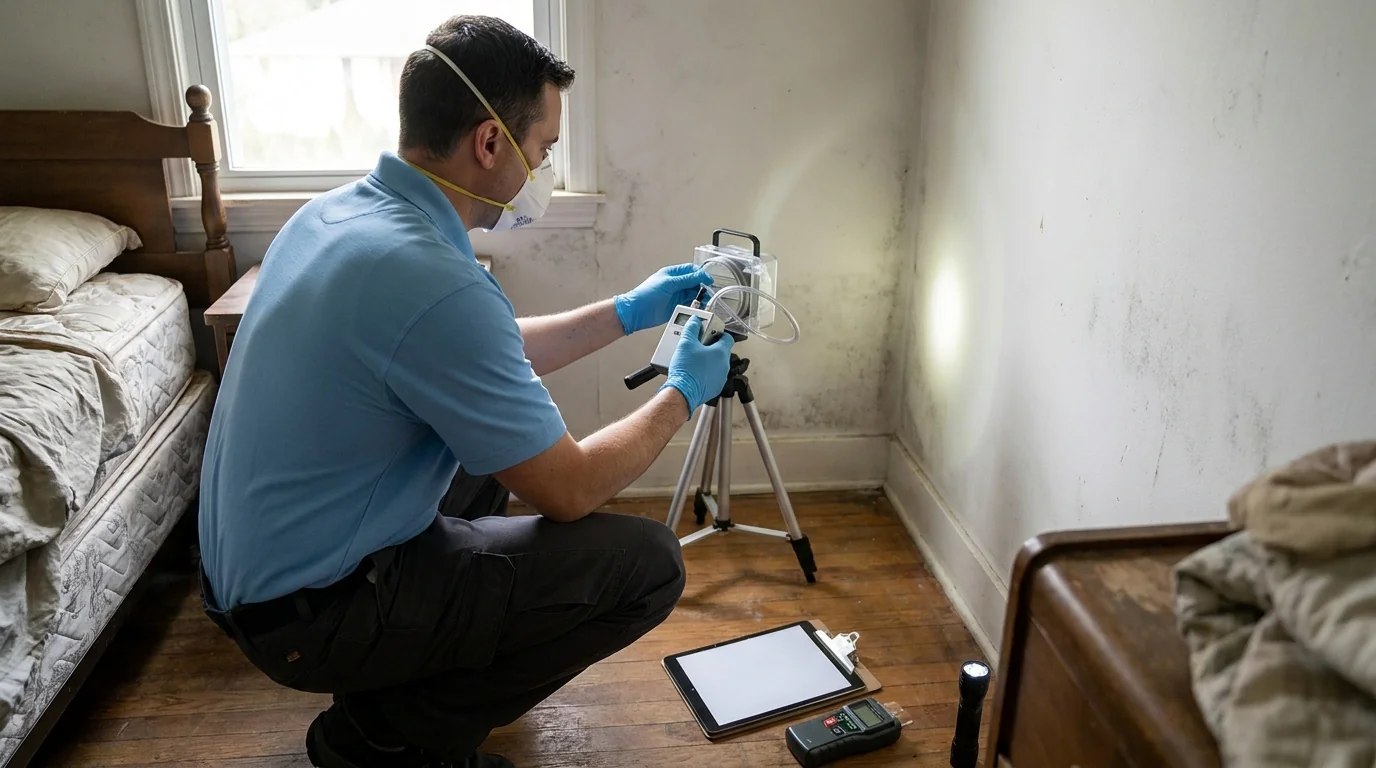
A mold inspection is not a visual scan. Our IICRC Certified Firm (#210213) technicians begin with a moisture mapping phase, using thermal imaging cameras and calibrated moisture meters to trace elevated readings back to their source, whether that’s a failed sump in a Delawanna split-level or a slow roof leak above a Botany Village flat. We document conditions with photographs and moisture readings before anything is disturbed.
From there, we collect air samples and, where surface growth is visible or suspected behind materials, swab or tape-lift samples. Those samples go to an accredited third-party laboratory for spore-count analysis and species identification. The lab report tells you not just whether mold is present, but which species, at what concentration, and how that compares to outdoor baseline levels, context that matters when you’re deciding whether remediation is urgent or whether a drying intervention alone may resolve the issue.
For Clifton’s older homes with original plaster walls, common in the Athenia and Richfield sections, we adjust our sampling approach. Plaster absorbs and holds moisture differently than modern drywall, which means active growth can exist behind a wall that reads visually clean. Thermal imaging often catches temperature differentials in plaster that standard visual inspection misses entirely.
Reaching Clifton from Kenilworth
Operating out of Kenilworth, our team reaches most of Clifton via the Garden State Parkway to Route 3, or through Route 21 north along the Passaic River corridor, the same stretch that sees the most flood-related calls after major rain events. Because we’re available around the clock, we can schedule inspections the same day you call, including early-morning slots before work or evening appointments that fit around tenant schedules in rental properties. For commercial clients along the Route 3 corridor, we can coordinate off-hours access to minimize disruption to business operations.
Local Note: What Clifton’s Flood History Means for Hidden Mold
Here’s something that comes up repeatedly in Clifton post-flood inspections: homes that had water intrusion during Ida or Irene were sometimes dried and closed up quickly, but not always completely. Insulation inside basement rim joists and under first-floor subfloors can hold residual moisture for months after the visible water is gone, and that insulation is rarely inspected unless someone is specifically looking for it. In the Lakeview section especially, we’ve found active mold colonies in rim-joist cavities years after a flood event that the homeowner believed was fully remediated. If your home flooded during either storm and you haven’t had a post-remediation air clearance test, that inspection is worth scheduling before the next rainy season.
If you’re in Clifton and you’re not sure whether what you’re smelling is a real problem or just an old house, call (855) 650-7422. We’ll give you a straight answer based on lab results, not guesswork.
Serving Clifton from our Fair Lawn headquarters — ★ 4.8 · 166 Google reviews
“Great workers, so nice and efficient! And Ottavio is the best” - Emma, October 2026Read our reviews on Google →
Mold Inspection and Testing in Clifton: Service Coverage
Frequently Asked Questions
How fast can you arrive for mold inspection and testing in Clifton?
Are homes in Lakeview and Delawanna at higher risk for mold after the Passaic River floods?
What does a mold inspection in a Botany Village multi-family building actually involve?
How long does it take to get mold test results back for a Clifton property?
Clifton's older split-levels often have original plaster walls — does that change how you test for mold?
Does homeowner's insurance in New Jersey typically cover mold inspection costs after a water loss in Clifton?
Mold Inspection and Testing response in Clifton
Most Clifton calls see a technician on-site within 60 minutes from our Fair Lawn headquarters.