24/7 Emergency Basement Flooding Cleanup in Fort Lee
24/7 emergency basement flooding cleanup in Fort Lee, NJ. IICRC-certified, insurance billing accepted. Call (855) 650-7422.
Our IICRC-certified technicians are dispatched from our Fair Lawn, NJ headquarters and are typically on-site in Fort Lee within 60 minutes of your call.
When a water main cracks beneath a Coytesville two-family or a supply line bursts on the 18th floor of a Hudson Lights tower, the water doesn’t politely stop at one unit, it travels. Fort Lee’s mix of prewar multifamily homes and dense high-rise condominium stacks means basement flooding here rarely looks like a simple puddle. It looks like saturated concrete block walls, warped subfloors, and a clock ticking toward mold colonization within 24 to 48 hours. The Restoration Group responds 24/7 to flooded basements across Fort Lee (07024) and the surrounding Bergen County area.
Why Fort Lee Properties See Basement Flooding Issues
Fort Lee sits atop the Palisades cliffs, and that geography shapes how water behaves here in ways that aren’t obvious until you’ve worked dozens of jobs in the borough. The steep grade running from the George Washington Bridge approach down toward the older residential streets means stormwater moves fast and concentrates at low points, basements in The Hill neighborhood and along the older blocks of Palisade Avenue collect runoff that flat-grade towns simply don’t see. Hurricane Ida in 2021 made that pattern impossible to ignore, pushing water into basements across Bergen County that had never flooded before.
Beyond storm events, Fort Lee’s building stock creates its own vulnerabilities. The prewar homes and multifamily buildings in Coytesville and The Hill often have original clay or cast-iron drain lines that are decades past their service life. Cracks, root intrusion, and joint failures in those lines cause slow seepage that homeowners mistake for condensation, until the floor is soaking. Meanwhile, the high-rise towers closer to the Main Street corridor generate a different problem entirely: a single failed washing-machine supply line or a pinhole in a domestic water riser can dump hundreds of gallons before a shutoff valve is located, and that water migrates down elevator shafts and mechanical chases into basement mechanical rooms and parking levels.
Our Basement Flooding Cleanup Process in Fort Lee
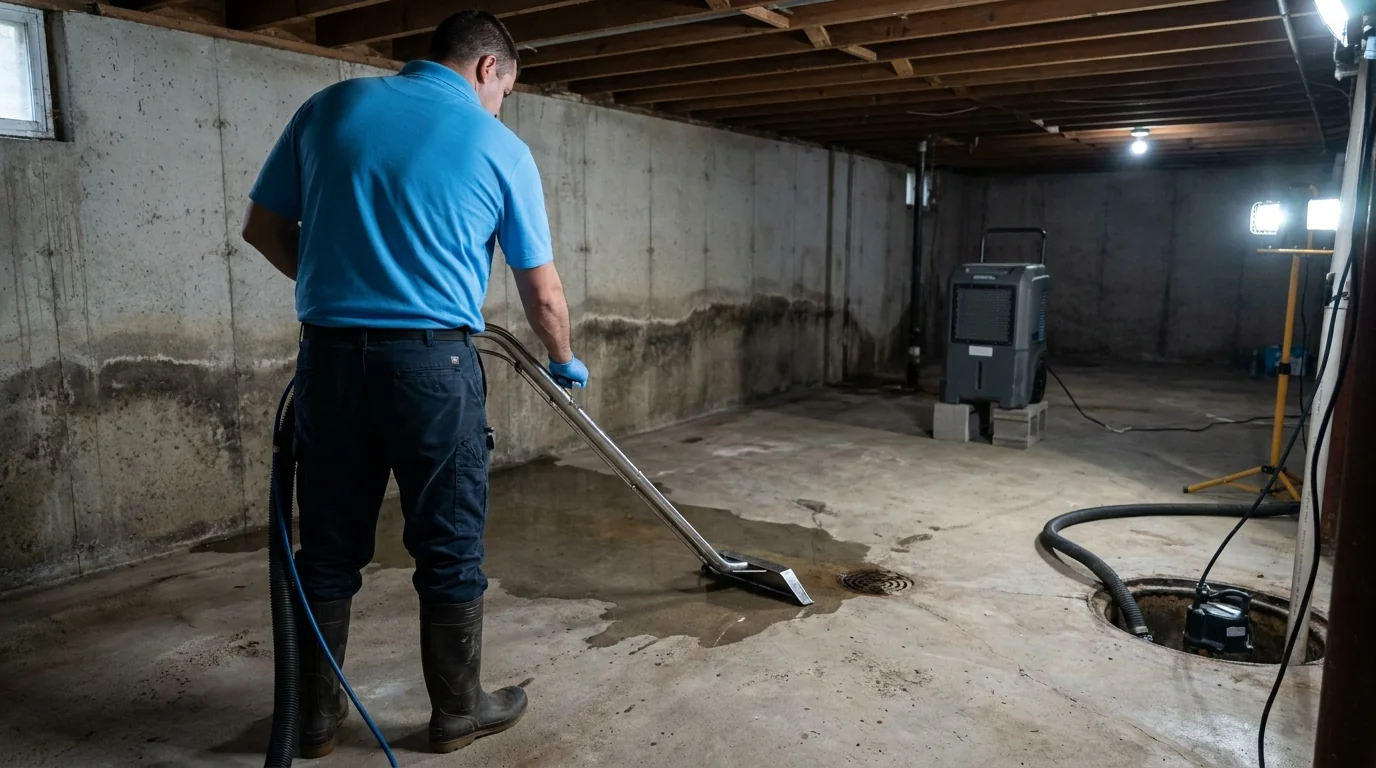
The first step on any flooded basement job is stopping the source, something that sounds obvious but gets skipped when crews rush straight to extraction. Once the water is no longer flowing, we use truck-mounted and portable extractors to pull standing water from the floor. In Fort Lee’s older homes, where basement floors are often unfinished concrete with a porous surface, that extraction phase takes longer than it does on sealed slabs because water wicks into the substrate.
After bulk water removal, we deploy industrial desiccant and refrigerant dehumidifiers alongside high-velocity air movers, calibrated to the actual cubic footage of the space. Moisture readings are taken at the concrete, at the base of any framed walls, and at the sill plate, the sill plate in particular is a failure point in older Fort Lee homes where the wood has been cycling wet and dry for generations. Affected drywall, insulation, and framing that cannot be dried in place are documented, removed, and inventoried for your insurance claim. As an IICRC Certified Firm (#210213), our drying protocols follow the S500 standard, and we monitor daily until target moisture levels are reached before any reconstruction begins.
Reaching Fort Lee from Kenilworth
The Restoration Group is based in Kenilworth, NJ, and dispatches crews 24/7. The most direct route to Fort Lee runs up Route 9W or via the Garden State Parkway to Route 46 east and across the upper deck of the George Washington Bridge, a corridor our crews know well. Traffic patterns near the GWB approach can add time during peak hours, which is why we stage equipment and coordinate dispatch as soon as a call comes in, not after we’ve assessed the job remotely. For high-rise losses in the towers near Hudson Lights or along the Main Street corridor, we confirm building access protocols with the front desk or property manager before arrival so there’s no delay getting equipment into the service elevator.
Fort Lee Insurance and HOA Coordination
Most homeowners and condo owners in Fort Lee carry standard HO-3 or HO-6 policies, and the distinction matters for basement flooding claims. An HO-6 condo policy typically covers damage originating inside the unit, but if the source is a common-area pipe or a neighbor’s unit above, the building’s master policy and potentially a third party’s liability coverage come into play. We photograph and document the loss thoroughly, source location, water migration path, affected materials with measurements, so that your adjuster has what they need to assign coverage correctly. We bill most major carriers directly and are licensed as a New Jersey Home Improvement Contractor through the NJ Division of Consumer Affairs.
Local Note
In Fort Lee’s high-rise buildings, basement mechanical rooms often share space with the building’s main electrical switchgear and elevator equipment pits. Before any extraction equipment goes in, our crew confirms with building management that the affected area has been de-energized, a step that’s sometimes skipped by less experienced crews in a rush. Elevator pits in particular collect water and are frequently the last space to get attention, but leaving standing water there accelerates corrosion on hydraulic components and creates a slip hazard for building staff. If your loss involves a basement mechanical room in a Fort Lee condo or apartment building, mention that when you call so we can coordinate the right safety steps before we arrive.
If your Fort Lee basement is holding water right now, every hour matters. Call The Restoration Group at (855) 650-7422, we answer 24 hours a day, seven days a week, and we’ll dispatch a crew to your address in Fort Lee with the equipment to start extraction immediately.
Serving Fort Lee from our Fair Lawn headquarters — ★ 4.8 · 166 Google reviews
“Great workers, so nice and efficient! And Ottavio is the best” - Emma, October 2026Read our reviews on Google →
Basement Flooding Cleanup in Fort Lee: Service Coverage
Frequently Asked Questions
How fast can you arrive for basement flooding cleanup in Fort Lee?
Are basements in Coytesville and The Hill more prone to flooding than other parts of Fort Lee?
A pipe failed in a unit above mine in a Fort Lee high-rise and water came into my basement storage area — whose insurance covers that?
How does Fort Lee's high-rise building stock change the way you approach basement water removal?
How long does basement drying typically take in Fort Lee's older prewar homes?
Does Fort Lee's location near the George Washington Bridge affect how quickly you can reach a flooded basement there?
Basement Flooding Cleanup response in Fort Lee
Most Fort Lee calls see a technician on-site within 60 minutes from our Fair Lawn headquarters.