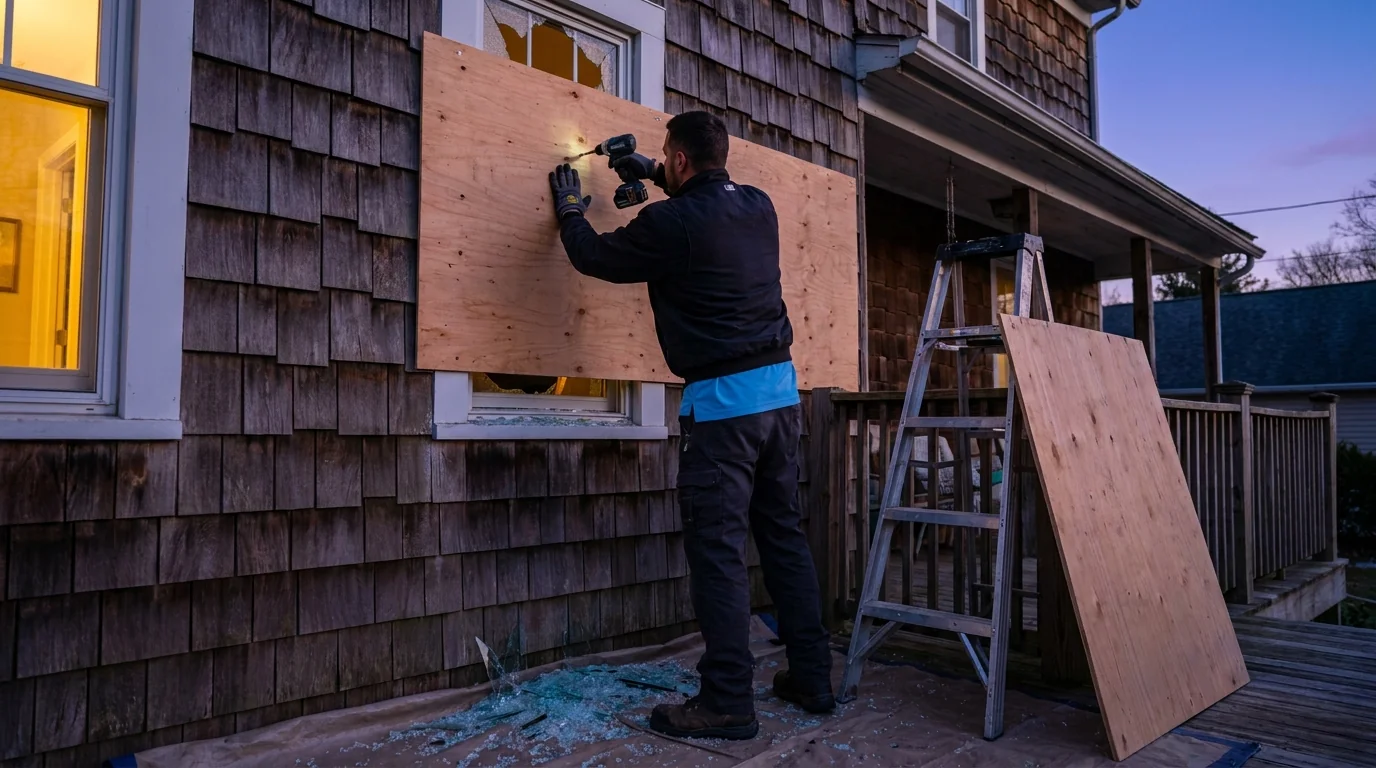
24/7 Emergency Board-Up and Tarping in Fort Lee
24/7 emergency board-up and tarping in Fort Lee, NJ. IICRC-certified, insurance billing accepted. Call (855) 650-7422.
Our IICRC-certified technicians are dispatched from our Fair Lawn, NJ headquarters and are typically on-site in Fort Lee within 60 minutes of your call.
When a fire tears through a high-rise on the Palisades or a nor’easter peels back roofing on one of Coytesville’s older two-families, the window between the initial damage and the next wave of loss is measured in hours, not days. Fort Lee’s combination of densely stacked residential towers, prewar multifamily homes, and cliff-top exposure to Hudson Valley storm systems makes rapid board-up and tarping less a convenience and more a structural necessity. The Restoration Group responds 24/7 out of Kenilworth, NJ, and carries IICRC Firm Certification (#210213) alongside an NJ Licensed Home Improvement Contractor credential, so the crew showing up at your door is qualified to do the job right the first time.
Why Fort Lee Properties Face Distinct Board-Up and Tarping Needs
Fort Lee’s geography does a lot of the damage before weather even arrives. The borough sits at the top of the Palisades cliffs, and steep-grade drainage means that storm runoff accelerates off rooftops and through compromised flashing faster than it would on flat terrain. A small breach in a roof membrane, the kind that might drip slowly in Paramus, can channel sheets of water into a structure here within minutes.
The housing stock compounds the challenge. Along the cliff-line and around the Hudson Lights mixed-use complex, glass-curtain-wall towers and modern mid-rises dominate, where a single broken window or fire-damaged facade can expose dozens of stacked units to wind, rain, and security risk simultaneously. A few blocks inland, The Hill and Coytesville neighborhoods hold prewar wood-frame and brick multifamily buildings, some dating to the 1920s, where original single-pane windows, aging roof decking, and unreinforced masonry openings require board-up approaches calibrated to older framing rather than modern stud spacing. One size does not fit both.
Fire damage is a particular driver of board-up calls in Fort Lee’s denser corridors. The Main Street business district and surrounding mixed-use blocks see commercial kitchen fires, electrical events, and vandalism that leave storefronts and upper-floor apartments exposed. After Tropical Storm Ida swept through Bergen County in 2021, the volume of emergency tarping calls in the 07024 ZIP code reflected just how quickly a compromised roof becomes a flooded interior.
Our Emergency Board-Up and Tarping Process in Fort Lee
When you call (855) 650-7422, dispatch begins immediately. A crew is routed toward Fort Lee while a project lead contacts you to gather access details, because in a high-rise building near the George Washington Bridge approach, getting to the right floor, coordinating with a doorman or property manager, and staging materials in a loading dock is a logistics step that can’t wait until arrival.
On-site, the process follows a documented sequence:
- Damage assessment, We photograph and measure every opening, document structural conditions, and identify secondary hazards (live utilities, unstable debris, compromised load-bearing elements) before any material goes up.
- Structural openings secured first, Roof breaches and large wall openings get priority because they carry the highest water-intrusion risk. We use heavy-duty polyethylene tarps anchored with furring strips and screw-fastened battens rather than staples alone, which pull free under wind load.
- Window and door board-up, Openings are measured and cut to fit. We use 3/4-inch OSB for standard residential openings and can source thicker stock for commercial storefronts. Boards are fastened into framing, not just the window casing, to resist forced entry.
- Documentation package, Every opening is photographed before and after securing. This file goes directly to your insurance adjuster and, where applicable, to your building’s HOA or property management company.
Fort Lee Insurance and HOA Coordination
Fort Lee’s condominium towers operate under some of the more detailed HOA governance structures in Bergen County. Many buildings along the Palisades have master policies that cover the building shell while unit owners carry HO-6 policies for interior improvements, which means a board-up job that spans both a broken exterior window and interior framing can involve two separate claims with two separate adjusters.
We document losses in a format that separates exterior structural work from interior mitigation, making it easier for adjusters to allocate costs correctly. If your building’s property manager needs a certificate of insurance or a scope-of-work letter before we can access the property, we have those documents ready to transmit before the crew leaves Kenilworth.
Local Note: High-Rise Staging on the Palisades
One thing that surprises property owners unfamiliar with Fort Lee’s tower buildings: loading dock access and freight elevator scheduling can add meaningful time to a board-up job on upper floors. Several of the high-rise condominiums along the Palisades cliff line restrict freight elevator use to specific hours, and some require advance notice to building security before contractors bring materials through the lobby. When we receive a call from a building in this corridor, our dispatcher asks for the property manager’s direct contact number at the same time as the unit address, so we can clear access logistics in parallel with driving time rather than discovering a locked freight entrance on arrival.
Call (855) 650-7422 any time, day or night, and The Restoration Group will dispatch a board-up and tarping crew to your Fort Lee property. Whether you’re dealing with fire damage in a Coytesville two-family or a storm-breached roof on a Palisades high-rise, we’ll secure the structure, document the loss, and hand you a file your insurance carrier can act on.
Serving Fort Lee from our Fair Lawn headquarters — ★ 4.8 · 166 Google reviews
“Great workers, so nice and efficient! And Ottavio is the best” - Emma, October 2026Read our reviews on Google →
Emergency Board-Up and Tarping in Fort Lee: Service Coverage
Frequently Asked Questions
How fast can you arrive for emergency board-up and tarping in Fort Lee?
How quickly can The Restoration Group reach a property in Fort Lee's Coytesville or The Hill neighborhoods?
Fort Lee has a lot of high-rise condos — can you board up a unit on an upper floor of a Palisades tower?
Does Fort Lee's mix of prewar homes and modern towers change how you approach a board-up job?
What materials do you use for roof tarping, and how do they hold up against nor'easters hitting the Palisades?
My Fort Lee condo building has a master HOA policy and I carry an HO-6 — how does board-up documentation work across two claims?
Will my homeowners insurance cover emergency board-up and tarping in Fort Lee?
Emergency Board-Up and Tarping response in Fort Lee
Most Fort Lee calls see a technician on-site within 60 minutes from our Fair Lawn headquarters.