
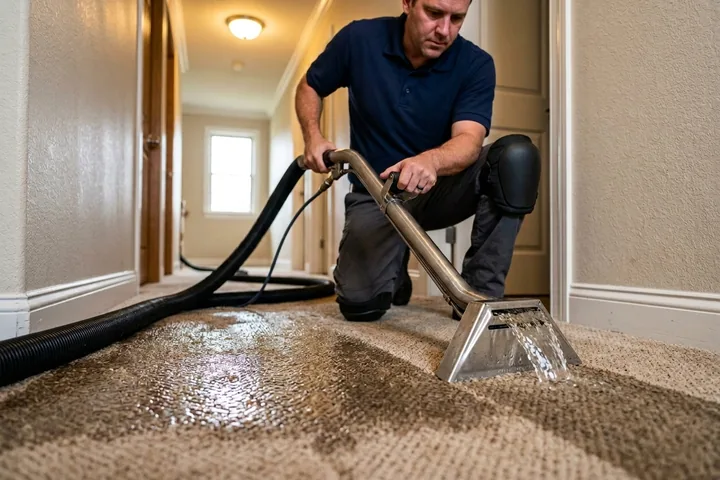
24/7 Emergency Water Removal & Cleanup in Fort Lee
24/7 emergency water removal and cleanup in Fort Lee, NJ. IICRC-certified, insurance billing accepted. Call (844) 808-8838.
Our IICRC-certified technicians are dispatched from our Fair Lawn, NJ headquarters and are typically on-site in Fort Lee within 60 minutes of your call.
Water damage emergency in Fort Lee? We answer 24/7, and when the call involves a stacked high-rise above the Palisades, every floor below the leak is a second emergency waiting to happen. Water from a failed supply line in a Hudson Lights-area tower doesn’t just pool, it finds the path of least resistance through riser shafts and unit-to-unit penetrations, soaking ceilings and walls several floors down before anyone upstairs even notices the carpet is wet.
Why Fort Lee Properties See Water Emergencies
Fort Lee’s building stock splits into two very different risk profiles. Along the cliffs, dense high-rise condo and apartment towers mean a single burst supply line or failed washing machine hose in one unit can cascade through drywall, flooring, and electrical chases into the units below, sometimes affecting five or six floors before a building engineer shuts the main. In Coytesville and The Hill, older prewar homes and small multifamily buildings bring a different problem: original cast-iron and galvanized plumbing that’s well past its service life, plus basements built into sloped lots where the Palisades grade pushes groundwater and storm runoff straight at foundation walls. Add the kind of storm Fort Lee saw with Ida in 2021, when rainfall overwhelmed drainage across Bergen County, and you get flooding events that hit both the high-rises and the older housing stock in the same week.
Our Emergency Water Removal & Cleanup Process in Fort Lee
The first step on any call is figuring out where the water actually came from and where it’s still traveling, which matters more in a Fort Lee high-rise than almost anywhere else we work. In a condo tower, we’re often coordinating with building management or an engineer to confirm the source is shut off before extraction starts, since water behind a shared wall can keep feeding into a unit long after the visible puddle is gone. Once the source is controlled, we move to standing water removal with truck-mounted and portable extraction equipment sized to the space, whether that’s a one-bedroom unit near Main Street or a finished basement in Linwood. Moisture mapping follows, using meters to check subfloor, drywall, and framing readings against the IICRC S500 standard, because surface-dry materials can still be holding water deep inside the assembly. Drying equipment stays in place and gets monitored daily until readings confirm the structure is back to normal, not just until the floor feels dry to the touch.
Fort Lee Insurance and HOA Coordination
Water losses in Fort Lee’s condo and co-op buildings almost always involve two layers of paperwork: the unit owner’s policy and the building’s master policy, and figuring out which one covers what can slow a claim down if nobody documents the loss properly from the start. We photograph and log affected materials as we go and can provide documentation formatted for both the individual carrier and, when needed, the HOA or management company’s insurer. For buildings that require board or management sign-off before work begins, we’re used to that extra coordination step and build it into the timeline rather than treating it as a surprise.
Local note
One detail that trips up out-of-town crews: Fort Lee’s high-rises along the Palisade and Central Fort Lee corridor often route plumbing risers through shared chases that run behind closet walls rather than exposed utility rooms, so a leak that shows up as a stain in a bedroom closet two floors down can have its actual source three units away horizontally. We’ve learned to ask building engineers for riser diagrams early rather than assuming the leak is directly overhead.
Standing water doesn’t wait for a convenient hour, and in a Fort Lee high-rise it doesn’t stay contained to one unit either. Whether you’re dealing with a burst pipe near Fort Lee Historic Park, a flooded basement in Coytesville, or a supply line failure in a tower overlooking the George Washington Bridge, call (844) 808-8838 and we’ll get a crew moving on emergency water removal and cleanup.
Serving Fort Lee from our Fair Lawn headquarters — ★ 4.8 · 171 Google reviews
“Honest people, super quick and very professional! I recommend them entirely.” - Jennifer, November 2026Read our reviews on Google →
Emergency Water Removal & Cleanup in Fort Lee: Service Coverage
Frequently Asked Questions
How fast can you arrive for emergency water removal & cleanup in Fort Lee?
How does water damage in a Fort Lee high-rise differ from a single-family home?
Do Fort Lee condo and co-op buildings require HOA or management approval before you start work?
Are Coytesville and The Hill more prone to basement flooding than other parts of Fort Lee?
What equipment do you use for standing water removal in a Fort Lee apartment or condo unit?
Does Fort Lee's ZIP code 07024 area affect how quickly you can respond?
Will my homeowners insurance cover emergency water removal & cleanup in Fort Lee?
Emergency Water Removal & Cleanup response in Fort Lee
Most Fort Lee calls see a technician on-site within 60 minutes from our Fair Lawn headquarters.