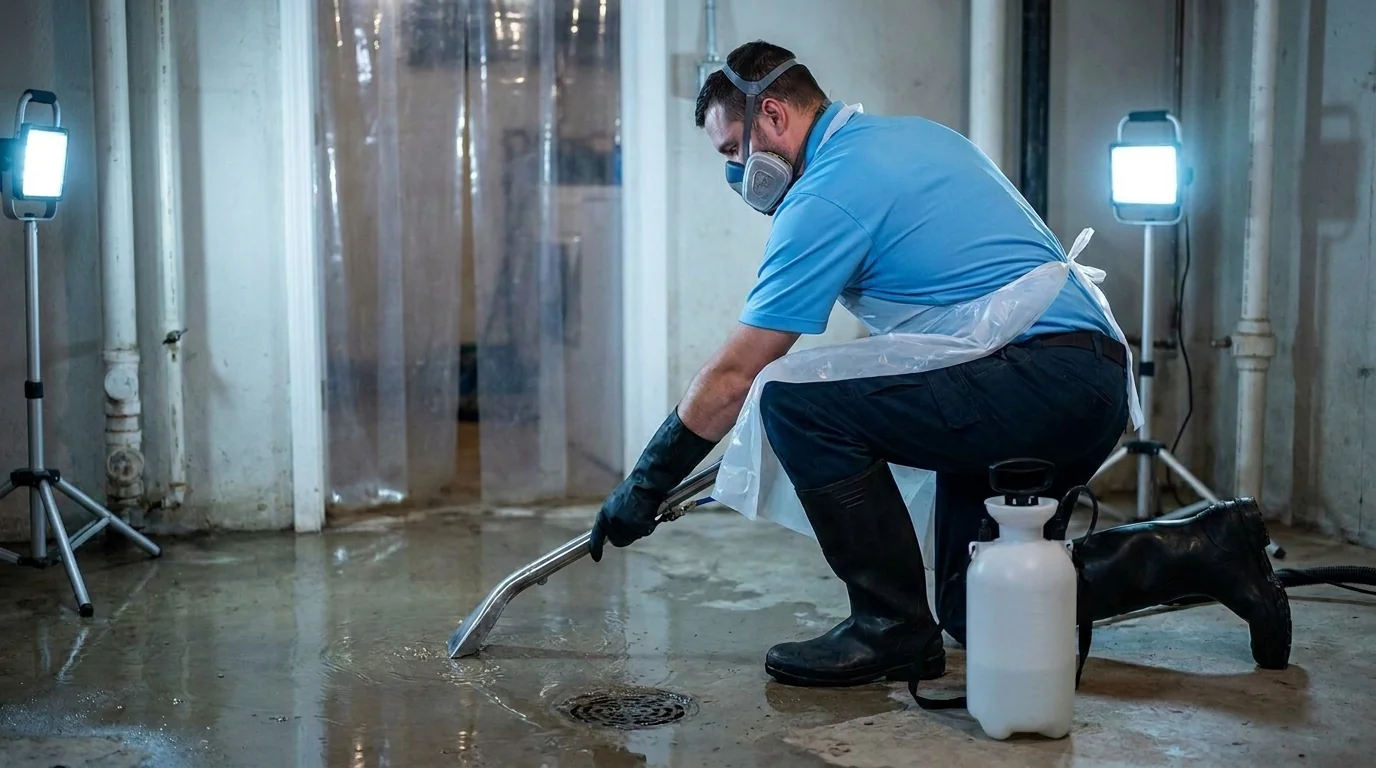
24/7 Emergency Sewage Cleanup and Sanitization in Fort Lee
24/7 emergency sewage cleanup and sanitization in Fort Lee, NJ. IICRC-certified, insurance billing accepted. Call (855) 650-7422.
Our IICRC-certified technicians are dispatched from our Fair Lawn, NJ headquarters and are typically on-site in Fort Lee within 60 minutes of your call.
Sewage backup in Fort Lee? We answer 24/7. Call now and our crew can be on-site within 60 minutes to contain the contamination and start the cleanup.
When a sewer line backs up inside a Fort Lee high-rise, the contamination rarely stays contained to one unit. Wastewater travels fast through shared drain stacks, and by the time a resident on the fourth floor notices the smell, the unit below may already have standing Category 3 water soaking into subfloor concrete. Whether the source is a clogged lateral line in one of the older prewar buildings in Coytesville, a failed ejector pump in a basement apartment on The Hill, or a main-line blockage in one of the Palisades-edge towers, the response has to be immediate, and the sanitization has to be thorough.
Why Fort Lee Properties See Sewage Backup Issues
Fort Lee’s building stock creates conditions that amplify sewage losses in ways that aren’t common in lower-density towns. The dense cluster of high-rise condominium and rental towers along the Palisades cliffs means a single in-unit supply-line or drain failure can cascade vertically through stacked units before anyone calls for help. In those buildings, shared plumbing chases and aging cast-iron drain stacks, many installed decades ago, are prone to root intrusion, grease buildup, and joint failures that send raw sewage backward into kitchens and bathrooms.
In the older residential pockets of Coytesville and The Hill, the picture is different but equally challenging. Many homes there were built before modern sewer infrastructure was standardized, and some properties still rely on lateral lines that run beneath steep-grade terrain. Fort Lee sits atop the Palisades cliffs, and that elevation change drives aggressive stormwater runoff, during heavy rain events like the remnants of Hurricane Ida in 2021, overwhelmed municipal lines pushed sewage back into basements across Bergen County, including throughout the 07024 ZIP code. When ground saturation is high, even a properly functioning lateral can reverse under hydrostatic pressure.
The Main Street business district and the Hudson Lights mixed-use complex add a commercial dimension: ground-floor retail and restaurant tenants share drain infrastructure with upper-floor residential units, and a blockage in a commercial kitchen line can affect multiple floors of apartments above.
Our Sewage Cleanup and Sanitization Process in Fort Lee
Raw sewage is classified as Category 3 water, the most contaminated classification under the IICRC S500 standard, which means the removal and sanitization protocol is more involved than a standard water loss. The process begins with containment: we isolate the affected area to prevent cross-contamination to clean spaces, which is especially important in high-rise buildings where HVAC systems can distribute airborne pathogens across multiple units.
Extraction comes next. Standing sewage is removed using truck-mounted and portable extraction equipment, followed by the removal of any porous materials, drywall, flooring, insulation, that cannot be adequately disinfected. In Fort Lee’s older multifamily buildings, this often includes original hardwood subfloors or plaster assemblies that have absorbed contaminated water deeply. After physical removal, all affected surfaces are treated with EPA-registered disinfectants rated for Category 3 losses. We apply antimicrobial agents to structural cavities, not just visible surfaces, because sewage contamination wicks into wall framing and concrete block faster than most homeowners expect.
Drying and dehumidification follow sanitization, using commercial-grade desiccant and refrigerant dehumidifiers. In Fort Lee’s high-rise units, where concrete construction slows evaporation compared to wood-frame homes, drying timelines typically run longer, we monitor moisture readings daily and document every reading for insurance purposes.
Fort Lee Insurance and HOA Coordination
Sewage backups in Fort Lee’s condominium towers frequently involve disputes between unit owners and HOA or building management over where responsibility begins and ends. The answer usually depends on whether the blockage originated in the unit’s private lateral or in the building’s shared main stack, a distinction that matters both for remediation scope and for which insurance policy responds. We document the source and affected areas thoroughly from the moment we arrive, providing the photo evidence and written scope that adjusters and HOA boards need to resolve those disputes quickly.
For commercial losses along the Main Street corridor or in mixed-use buildings, we coordinate directly with property managers and can provide the documentation formats required by most commercial carriers. As an NJ Licensed Home Improvement Contractor registered with the NJ Division of Consumer Affairs, we carry the licensing and insurance documentation that building managers and HOAs typically require before authorizing work.
Local Note
In Fort Lee’s Palisades-edge high-rises, building management often requires that contractors use service elevators and designated freight entrances, and those elevators are frequently shared with other vendors during business hours. On multi-unit sewage losses where we’re moving extraction equipment and contaminated material between floors, we coordinate staging and elevator access with the building superintendent before work begins. Skipping that step can add hours to a job and create friction with HOA management at exactly the wrong moment. It’s a small operational detail, but it’s the kind of thing that separates a clean job from a complicated one in a dense vertical building.
If you’re dealing with a sewage backup anywhere in Fort Lee, from a Coytesville basement to a Palisades high-rise, call The Restoration Group at (855) 650-7422. Our IICRC Certified Firm team responds 24/7, and we’ll have a crew moving toward you while you’re still on the phone.
Serving Fort Lee from our Fair Lawn headquarters — ★ 4.8 · 166 Google reviews
“Great workers, so nice and efficient! And Ottavio is the best” - Emma, October 2026Read our reviews on Google →
Sewage Cleanup and Sanitization in Fort Lee: Service Coverage
Frequently Asked Questions
How fast can you arrive for sewage cleanup and sanitization in Fort Lee?
How quickly can The Restoration Group reach a sewage backup in Fort Lee's high-rise buildings along the Palisades?
In a Fort Lee condo building, who is responsible for sewage cleanup costs — the unit owner or the HOA?
Are older homes in Coytesville and The Hill more vulnerable to sewer backups during heavy rain?
What does Category 3 sewage cleanup actually involve, and why does it take longer than a standard water loss?
Does Fort Lee's 07024 ZIP code have any specific permit or inspection requirements for sewage remediation work?
Will my homeowners insurance cover sewage cleanup and sanitization in Fort Lee?
Sewage Cleanup and Sanitization response in Fort Lee
Most Fort Lee calls see a technician on-site within 60 minutes from our Fair Lawn headquarters.
Nearby & Related
- 24/7 Emergency Sewage Cleanup and Sanitization in Kenilworth
- Restoration Services in Fort Lee
- 24/7 Emergency Fire Damage Restoration in Fort Lee
- Mold Remediation in Fort Lee
- 24/7 Emergency Sewage Cleanup and Sanitization in Bayonne
- 24/7 Emergency Sewage Cleanup and Sanitization in Bloomfield
- Contact The Restoration Group