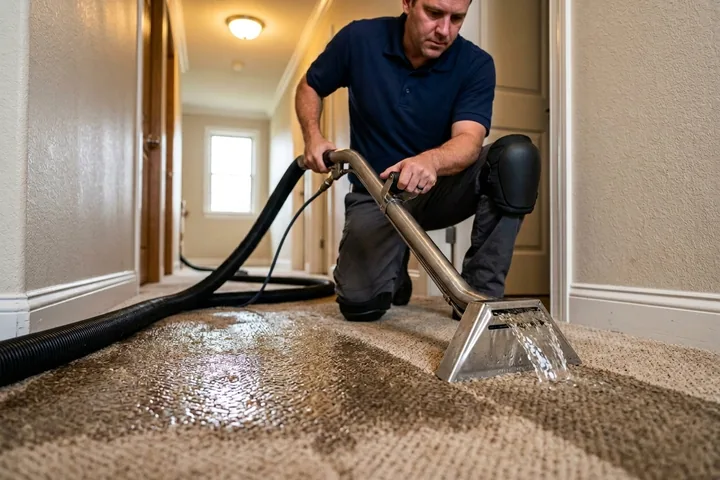
Water Cleanup in Hackensack
24/7 water cleanup in Hackensack, NJ. IICRC-certified, insurance billing accepted. Call (855) 650-7422.
Our IICRC-certified technicians are dispatched from our Fair Lawn, NJ headquarters and are typically on-site in Hackensack within 60 minutes of your call.
When a pipe lets go in one of Hackensack’s stacked Prospect Avenue high-rises or a nor’easter pushes the Hackensack River over its banks into low-lying basements near the Southside, the clock starts immediately. Water migrates through floor assemblies, saturates decades-old plaster and lathe, and begins feeding mold colonies within 24 to 48 hours. The Restoration Group responds 24/7 to water cleanup calls across Hackensack, reaching 07601 and 07602 ZIP codes from our Kenilworth base, so the damage stops spreading before it compounds.
Why Hackensack Properties See Water Damage Differently
Hackensack’s building stock creates conditions that most generic water damage guides don’t account for. The city’s prewar two- and three-family homes, common throughout the Fairmount neighborhood and along older residential blocks near the Bergen County Courthouse, were built with cast-iron drain stacks and galvanized supply lines that are now well past their design life. Galvanized pipe corrodes from the inside out, narrowing over decades until pressure spikes during cold snaps crack the fitting entirely. You won’t see it coming, and when it fails, it often fails behind a plaster wall.
The Hackensack River’s tidal influence compounds the problem on the eastern side of the city. Storm surge doesn’t drain the way it does in inland towns, water table rises, floor drains back up, and sump pumps that were adequate for ordinary rain events get overwhelmed. Tropical Storm Ida in 2021 demonstrated exactly this across Bergen County, pushing water into basements that had never flooded before. Properties near Johnson Park and lower-lying corridors toward the river are especially vulnerable during back-to-back storm events when the ground is already saturated.
The Prospect Avenue corridor introduces a different risk profile: high-density residential towers where a single failed supply line or washing machine hose on an upper floor sends water cascading through drywall, drop ceilings, and subflooring across multiple units simultaneously. A loss that starts on the eighth floor can show up on the sixth before anyone smells it.
Our Water Cleanup Process in Hackensack
Water cleanup in Hackensack isn’t a one-size process. The approach shifts depending on whether we’re working in a prewar plaster building, a mid-century cape with a finished basement, or a commercial space in the Main Street business district.
We begin with moisture mapping, thermal imaging and calibrated meters that read behind surfaces, not just at them. Plaster walls in older Hackensack homes are dense enough to read dry at the face while the lath and framing behind them hold significant moisture. Missing that hidden saturation is how a “finished” job turns into a mold call six weeks later.
From there, the process follows the IICRC S500 standard for water damage restoration: contamination classification, controlled extraction of standing water, strategic placement of commercial desiccant dehumidifiers and air movers, and daily moisture readings until materials reach documented dry standards. We photograph and log every reading, that documentation matters when you’re filing with your carrier.
For multi-unit buildings along Prospect Avenue or commercial properties near Hackensack University Medical Center, we coordinate directly with property managers and, where required, building superintendents to ensure access across affected units without disrupting unaffected residents.
Reaching Hackensack from Kenilworth
Our Kenilworth headquarters puts us on Route 22 East to the Garden State Parkway or up through Union and Essex counties to Route 17 North, routes that keep response times tight across Bergen County around the clock. Hackensack’s grid is straightforward once you’re off the highway, which matters when we’re staging equipment in dense neighborhoods near the Central Business District or navigating the narrow residential blocks in the Heights. We’re available 24 hours a day, seven days a week, including holidays.
Hackensack Insurance Coordination
Most standard homeowner policies cover sudden and accidental water losses, burst pipes, appliance failures, overflow events. What they typically exclude is gradual leakage, so the documentation we create from the first hour on-site matters. We itemize affected materials, photograph moisture readings, and produce the scope of work in a format carriers recognize. We bill major insurers directly and work with adjusters throughout the claim so you’re not managing the paperwork while also managing a displaced household.
For commercial properties and multi-unit buildings, losses often involve multiple policies and multiple parties. We’ve worked through those coordination layers before and can communicate directly with property managers, building owners, and their respective carriers.
Local Note: Plaster Buildings and Hidden Moisture
In Hackensack’s older Fairmount and Southside homes, the plaster-and-lath wall system that was standard construction through the mid-twentieth century behaves very differently from modern drywall during a water loss. Plaster is dense and slow to absorb, but once it’s saturated, especially the brown coat, it releases moisture back into the air over an extended drying cycle. Surface readings can drop to acceptable levels days before the framing behind the wall reaches equilibrium. We extend the drying validation period on plaster structures and don’t close out a job based on face readings alone. Cutting corners on that step is how structural damage and mold problems develop after a crew has already left.
If you’re dealing with standing water, wet flooring, or visible water intrusion anywhere in Hackensack, call The Restoration Group at (855) 650-7422. We’ll assess the damage, explain what the drying process looks like for your specific building, and get extraction equipment on-site the same day.
Serving Hackensack from our Fair Lawn headquarters — ★ 4.8 · 160 Google reviews
“Prompt and professional work. Kept in contact thru out the process which was very important to me.” — F., July 2026Read our reviews on Google →
Water Cleanup in Hackensack: Service Coverage
Frequently Asked Questions
How fast can you arrive for water cleanup in Hackensack?
How quickly can The Restoration Group reach a water emergency in Hackensack's Prospect Avenue high-rises or the Southside?
Are older homes in Fairmount and the Heights more complicated to dry out after a water loss?
My basement flooded during a heavy storm near the Hackensack River — does homeowner's insurance cover that?
A pipe burst in an upper unit of our Prospect Avenue building and water came through to the floors below — how does cleanup work across multiple units?
How long does water cleanup typically take in a Hackensack home with finished basement space?
Water Cleanup response in Hackensack
Most Hackensack calls see a technician on-site within 60 minutes from our Fair Lawn headquarters.