Water Cleanup in Kenilworth
24/7 water cleanup in Kenilworth and surrounding areas. IICRC-certified, insurance billing accepted. Call (855) 650-7422.
Standing water is only part of the problem. Within the first hour after a pipe bursts or a basement floods, water is already moving, wicking into drywall, traveling under flooring, and saturating insulation behind walls where no mop or wet-vac can reach it. The visible puddle is the easy part. What gets left behind in framing cavities, subfloor assemblies, and wall cavities is what turns a manageable water event into a mold problem or a structural repair. Water cleanup done right means getting every hidden pocket of moisture out before it has a chance to colonize.
What water cleanup actually involves
Professional water cleanup is not mopping and running fans. It starts with identifying where the water has actually traveled, not just where it pooled, using thermal imaging cameras and penetrating moisture meters that read saturation levels inside wall assemblies, not just at the surface. A wall can feel dry to the touch while the lath or OSB behind it is still reading above 20% moisture content, well above the threshold where mold growth becomes likely.
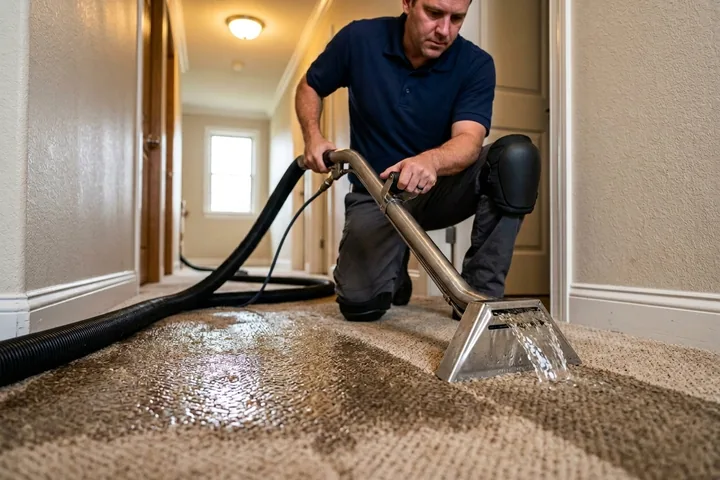
Once the full extent of saturation is mapped, the work moves to extraction: truck-mounted or portable extraction units that pull standing water and then work on surface-absorbed moisture in carpet, pad, and concrete. After extraction, the drying phase begins, a combination of commercial-grade low-grain refrigerant (LGR) dehumidifiers and high-velocity air movers positioned to create a drying chamber around affected materials. This is not the same as renting a dehumidifier from a hardware store. LGR units pull moisture from the air at much lower grain levels than consumer units, which matters significantly in New Jersey’s humid summers.
Moisture readings are logged daily. Drying is not complete when materials feel dry, it is complete when moisture meter readings return to pre-loss baselines for the specific material type. For most residential losses, structural drying takes three to five days under active equipment. Concrete slabs and thick lumber assemblies can take longer.
Category of water matters throughout. Clean water from a supply line (Category 1) is handled differently than gray water from an appliance overflow (Category 2) or black water from sewage or floodwater (Category 3). Category 2 and 3 losses require antimicrobial treatment of affected surfaces and, in many cases, removal of porous materials that cannot be adequately sanitized.
Our process
-
Emergency contact and site assessment, The moment you call (855) 650-7422, we begin routing a crew. On arrival, we determine the water category, identify the source if it is still active, and map moisture migration using thermal and meter readings before a single piece of equipment is placed.
-
Water extraction, High-powered extraction removes standing water and pulls absorbed moisture from carpet, pad, and hard-surface flooring. In basement losses, this step may also involve sump management and debris removal before extraction equipment can be positioned.
-
Structural drying and containment, LGR dehumidifiers and air movers are set to dry affected structural materials in place wherever possible. For Category 2 or 3 losses, containment barriers are established to prevent cross-contamination to unaffected areas, and antimicrobial agents are applied to all exposed surfaces.
-
Daily moisture monitoring, A technician returns each day to log moisture readings, reposition equipment as materials dry, and document progress. This daily log becomes part of the claim file.
-
Clearance and scope documentation, When all readings return to acceptable baselines, equipment is removed and a final moisture report is generated. If building materials need to be removed or replaced, a written scope of work is prepared before any reconstruction begins.
What separates a good water cleanup response from a bad one
The most common failure in water cleanup is stopping at what is visible. Extraction crews who pull the standing water, run fans for a day, and call the job dry are leaving moisture in wall cavities and subfloor assemblies that will not show up until mold does, often weeks later, and sometimes behind freshly painted drywall.
A second common problem is incorrect equipment sizing. Drying calculations are based on the volume of the drying chamber, the material types present, and the ambient humidity conditions. Under-dehumidifying a space extends the drying window and increases the chance of secondary damage. Over-dehumidifying without adequate air movement creates uneven drying that can warp hardwood flooring and cause drywall to crack.
Insurance adjusters and independent moisture consultants look for daily moisture logs with specific readings tied to specific materials and locations. A claim file that shows only “equipment placed” and “equipment removed” without daily readings is a red flag that the drying was not properly monitored. IICRC Certified Firm #210213, The Restoration Group documents every reading, every day, in a format that holds up to adjuster review.
For Category 2 and 3 losses, adjusters also look for documentation that antimicrobial treatment was applied and that non-salvageable porous materials were properly removed rather than dried in place. Drying sewage-contaminated drywall in place is not an acceptable remediation, it is a liability.
What does water cleanup cost?
Typical costs for residential water cleanup depend on the size of the affected area, the water category, and how far moisture has migrated into structural assemblies. Most homeowners pay somewhere in the ranges below, these are industry-typical figures, not quotes.
| Scenario | Typical industry range |
|---|---|
| Single room, Category 1 (clean water) | $1,200 – $3,500 |
| Multi-room, Category 1 | $3,500 – $7,000 |
| Single room, Category 2 (gray water) | $2,500 – $5,500 |
| Basement flood, Category 2 or 3 | $4,000 – $12,000 |
| Whole-floor or multi-story loss | $8,000 – $20,000+ |
| Sewage backup with material removal | $3,500 – $9,000 |
Every loss is different, and The Restoration Group provides a written scope before any work begins. Homeowners insurance typically covers sudden and accidental water losses, a burst pipe, an appliance failure, or storm-driven water entry, but generally excludes gradual leaks or flood water originating from ground-level overflow, which falls under separate flood insurance.
Seasonal and regional considerations
Kenilworth and the surrounding Union County area sit in a climate zone where freeze-thaw cycles between December and March are a consistent source of pipe failures. Supply lines in exterior walls and uninsulated crawl spaces are particularly vulnerable during hard freezes, and the failures often do not present until the pipe thaws, sometimes days after the freeze event, when the homeowner assumes the danger has passed.
Summer humidity in northern New Jersey creates a secondary risk: when air-conditioned interior spaces meet humid outdoor air through a compromised envelope, condensation can accumulate inside wall assemblies without any plumbing failure at all. This type of moisture intrusion is slower and easier to miss, but it creates the same mold conditions as a fast acute loss.
Basements throughout the region, particularly in older neighborhoods with clay-heavy soils and aging drain tile, are prone to hydrostatic intrusion during heavy rainfall events. Flood water cleanup in these situations is a Category 3 loss by default, regardless of how the water looks, because groundwater carries contaminants that clean municipal water does not.
Service area
The Restoration Group is based in Kenilworth, NJ and serves communities throughout Union, Essex, Middlesex, and Morris counties, including Cranford, Westfield, Summit, Springfield, Clark, Rahway, Linden, Roselle, and surrounding areas. Each city service page links back here for the full technical detail on what water cleanup involves. If your town is not listed, call, coverage extends throughout northern and central New Jersey.
If you are looking at water on your floor right now, the clock on secondary damage is already running. Call (855) 650-7422 to schedule your moisture assessment, a technician will map the full extent of the loss and give you a written scope before any work begins.
Frequently Asked Questions
Does homeowners insurance cover water cleanup?
How long does structural drying actually take after a water loss?
What is the difference between Category 1, 2, and 3 water, and why does it matter for cleanup?
Can water travel further than where I can see it?
What should I do while waiting for the crew to arrive?
Looking for the best water cleanup company in Fair Lawn?
The Restoration Group provides licensed and insured water cleanup in Fair Lawn, NJ and the surrounding area, and has served local property owners since 2021. Customers rate us 4.8 out of 5 stars across 160 Google reviews. We answer calls 24/7 — call (908) 970-8533 for immediate help.
Need Water Cleanup now?
We respond 24/7 across Fair Lawn and surrounding NJ cities.
Related Coverage
- Our Restoration Services
- Contact The Restoration Group
- Water Cleanup in Bayonne
- Water Cleanup in Bloomfield
- Water Cleanup in Bridgewater
- Water Cleanup in Brooklyn
- Water Cleanup in Clark
- Water Cleanup in Clifton
- Water Cleanup in Cranford
- Water Cleanup in East Brunswick
- Water Cleanup in East Orange
- Water Cleanup in Edison
- Water Cleanup in Elizabeth
- Water Cleanup in Englewood