Mold Inspection and Testing in Hillside
24/7 mold inspection and testing in Hillside, NJ. IICRC-certified, insurance billing accepted. Call (855) 650-7422.
Our IICRC-certified technicians are dispatched from our Fair Lawn, NJ headquarters and are typically on-site in Hillside within 60 minutes of your call.
Hillside’s housing stock tells a story in moisture. The 1920s–1950s colonials and two-families packed into neighborhoods like Saybrook and Winans were built before vapor barriers were standard, and their unfinished or semi-finished basements sit directly on slab or rubble-stone foundations that wick groundwater year-round. When Tropical Storm Ida pushed the Elizabeth River over its banks in 2021 and drove sewer backups into those same basements, many homeowners dried out the visible water and moved on, not realizing that mold can begin colonizing porous concrete, wood framing, and fiberglass insulation within 24 to 72 hours of a moisture event. If your basement smelled musty last summer but looked dry by fall, a professional mold inspection and testing assessment is the only way to know what’s actually living inside your walls.
Why Hillside Properties See Elevated Mold Risk
The geology and drainage patterns in the 07205 ZIP code create conditions that keep moisture in play long after a storm passes. The eastern edge of town sits in the Elizabeth River floodplain, and low-lying streets flood during hard summer downpours even without a named storm. Sump-pump failures are common, the pump runs constantly during a heavy rain event, and when it trips a breaker or the float sticks, a finished basement can take on several inches of water overnight before anyone notices.
Beyond flooding, the age of the housing stock matters. Galvanized supply lines in pre-1960 homes corrode from the inside out, producing pinhole leaks that drip slowly inside wall cavities for months. Cast-iron drain stacks crack at the hub joints and allow sewer gases and organic material into crawlspaces. Neither failure announces itself loudly. By the time a homeowner smells something off near the laundry or notices a soft spot in drywall, mold colonies are often already established behind the surface.
The Route 22 corridor and the Conant Street industrial zone add a different dimension: commercial and warehouse properties with flat or low-slope roofs, large-area sprinkler systems, and HVAC units that cycle conditioned air across wide floor plates. A slow roof leak or a single sprinkler head that weeps for a weekend can saturate insulation above a drop ceiling across hundreds of square feet before a facilities manager sees a stain.
Our Mold Inspection and Testing Process in Hillside
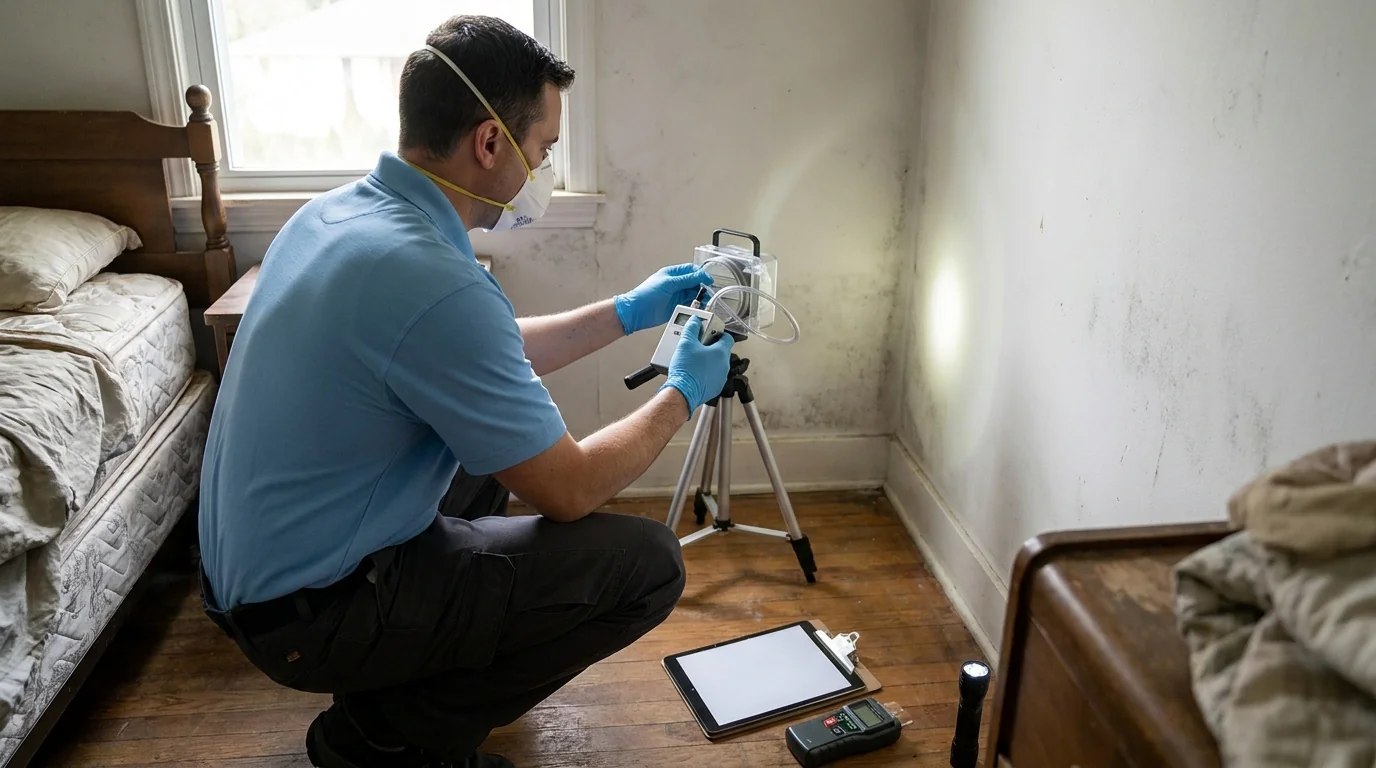
A mold inspection is not a visual walkthrough with a flashlight. Our IICRC Certified Firm (#210213) technicians follow a structured assessment protocol that accounts for the specific construction patterns common in Hillside.
The inspection begins with a moisture mapping phase. We use thermal imaging cameras and calibrated moisture meters to read behind drywall, under flooring, and along foundation walls, the areas where Hillside’s older homes hide chronic dampness. We check the sump pit, the perimeter drain tile condition, and the condition of any visible supply and drain lines.
Air sampling comes next. We collect spore trap samples from the areas of concern and from a control location outside the structure. Those samples go to an accredited third-party laboratory for analysis. The lab report identifies the genera and relative concentrations of mold spores present indoors compared to the outdoor baseline, giving you a defensible, documented picture of indoor air quality rather than a guess.
For properties where surface mold is visible or suspected inside a wall cavity, we also collect tape-lift or swab samples to confirm species identification. This matters when the remediation scope needs to be defined precisely, or when a buyer, seller, or insurer requires documentation.
We deliver a written assessment report that includes moisture readings, sampling locations, lab results, and a plain-language explanation of what the findings mean for your property.
Reaching Hillside from Kenilworth
Our team is based in Kenilworth, roughly three miles from the center of Hillside via Route 22. We operate 24/7, so whether a property manager on the Conant Street corridor calls at 7 a.m. or a homeowner near Hillside Center notices a problem on a Sunday evening, we can schedule an assessment and dispatch a technician without waiting for the next business day. Call (855) 650-7422 to reach us directly.
Local Note: What Ida Left Behind in Hillside Basements
One pattern we’ve seen repeatedly in Hillside since the 2021 flooding: homeowners who ran dehumidifiers and fans after the backups assumed the basement was dry because the floor felt dry underfoot. But in homes with 2×4 framing on concrete block perimeter walls, a common construction detail in the postwar capes near Evergreen Cemetery, the bottom plate and the first 12 inches of stud framing often stay wet long after the slab surface dries, because the block wicks moisture upward and the framing sits in direct contact with it. Standard consumer moisture meters read the surface; they miss the framing behind the drywall. That hidden moisture is exactly where mold establishes itself first, and it’s exactly why sampling behind the surface, not just testing the air, is part of a complete assessment in this housing stock.
If your home was affected by Ida or by any subsequent basement flooding and you haven’t had a professional inspection since, the time to schedule one is before you finish or renovate that space, not after.
Call (855) 650-7422 or reach out online to schedule a mold inspection and testing assessment for your Hillside property. We document everything, explain the results in plain language, and give you a clear picture of what remediation, if any, your home actually needs.
Serving Hillside from our Fair Lawn headquarters — ★ 4.8 · 167 Google reviews
“Well, the restoration group I would say they are always prompt in terms of arriving on time. they came and They did what they had to do. very friendly and they were able to explain to me the process what they were doing and what it was for. I did appreciate that. most importantly I needed to get a…” - Viergina, September 2026Read our reviews on Google →
Mold Inspection and Testing in Hillside: Service Coverage
Frequently Asked Questions
How fast can you arrive for mold inspection and testing in Hillside?
Are basements in Hillside's Saybrook and Winans neighborhoods more prone to mold after heavy rain?
My Hillside home had sewer backup during Tropical Storm Ida but I dried it out myself — do I still need a mold inspection?
Does the age of housing in the 07205 ZIP code affect what type of mold testing is needed?
Can mold testing results be used with my homeowner's insurance claim after a Hillside basement flood?
How long does a mold inspection and testing visit take for a typical Hillside home?
Mold Inspection and Testing response in Hillside
Most Hillside calls see a technician on-site within 60 minutes from our Fair Lawn headquarters.