Water Cleanup in Hillside
24/7 water cleanup in Hillside, NJ. IICRC-certified, insurance billing accepted. Call (855) 650-7422.
Our IICRC-certified technicians are dispatched from our Fair Lawn, NJ headquarters and are typically on-site in Hillside within 60 minutes of your call.
When the Elizabeth River backs up during a hard summer storm, or a galvanized supply line finally gives out in a Saybrook two-family at 2 a.m., the water doesn’t wait for business hours, and neither do we. Hillside’s dense housing stock and low-lying eastern neighborhoods create a specific set of water damage patterns that demand more than a shop-vac and a few fans. The Restoration Group responds 24/7 from Kenilworth, reaching 07205 addresses quickly to stop active losses and begin structured drying before secondary damage sets in.
Why Hillside Properties See Water Damage Differently
Most of Hillside was built between the 1920s and 1950s, and that construction era shows up in every water loss call. Original galvanized steel supply lines corrode from the inside out, they can look intact on the outside while the interior bore has narrowed to a trickle and the walls are pitting through. Cast-iron drain stacks crack at the hub joints. Finished and semi-finished basements, common throughout the Winans and Conant neighborhoods, sit directly in the path of any sewer backup or sump-pump failure.
The Elizabeth River’s eastern corridor through town is the other constant. During Tropical Storm Ida in 2021, river overflow and municipal sewer surcharge pushed water into basements across the low ground east of Hillside Center. That wasn’t an isolated event, it’s a recurring pattern whenever the region absorbs two or more inches of rain in a short window. Properties near Evergreen Cemetery and the lower blocks off North Broad Street sit in terrain that drains slowly, meaning standing water lingers longer than it would in higher-elevation Union County communities.
The Route 22 corridor and the Conant Street industrial area add a commercial dimension: sprinkler-system discharges, roof membrane failures, and overnight pipe breaks in warehouse and retail spaces produce large-volume losses that require industrial-capacity extraction before any structural assessment is possible.
Our Water Cleanup Process in Hillside
Every job starts with moisture mapping, thermal imaging and calibrated moisture meters applied to walls, subfloors, and ceiling assemblies before a single fan is placed. In Hillside’s older homes, this step matters more than in newer construction. Plaster-and-lath walls, common in pre-1950 colonials throughout the Saybrook and Hillside Center sections, absorb water into the lath cavity and can read nearly dry at the surface while the wood framing behind stays saturated. Skipping the mapping step and relying on surface readings alone leads to mold growth inside wall cavities weeks after the visible water is gone.
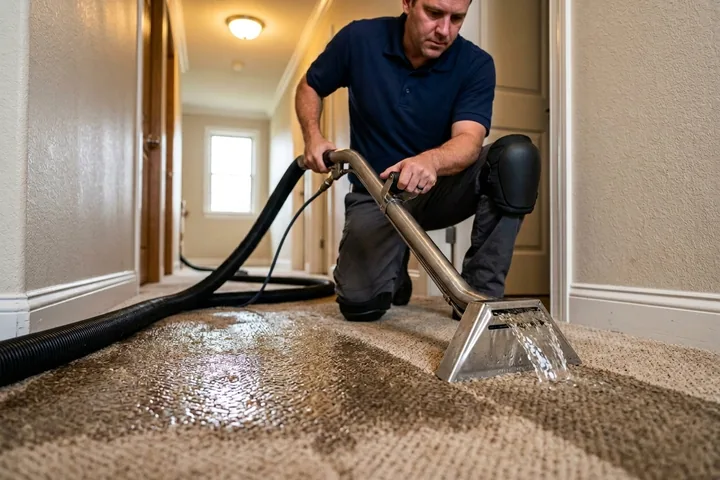
Once the scope is confirmed, we extract standing water with truck-mounted and portable units, then establish a drying system calibrated to the specific materials and square footage involved, not a generic number of air movers dropped and left. Drying logs are recorded daily and shared with your insurance adjuster. Affected materials that cannot be dried in place (saturated insulation, compromised subfloor panels, buckled base cabinets) are documented photographically before removal so the scope is defensible at the claims stage.
For commercial losses along the Route 22 corridor or in the Conant Street industrial zone, we coordinate after-hours access and work around tenant operations where possible, since a closed retail bay or warehouse aisle carries its own business-interruption cost.
Reaching Hillside from Kenilworth
Our Kenilworth base puts us a short drive from Hillside via Route 22 or Springfield Avenue, two of the most direct connections between the townships. We dispatch around the clock, so a sump failure during a 3 a.m. downpour or a burst pipe discovered on a Sunday morning gets the same response as a weekday call. When we arrive, we come with extraction equipment loaded, not just an estimator with a clipboard.
Local Note: What Hillside’s Basement Finishes Change About Drying
In Hillside’s semi-finished basements, the kind with drop-ceiling tiles, paneled walls over concrete block, and carpet over a slab, water cleanup is more complicated than it looks on the surface. Carpet and pad over concrete trap moisture against a non-permeable surface, and the concrete itself wicks water laterally for several feet beyond the visible wet zone. Drop-ceiling tiles hide the condition of the joists and any insulation above. We pull ceiling tiles and probe the joist bays before finalizing the drying plan, because what’s happening above the ceiling line in a flooded Hillside basement is almost always worse than what’s visible from the floor. Skipping that step is how a “dried” basement ends up with a mold problem sixty days later.
If your home or property in Hillside has taken on water, whether from a pipe failure, a sump that couldn’t keep up, or storm-driven sewer backup, call (855) 650-7422 now. We’ll assess the full scope, start extraction immediately, and document everything your insurance carrier needs to move the claim forward.
Serving Hillside from our Fair Lawn headquarters — ★ 4.8 · 160 Google reviews
“Prompt and professional work. Kept in contact thru out the process which was very important to me.” — F., July 2026Read our reviews on Google →
Water Cleanup in Hillside: Service Coverage
Frequently Asked Questions
How fast can you arrive for water cleanup in Hillside?
How quickly can The Restoration Group reach a Hillside address when I call at night?
Are basements in the Winans and Conant neighborhoods more vulnerable to sewer backup than other parts of Hillside?
My Hillside colonial has plaster walls. Does that change how long water cleanup takes?
What documentation do you provide for an insurance claim on a Hillside water loss?
Can you handle a commercial water loss at a Route 22 or Conant Street property, not just residential?
Water Cleanup response in Hillside
Most Hillside calls see a technician on-site within 60 minutes from our Fair Lawn headquarters.