Mold Remediation in Hoboken
24/7 mold remediation in Hoboken, NJ. IICRC-certified, insurance billing accepted. Call (855) 650-7422.
Our IICRC-certified technicians are dispatched from our Fair Lawn, NJ headquarters and are typically on-site in Hoboken within 60 minutes of your call.
Hoboken’s position on a former tidal marsh means that when rain overwhelms the combined sewer system, as it did catastrophically during Superstorm Sandy in 2012 and again during Ida in 2021, water doesn’t just drain away. It backs up into basements, garden units, and the below-grade mechanical rooms of the dense brownstones and brick rowhomes that line nearly every block of the 07030 ZIP code. Within 24 to 48 hours of that kind of saturation, mold can begin colonizing drywall, wood framing, and insulation. By the time the smell becomes obvious, the colony is already established.
Why Hoboken Properties See Mold Issues
The building stock tells most of the story. A significant share of Hoboken’s residential units sit inside 19th-century masonry construction, thick brick walls, rubble-stone foundations, and below-grade garden apartments that were never designed for the water table conditions a changing climate keeps delivering. These older structures absorb and hold moisture in ways that newer construction doesn’t. A slow pipe drip inside a shared party-wall stack can stay hidden for weeks, feeding mold growth in a cavity that spans two neighboring units before either owner notices discoloration or odor.
The waterfront corridor adds a different set of conditions. High-rise buildings near Pier A Park and along the Hudson edge deal with roof-level condensation issues, mechanical-room humidity, and the occasional sprinkler malfunction, all of which can introduce sustained moisture into wall assemblies and ceiling cavities. Meanwhile, the Washington Street business district and the Stevens Institute of Technology campus generate a steady stream of commercial and student-housing water events: roof leaks, overflowing HVAC drain pans, and the kind of slow-drip damage that gets noticed only when a tenant complains about a musty smell.
Our Mold Remediation Process in Hoboken
Every job starts with a thorough visual inspection and moisture mapping. In Hoboken’s older brownstones, that means probing party walls, checking the underside of garden-unit ceilings, and testing masonry for elevated moisture readings, not just scanning the obvious wet surface. Mold hides behind baseboard trim, inside closets that share an exterior wall, and under flooring that was relaid after a previous flood without adequate drying time.
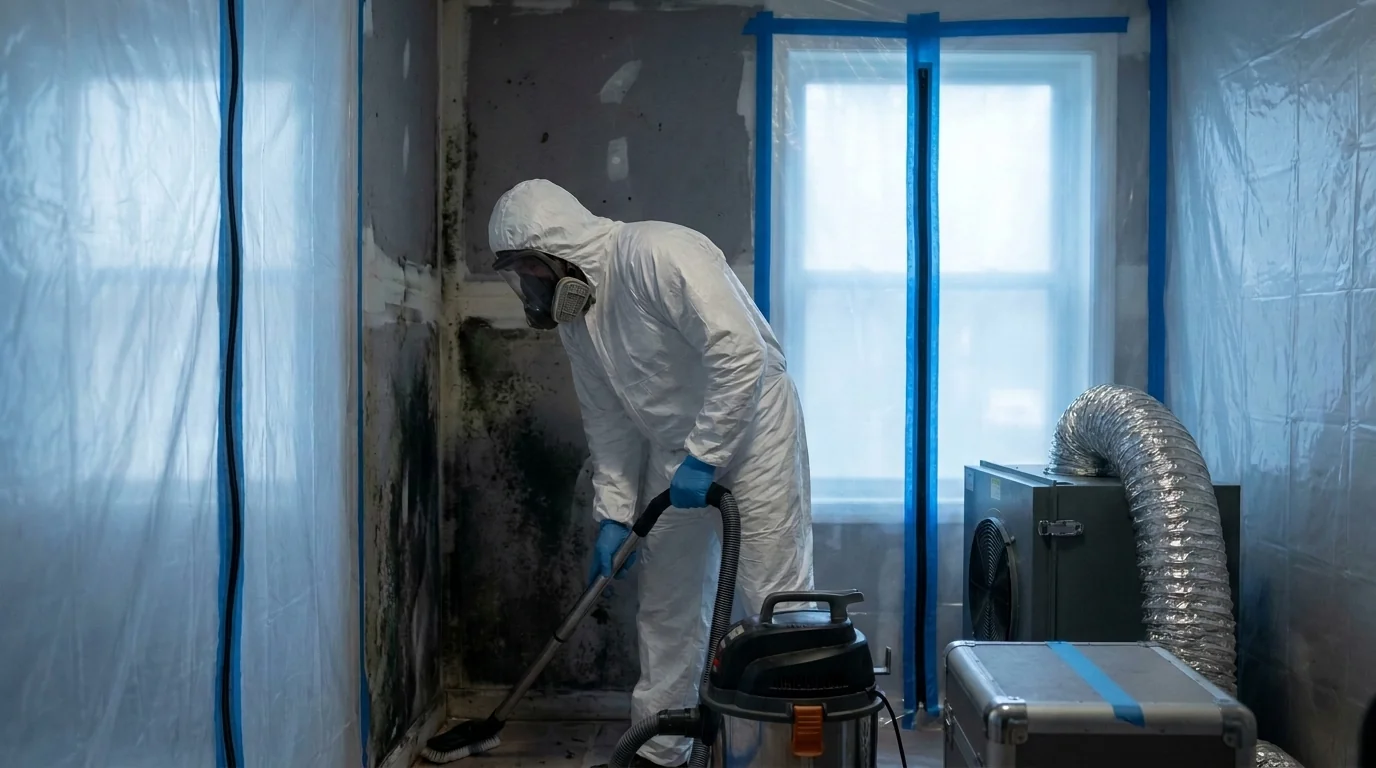
Once the scope is confirmed, the affected area is isolated with negative-air containment barriers. This step matters especially in multi-unit buildings: spores released during removal can migrate through shared HVAC returns, elevator shafts, or gaps in the original plaster construction. Negative air pressure keeps the work zone sealed while HEPA-filtered air scrubbers run continuously.
Contaminated materials, drywall, insulation, wood framing that has lost structural integrity, are removed, bagged, and disposed of per New Jersey DEP guidelines. Remaining structural surfaces are treated with an EPA-registered antimicrobial agent. Drying equipment stays on-site until moisture readings return to baseline, which in a masonry building can take longer than in wood-frame construction because brick and mortar release absorbed water slowly. The job isn’t closed until clearance readings confirm the space is dry and the visible colony is gone.
Reaching Hoboken from Kenilworth
The Restoration Group’s base in Kenilworth puts the team on the New Jersey Turnpike or Routes 1 and 9 toward the Holland Tunnel approach, with access to Hoboken from the south via the Tonnele Avenue corridor. Because the team is available around the clock, a call placed at any hour, whether it’s a Downtown Hoboken basement discovered flooded at midnight or a Castle Point building manager dealing with a broken supply line on a Sunday morning, gets a live response and dispatch, not a voicemail. Uptown and Southwest Hoboken addresses are reachable via the same approach routes without navigating the densest midtown blocks.
Local Note
One pattern that comes up repeatedly in Hoboken’s older rowhouse blocks: a previous owner patched water-damaged drywall and repainted without remediating the underlying mold. The surface looks clean, but the colony is alive behind the new paint layer, and the first humid summer, or the next basement flood, reactivates it. If you’re buying or renovating a pre-1980 brownstone anywhere from Midtown down toward the Hoboken Terminal end of town, it’s worth having a moisture inspection done before work begins, not after the smell returns. Encapsulation over active growth is not remediation.
If you’re dealing with visible mold, a persistent musty odor, or water damage that wasn’t fully dried after the last flood event, call The Restoration Group at (855) 650-7422. The team is IICRC Certified (Firm #210213) and licensed through the NJ Division of Consumer Affairs as a Home Improvement Contractor, and they’re available any time, day or night, to assess and contain the problem before it spreads further.
Serving Hoboken from our Fair Lawn headquarters — ★ 4.8 · 166 Google reviews
“Hired the Restoration Group after mold and flood in our house. Their 24 hour line was always available. They came right away and were prompt completing the work. Everyone was friendly.” - Amanda, October 2026Read our reviews on Google →
Mold Remediation in Hoboken: Service Coverage
Frequently Asked Questions
How fast can you arrive for mold remediation in Hoboken?
Are garden-level units in Hoboken's brownstones at higher risk for mold after a heavy rain event?
Can mold spread between units in a Hoboken multi-family building during remediation?
How does Hoboken's masonry construction affect how long mold remediation takes?
Does Hoboken have any local requirements that affect mold remediation work in residential buildings?
Will my homeowner's or renter's insurance cover mold remediation in a Hoboken basement that flooded during a storm?
Mold Remediation response in Hoboken
Most Hoboken calls see a technician on-site within 60 minutes from our Fair Lawn headquarters.