24/7 Emergency Water Damage Restoration in Hoboken
24/7 emergency water damage restoration in Hoboken, NJ. IICRC-certified, insurance billing accepted. Call (855) 650-7422.
Our IICRC-certified technicians are dispatched from our Fair Lawn, NJ headquarters and are typically on-site in Hoboken within 60 minutes of your call.
Hoboken sits on a low-lying strip of former tidal marsh between the Hudson River and the Palisades, and that geography never lets the city forget it. Whether it’s a nor’easter overwhelming the combined sewer system and pushing water up through basement floor drains in Southwest Hoboken, a burst pipe in a century-old brownstone party-wall stack, or a roof leak soaking the top floor of a waterfront high-rise, water moves fast through dense urban buildings, and the damage compounds by the hour. The Restoration Group responds 24/7 across Hoboken’s 07030 ZIP code, bringing IICRC-certified water damage restoration to properties that range from below-grade garden units to multi-story mixed-use buildings.
Why Hoboken Properties See Water Damage Differently
Most of Hoboken was built in the late 1800s and early 1900s, and that housing stock carries specific vulnerabilities. Brownstones and brick rowhomes share party walls with adjacent units, which means a pipe burst in one apartment can saturate the framing of two or three neighboring homes before anyone notices. Below-grade units, common throughout Downtown Hoboken and along the blocks radiating out from Washington Street, sit at or below the water table, making them the first to flood when the sewer system backs up during heavy rain.
Superstorm Sandy in 2012 submerged large sections of the city, and Ida in 2021 proved that even a fast-moving storm can overwhelm Hoboken’s combined sewer infrastructure and push water into basements citywide. These aren’t once-in-a-generation events anymore. Cast-iron and galvanized plumbing in pre-war buildings corrodes from the inside out; a stack that has served a six-unit brownstone for 80 years can fail without warning, sending water through multiple floors simultaneously. On the commercial side, sprinkler activations and roof-drain failures at buildings near Stevens Institute of Technology and along the Washington Street business district create large-scale water events in occupied spaces that need rapid, coordinated response.
Our Water Damage Restoration Process in Hoboken
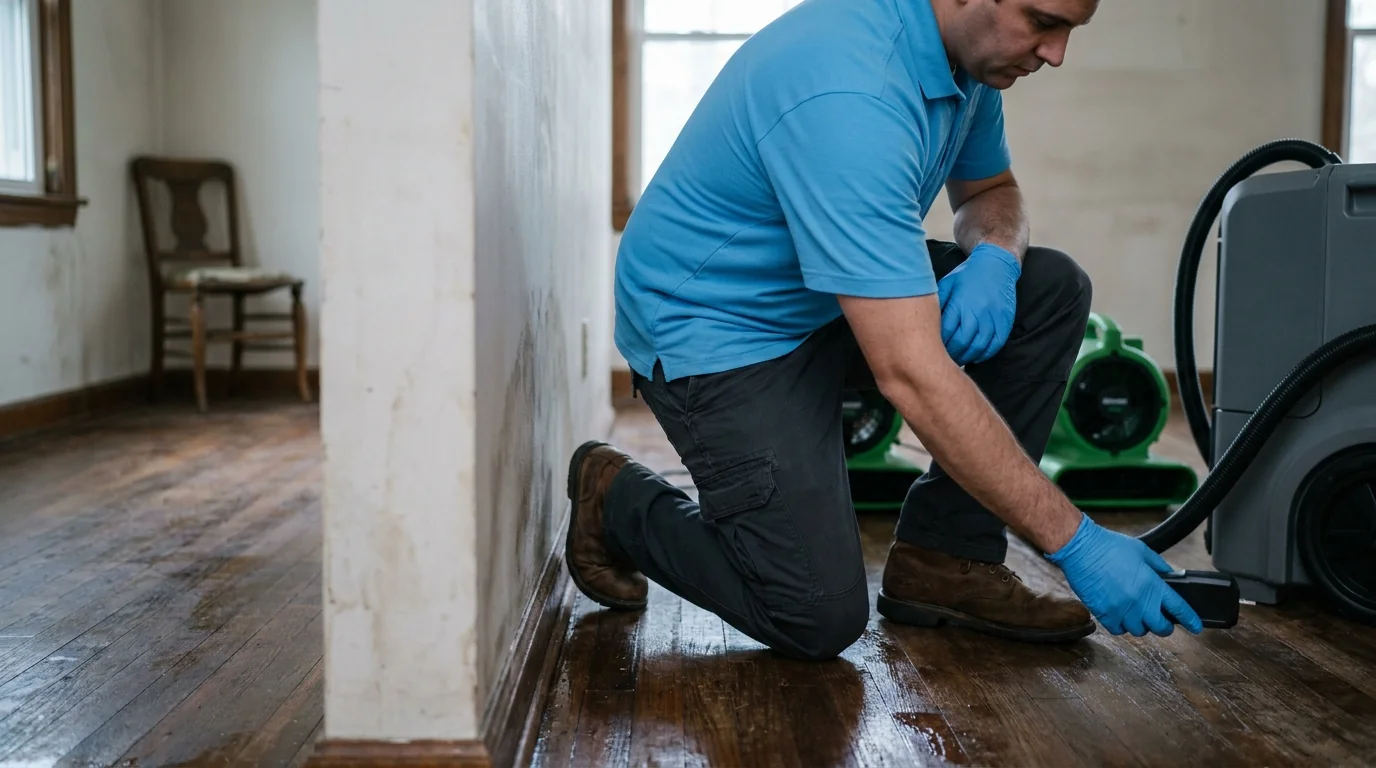
When we arrive, the first priority is stopping active water intrusion and protecting unaffected areas. In Hoboken’s dense rowhouse blocks, that often means working in tight stairwells, through shared utility chases, and around original hardwood floors and plaster walls that require careful handling.
Inspection and moisture mapping, We use thermal imaging cameras and calibrated moisture meters to trace water migration through walls, subfloors, and ceiling assemblies. In older buildings, water travels further than it appears on the surface.
Water extraction, Truck-mounted and portable extractors pull standing water from flooring, carpet, and subfloor cavities. In below-grade units with limited access, portable high-capacity units go where trucks cannot.
Structural drying, Industrial desiccant dehumidifiers and axial air movers are positioned according to a drying plan calibrated to the specific materials in the space. Drying timelines are documented daily and adjusted based on psychrometric readings, not guesswork.
Monitoring and clearance, We return each day to log moisture readings until affected materials reach dry standard per the IICRC S500. Documentation is provided to you and, when applicable, directly to your insurance carrier.
Reaching Hoboken from Kenilworth
The Restoration Group is based in Kenilworth, NJ, and runs 24/7 emergency response. From Kenilworth, crews reach Hoboken via the NJ Turnpike and Route 3 or the Pulaski Skyway corridor, with access into the city from the south and west. Hoboken’s one-square-mile footprint means that once we’re in the city, we can reach Uptown near Castle Point or the waterfront blocks near Pier A Park without significant added travel time. We call ahead on arrival to coordinate parking and building access, a practical necessity in a city where street parking near a loss site is rarely guaranteed.
Local Note
In Hoboken’s pre-war brownstones, original plaster walls behave very differently from modern drywall during a water loss. Plaster is dense and slow to absorb moisture, but once saturated it holds water for an extended period and releases it slowly, meaning drying timelines run longer than they would in a comparable newer building, and moisture readings can plateau before the wall assembly is actually dry. We account for this in our drying plans rather than pulling equipment prematurely, which is one of the most common causes of secondary mold growth in older Hoboken units. If your building has original plaster, tell us when you call, it shapes the equipment setup from day one.
Water damage in a Hoboken brownstone or waterfront building doesn’t follow a generic script. If you’re dealing with standing water, saturated walls, or a sewage backup right now, call The Restoration Group at (855) 650-7422, we’re available around the clock and ready to dispatch to any address in Hoboken.
Serving Hoboken from our Fair Lawn headquarters — ★ 4.8 · 166 Google reviews
“Hired the Restoration Group after mold and flood in our house. Their 24 hour line was always available. They came right away and were prompt completing the work. Everyone was friendly.” - Amanda, October 2026Read our reviews on Google →
Water Damage Restoration in Hoboken: Service Coverage
Frequently Asked Questions
How fast can you arrive for water damage restoration in Hoboken?
How quickly can The Restoration Group reach a flooding emergency in Downtown Hoboken or Southwest Hoboken?
Hoboken's sewer system backed water into my basement during a storm — is that covered differently than a pipe burst?
My Hoboken brownstone has original plaster walls. Does that change how water damage restoration works?
A pipe burst in the unit above mine and water came through my ceiling — who is responsible, and how does the restoration process work in a Hoboken multi-unit building?
How long does structural drying typically take after a water loss in a Hoboken garden-level or below-grade unit?
Will my homeowners insurance cover water damage restoration in Hoboken?
Water Damage Restoration response in Hoboken
Most Hoboken calls see a technician on-site within 60 minutes from our Fair Lawn headquarters.