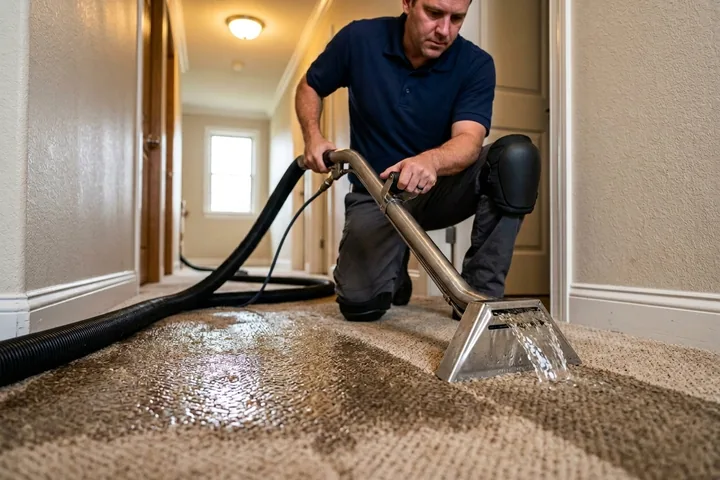
Water Cleanup in Linden
24/7 water cleanup in Linden, NJ. IICRC-certified, insurance billing accepted. Call (855) 650-7422.
Our IICRC-certified technicians are dispatched from our Fair Lawn, NJ headquarters and are typically on-site in Linden within 60 minutes of your call.
When the Rahway River or Morses Creek rises after a heavy storm, Linden’s low-lying streets don’t drain the way newer developments do, and in neighborhoods like Tremley Point, that means water finds its way into finished basements before most homeowners realize what’s happening. The Restoration Group responds to water cleanup calls across Linden 24/7, arriving with extraction equipment, moisture meters, and drying systems calibrated for the specific way postwar construction holds water.
Why Linden Properties See Water Damage Differently
Linden’s housing stock tells the story in the walls and floors. The capes, colonials, and split-levels built through the 1940s, 50s, and 60s, concentrated in areas like Sunnyside, Bower, and the West End, were constructed with finished basements as a matter of course. That was practical then. Today it means a failed supply line or a backed-up cast-iron drain can saturate carpet, subfloor, framing, and drywall before the water even reaches the floor drain.
Cast-iron drain stacks in homes of this era corrode from the inside out. The pipe looks intact until it isn’t. When one fails, water doesn’t trickle, it dumps. Original copper supply lines in the same vintage homes develop pinhole leaks at fittings, especially where water pressure fluctuates along older municipal mains. These aren’t hypotheticals; they’re the pattern that drives a significant share of residential water cleanup calls in the 07036 ZIP code.
Along the Route 1 & 9 industrial corridor and the Wood Avenue business district, the loss profile shifts. Sprinkler-system discharges, overnight pipe breaks in commercial buildings, and equipment failures in warehouse and light-industrial spaces produce large-volume losses that require high-capacity extraction and rapid structural drying to meet insurance carrier timelines.
Our Water Cleanup Process in Linden
Every job starts with a full moisture assessment, not a visual scan. We use thermal imaging and calibrated moisture meters to map where water has traveled behind walls and under flooring, because surface readings in older plaster-and-lath construction routinely understate actual saturation. Water that reads dry at the surface can leave lath and framing wet for days if drying equipment isn’t positioned to address the actual moisture boundary.
From there, the process moves in sequence:
- Extraction, truck-mounted and portable units pull standing water and water trapped in carpet padding and subfloor assemblies.
- Structural drying, commercial-grade desiccant and refrigerant dehumidifiers, paired with high-velocity air movers, are placed based on the moisture map, not a standard room count.
- Monitoring, we return on a documented schedule to log readings and adjust equipment placement until materials reach target dryness per the IICRC S500 standard.
- Documentation, moisture logs, photos, and equipment records are compiled throughout, which matters when an insurance adjuster needs to verify scope.
For homes with finished basements, the majority of affected properties in Linden, we pay particular attention to the wall cavity between the foundation and the finished surface. That gap traps water and doesn’t dry from either side without directed airflow.
Reaching Linden from Our Kenilworth HQ
The Restoration Group is headquartered in Kenilworth, which puts Linden within a short drive under most conditions. From Kenilworth, the typical route runs south on Route 28 to the Garden State Parkway or cuts across to Routes 1 & 9, both options keep transit time short even during off-peak hours. Because we operate 24/7, a call at 2 a.m. after a pipe failure or a storm surge doesn’t wait for a morning crew rotation.
For calls near Tremley Point or the areas south toward the Arthur Kill, we account for the industrial street grid and, during storm events, potential road flooding on low-elevation routes. Knowing the neighborhood layout before we arrive means we’re not losing time at dispatch.
Local Note
Linden’s postwar split-levels present a specific drying challenge that doesn’t show up in newer construction: the intermediate floor level, the “lower level” that sits partially below grade, often has a concrete slab with a wood subfloor system built on top of it. When water gets under that assembly, the slab stays cold, condensation continues even after the visible water is gone, and standard drying timelines don’t apply. We position dehumidifiers to address the vapor drive from the slab surface, not just the ambient room humidity. Skipping that step is why some water cleanup jobs in this housing type end with a mold call three weeks later.
If you’re dealing with standing water, wet materials, or a loss that happened overnight, call (855) 650-7422. We serve all of Linden, from Sunnyside to Tremley Point to the Wood Avenue corridor, and we’ll walk you through exactly what the cleanup involves before any work begins.
Serving Linden from our Fair Lawn headquarters — ★ 4.8 · 160 Google reviews
“Teams were very prompt and respectful.. company responded quickly and kept in touch” — Peggy, August 2026Read our reviews on Google →
Water Cleanup in Linden: Service Coverage
Frequently Asked Questions
How fast can you arrive for water cleanup in Linden?
How quickly can The Restoration Group reach Tremley Point or other low-lying Linden neighborhoods after a flooding event?
Are finished basements in Linden's older homes harder to dry out than a standard basement?
Does Linden's aging cast-iron plumbing affect the scope of a water cleanup job?
How does insurance documentation work for a water loss in Linden's Wood Avenue commercial district?
What's the risk of mold if water cleanup in a Linden home is delayed by even a day or two?
Water Cleanup response in Linden
Most Linden calls see a technician on-site within 60 minutes from our Fair Lawn headquarters.