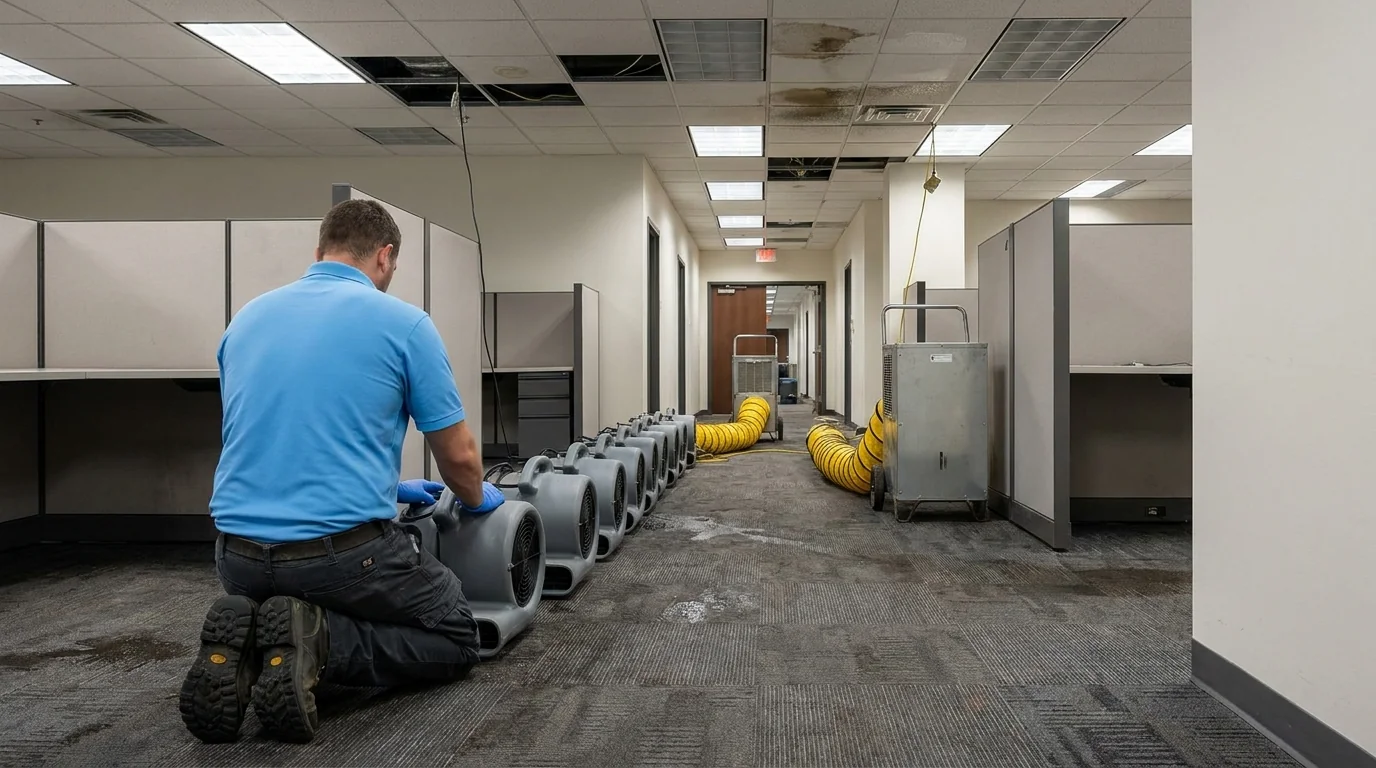
Commercial Restoration in New Brunswick
24/7 commercial restoration in New Brunswick, NJ. IICRC-certified, insurance billing accepted. Call (855) 650-7422.
Our IICRC-certified technicians are dispatched from our Fair Lawn, NJ headquarters and are typically on-site in New Brunswick within 60 minutes of your call.
Downtown New Brunswick runs on tight margins and tighter timelines, a sprinkler discharge at a George Street restaurant at 2 a.m. or a burst cast-iron supply line flooding a Rutgers-adjacent office building can idle a business for days if the response is slow or the drying protocol is wrong. The Restoration Group handles commercial losses across New Brunswick’s 08901 and 08903 ZIP codes, from riverfront retail to institutional facilities, with the kind of structured process that satisfies both insurance adjusters and property managers who can’t afford a prolonged closure.
Why New Brunswick Commercial Properties Face Elevated Restoration Risk
New Brunswick’s building stock is unusually layered. The blocks closest to Rutgers University, including Rutgers Village and the corridors feeding into campus, are dense with early-1900s multifamily and mixed-use structures whose galvanized and cast-iron supply lines have long exceeded their service life. When one of those lines fails inside a commercial tenant space, water doesn’t travel predictably: it follows old framing cavities, drops through plaster-and-lath assemblies, and pools in basement mechanical rooms before anyone notices.
The downtown high-rise corridor adds a different exposure. Sprinkler systems in newer commercial towers are reliable until they’re not, a single head activated by a kitchen exhaust event or a mechanical room heat spike can release hundreds of gallons before the panel trips. Restaurants and offices along the George Street business district have seen exactly this pattern, and the losses compound quickly when the affected floor is above occupied retail.
Then there’s the Raritan River. Boyd Park sits at the southern edge of the city, and the low-lying riverfront blocks between downtown and the water have flooded repeatedly over the decades. Tropical Storm Ida in 2021 pushed water into ground-floor commercial spaces in that corridor, a reminder that New Brunswick’s flood exposure isn’t theoretical. Businesses in those zones need a restoration contractor who already understands the city’s drainage patterns, not one reading a map for the first time.
Our Commercial Restoration Process in New Brunswick
Every commercial loss is different, but the sequence that limits business interruption is consistent. When we arrive on-site, the first priority is stopping active damage, isolating the water source, boarding compromised openings after a fire, or containing a sewage intrusion before it migrates into adjacent tenant spaces. In older New Brunswick mixed-use buildings, that containment step is more involved than it sounds: shared wall assemblies and open floor systems mean a loss on one floor can affect two or three others.
Once the source is controlled, we document thoroughly, room-by-room moisture mapping, thermal imaging of wall cavities, and photo documentation calibrated to what commercial insurance carriers need for a clean claim. Drying equipment is staged to match the building’s layout and occupancy requirements; a restaurant that needs to reopen its kitchen in 48 hours gets a different equipment plan than a vacant office floor being rebuilt over two weeks.
For fire and smoke losses, the odor work in commercial spaces is more demanding than residential. Smoke penetrates HVAC ductwork, settles into upholstered seating, and embeds in porous ceiling tiles in ways that require systematic source removal rather than masking. We work through the scope methodically so the space is genuinely clean when employees return, not just visually presentable.
Reaching New Brunswick from Kenilworth
The Restoration Group is based in Kenilworth, roughly 12 miles from central New Brunswick via the Garden State Parkway to Route 1 or through surface routes on Route 27. Because we operate 24/7, a call at midnight from a property manager dealing with a burst pipe in a Downtown office building or a sprinkler event near the State Theatre New Jersey corridor gets the same dispatch response as a mid-afternoon call. We can typically have a crew staged and beginning extraction well before a situation that started as a manageable leak becomes a structural drying project.
For properties in the Fifth Ward or along the Highland Park border, areas where street access can tighten during peak Rutgers traffic, we coordinate arrival logistics on the initial call so equipment staging doesn’t slow the response.
New Brunswick Insurance Coordination for Commercial Losses
Commercial property claims in New Brunswick move through the same major carriers as anywhere in New Jersey, but the documentation requirements for mixed-use and multi-tenant buildings add complexity. A loss that touches a landlord’s policy, a tenant’s business interruption coverage, and a separate liability carrier simultaneously requires careful scope separation from the start, otherwise the claim gets contested at the adjustment stage.
As an IICRC Certified Firm (#210213), we produce drying logs, moisture readings, and equipment records that meet the documentation standards commercial adjusters expect. We communicate directly with your adjuster and, where applicable, with your property management company, so you’re not translating between the restoration crew and the insurance side.
Local Note
One pattern we’ve seen repeatedly in New Brunswick’s older commercial corridors: buildings that were originally residential rowhouses and later converted to ground-floor retail retain the original floor framing, which means water from an upper-level loss travels laterally through joist bays much farther than it would in purpose-built commercial construction. A leak that appears contained to one room on the second floor can show up as elevated moisture readings across the entire ground-floor retail space below. If you’re managing a converted property near Rutgers Village or in the older blocks off George Street, it’s worth flagging that construction history when you call, it changes how we scope the initial inspection.
If your New Brunswick business or property is dealing with water, fire, smoke, or storm damage, call The Restoration Group at (855) 650-7422. We’ll assess the loss, walk you through the process, and get work started before the damage compounds.
Serving New Brunswick from our Fair Lawn headquarters — ★ 4.8 · 166 Google reviews
“Prompt, knowledgeable, skillful and honest. Highly recommend. They remediated within 24 hours. Total peace of mind restored. Worth every penny.” - Anne, October 2026Read our reviews on Google →
Commercial Restoration in New Brunswick: Service Coverage
Frequently Asked Questions
How fast can you arrive for commercial restoration in New Brunswick?
How quickly can The Restoration Group reach a commercial property in Downtown New Brunswick or the George Street corridor?
Does New Brunswick's older mixed-use building stock affect how long a commercial drying project takes?
Our restaurant near the State Theatre New Jersey had a sprinkler activation overnight. What does the commercial restoration process look like for a food-service space?
Are commercial properties in New Brunswick's low-lying riverfront blocks near Boyd Park eligible for flood-specific restoration coverage?
Can you handle a commercial loss that affects multiple tenants in a New Brunswick mixed-use building?
Will my homeowners insurance cover commercial restoration in New Brunswick?
Commercial Restoration response in New Brunswick
Most New Brunswick calls see a technician on-site within 60 minutes from our Fair Lawn headquarters.